Today · in your zone
What's happening right now
Off-season for blackberry in zone 11.
Tap to switch. plant calibrates to where you are in the journey.
Blackberries are one of the fastest, most generous fruits you can grow: plant while dormant and you can be picking within a year or two, with a patch that lasts 15 to 20 years. Two things matter most. First, the cane: the roots live for years, but each cane lives only two, so how you prune depends on whether your type fruits on new canes or year-old canes. Second, the habit: some types stand up on their own, some are huge and need a trellis, and the trailing kinds taste the best but are the least cold-hardy. They pollinate themselves and handle heat far better than raspberries, so they thrive across the South. Blackberries are fast, generous, long-lived perennial cane fruits: a planting set out while dormant can hand you berries within a year or two and keep bearing for 15 to 20 years. Two things define them. First, the biennial cane: roots and crown are permanent, but each cane lives two years, so matching your pruning to whether the type fruits on first-year canes (primocane-fruiting) or second-year canes (summer-bearing) is the whole game. Second, the growth habit, which sets everything about support and spacing: erect types stand on their own and sucker; semi-erect thornless types grow huge and must be trellised; trailing types (marionberry, boysenberry) are the most flavorful but the least cold-hardy. They are self-fertile and much more heat-tolerant than raspberries, which makes them the caneberry of the South.
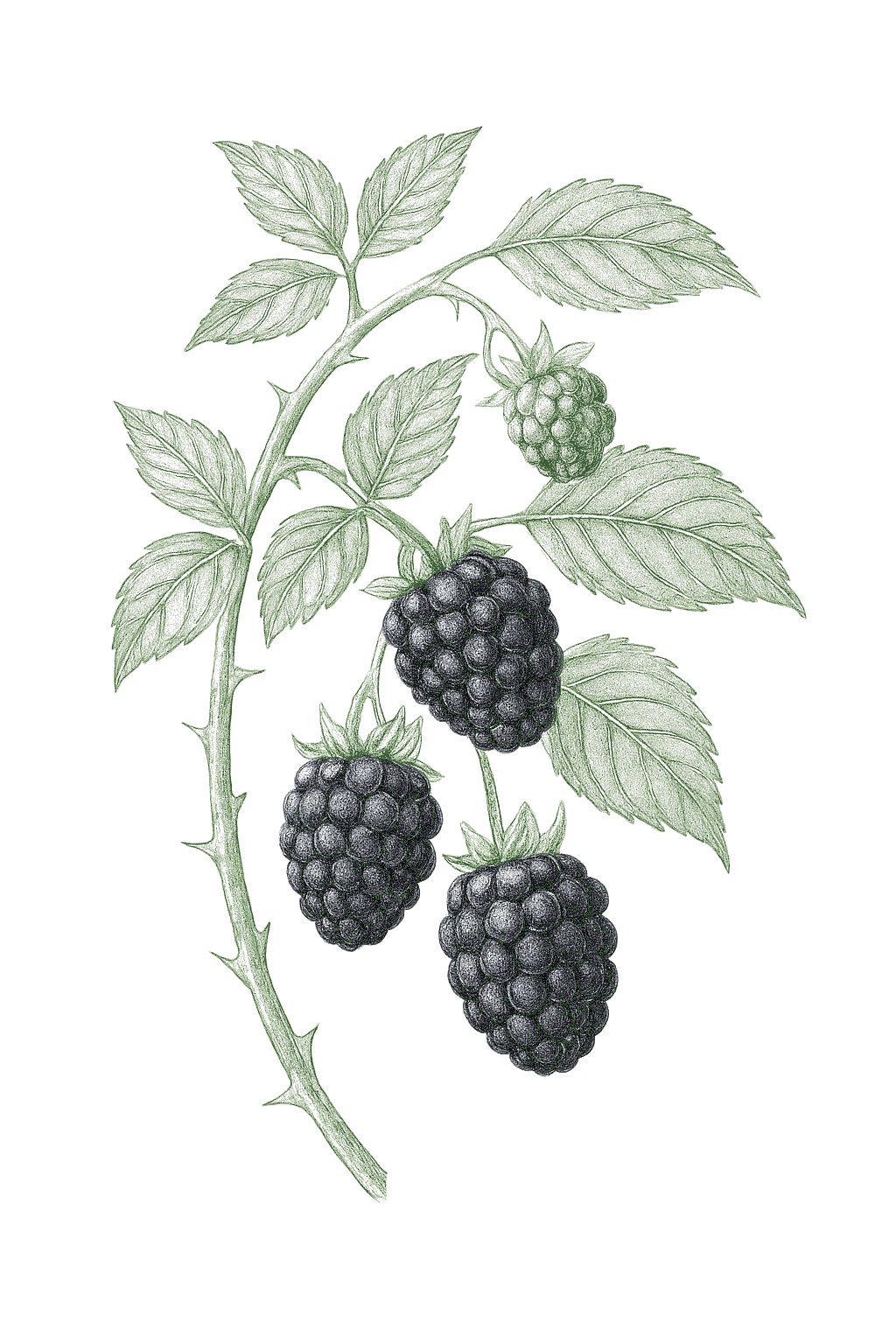
Off-season for blackberry in zone 11.
Blackberries need a cold winter rest, measured in chill hours (time below about 45 °F), before they fruit well, but they need less than most raspberries. Low-chill types like Kiowa, Natchez, and Prime-Ark need only a little winter cold, so they grow well in the South. Higher-chill types like Navaho and Chester need a lot more and suit colder regions. If a type does not get the chill it needs, it barely fruits, so match the variety to your climate.Most blackberries need a stretch of winter chill (hours below about 45 °F) to break dormancy and fruit normally, but they are lower-chill than most raspberries. Low-chill Southern types such as Kiowa, Natchez, Ouachita, and the Prime-Ark line need only about 200 to 400 hours, which is why they succeed across the Deep South; higher-chill types such as Navaho, Apache, and Chester want 800 or more and are better suited to colder regions. Too little chill for the type gives weak, erratic budbreak and little fruit, so matching the type's chill requirement to your winter is the main thing, alongside habit, that decides which blackberry to grow.
These need more chill than your winter dependably delivers. In a mild winter they bloom unevenly and crop lightly.
These need more chill than your winter dependably delivers. In a mild winter they bloom unevenly and crop lightly.
In far south Florida, blackberries barely work because winters are too warm. A low-chill fall-bearing type might give a small early crop, but do not count on much.In far south Florida a blackberry can only be grown marginally, as a low-chill primocane-fruiting cane fruit that never gets a real winter; with minimal dormancy it may push a small early crop before the heat. Even the adapted types are short-lived here.
Once established, your blueberries follow the same yearly rhythm. Choose a cultivar by chill class above, then use this calendar for the season-to-season timing.
Blackberries need a cold winter rest, measured in chill hours (time below about 45 °F), before they fruit well, but they need less than most raspberries. Low-chill types like Kiowa, Natchez, and Prime-Ark need only a little winter cold, so they grow well in the South. Higher-chill types like Navaho and Chester need a lot more and suit colder regions. If a type does not get the chill it needs, it barely fruits, so match the variety to your climate.Most blackberries need a stretch of winter chill (hours below about 45 °F) to break dormancy and fruit normally, but they are lower-chill than most raspberries. Low-chill Southern types such as Kiowa, Natchez, Ouachita, and the Prime-Ark line need only about 200 to 400 hours, which is why they succeed across the Deep South; higher-chill types such as Navaho, Apache, and Chester want 800 or more and are better suited to colder regions. Too little chill for the type gives weak, erratic budbreak and little fruit, so matching the type's chill requirement to your winter is the main thing, alongside habit, that decides which blackberry to grow.
These need more chill than your winter dependably delivers. In a mild winter they bloom unevenly and crop lightly.
These need more chill than your winter dependably delivers. In a mild winter they bloom unevenly and crop lightly.
Your blackberry loses its leaves and rests through winter (this rest is called dormancy). The roots live for years, but each cane lives only two: it grows one year, then fruits and dies. You prune in winter, and how you prune depends on the type. Plant once and a patch keeps producing for many years.Here a blackberry is grown as a deciduous cane fruit: the canes drop their leaves and rest through winter, banking the chill the plant needs, while the perennial crown and roots live for 15 to 20 years and each cane lives only two, growing one year and fruiting the next before dying. You prune in the dormant season, matching the cut to habit and type. Planted once, a patch fruits for two decades.
Once established, your blueberries follow the same yearly rhythm. Choose a cultivar by chill class above, then use this calendar for the season-to-season timing.
Blackberries need a cold winter rest, measured in chill hours (time below about 45 °F), before they fruit well, but they need less than most raspberries. Low-chill types like Kiowa, Natchez, and Prime-Ark need only a little winter cold, so they grow well in the South. Higher-chill types like Navaho and Chester need a lot more and suit colder regions. If a type does not get the chill it needs, it barely fruits, so match the variety to your climate.Most blackberries need a stretch of winter chill (hours below about 45 °F) to break dormancy and fruit normally, but they are lower-chill than most raspberries. Low-chill Southern types such as Kiowa, Natchez, Ouachita, and the Prime-Ark line need only about 200 to 400 hours, which is why they succeed across the Deep South; higher-chill types such as Navaho, Apache, and Chester want 800 or more and are better suited to colder regions. Too little chill for the type gives weak, erratic budbreak and little fruit, so matching the type's chill requirement to your winter is the main thing, alongside habit, that decides which blackberry to grow.
These need more chill than your winter dependably delivers. In a mild winter they bloom unevenly and crop lightly.
Your blackberry loses its leaves and rests through winter (this rest is called dormancy). The roots live for years, but each cane lives only two: it grows one year, then fruits and dies. You prune in winter, and how you prune depends on the type. Plant once and a patch keeps producing for many years.Here a blackberry is grown as a deciduous cane fruit: the canes drop their leaves and rest through winter, banking the chill the plant needs, while the perennial crown and roots live for 15 to 20 years and each cane lives only two, growing one year and fruiting the next before dying. You prune in the dormant season, matching the cut to habit and type. Planted once, a patch fruits for two decades.
Once established, your blueberries follow the same yearly rhythm. Choose a cultivar by chill class above, then use this calendar for the season-to-season timing.
Blackberries need a cold winter rest, measured in chill hours (time below about 45 °F), before they fruit well, but they need less than most raspberries. Low-chill types like Kiowa, Natchez, and Prime-Ark need only a little winter cold, so they grow well in the South. Higher-chill types like Navaho and Chester need a lot more and suit colder regions. If a type does not get the chill it needs, it barely fruits, so match the variety to your climate.Most blackberries need a stretch of winter chill (hours below about 45 °F) to break dormancy and fruit normally, but they are lower-chill than most raspberries. Low-chill Southern types such as Kiowa, Natchez, Ouachita, and the Prime-Ark line need only about 200 to 400 hours, which is why they succeed across the Deep South; higher-chill types such as Navaho, Apache, and Chester want 800 or more and are better suited to colder regions. Too little chill for the type gives weak, erratic budbreak and little fruit, so matching the type's chill requirement to your winter is the main thing, alongside habit, that decides which blackberry to grow.
These need more chill than your winter dependably delivers. In a mild winter they bloom unevenly and crop lightly.
These need more chill than your winter dependably delivers. In a mild winter they bloom unevenly and crop lightly.
In Hawaii, blackberries can only be tried at cool high elevations, and even then a crop is uncertain because there is no real winter. In the warm lowlands they will not fruit. Treat it as an experiment.In Hawaii a cultivated blackberry can only be attempted at cool high elevation, as a low-chill cane fruit that never gets a true winter; with minimal dormancy it may push a small, uncertain crop in spring. In the warm lowlands it simply will not fruit.
Once established, your blueberries follow the same yearly rhythm. Choose a cultivar by chill class above, then use this calendar for the season-to-season timing.












Not sure what soil you have? Grab a small handful of damp soil from your garden bed and squeeze it. If it crumbles apart easily, it's sandy. If it holds together but breaks when you poke it, it's loam (what most vegetables want). If it stays in a hard, slippery ball, it's clay.
Blackberries want loose, well-drained soil rich in organic matter and full sun. A slightly acidic pH around 6.0 to 6.5 is ideal and most gardens already have it. Mixing in compost and planting on a slightly raised row before planting helps a lot, because the roots will not stand wet feet.
Mix 2-3 inches of compost into the top 6 inches of your bed before planting. Compost holds moisture (which sandy soil drains too fast) and adds the nutrients sandy soil tends to lack. Repeat each season. Compost breaks down over time.
Mix 2-3 inches of compost AND a few inches of coarse sand or perlite into the top 6 inches of your bed. The compost feeds the plants; the sand breaks up the clay so air and water can move through. Don't add sand without compost. It can compact like concrete.
If amending your soil sounds like too much work, or if your soil is heavy clay, full of rocks, or contaminated, build over it. A raised bed at least 12 inches deep filled with a 50/50 mix of compost and sandy loam gives you ideal growing soil with no battles. A 5-gallon container with quality potting mix does the same for one plant at a time. Both bypass your native soil entirely.
The numbers that matter, at a glance.
Blackberries like soil that is slightly acidic, about pH 6.0 to 6.5, which is what most gardens already have. Unlike blueberries, they need no special acidic soil. If your soil is very alkaline and the leaves yellow between the veins, work in compost and use a chelated-iron product.Blackberries prefer a slightly acidic soil, roughly pH 6.0 to 6.5, and tolerate about 5.5 to 7.0. This is close to what most vegetable gardens already carry, so no special acidification is needed, unlike a blueberry. In strongly alkaline soils above about 7.5 the plants can develop iron chlorosis (yellowing between the veins), best corrected with added organic matter and a chelated-iron product rather than a drastic pH change.
Feed blackberries in early spring when growth starts, using a balanced fertilizer or some composted manure spread along the row, and again lightly right after you finish picking. That feeding fuels the new canes for next year. Go easy late in the season, since too much makes weak, floppy canes.Blackberries are moderate feeders. Apply a balanced fertilizer or well-rotted manure in early spring as new growth begins, banded along the row rather than against the crowns, and a second, lighter feeding right after harvest to build the primocanes that carry next year's crop. Nitrogen drives cane vigor, but too much late in the season produces soft, disease-prone canes, so feed early and taper off by late summer. A soil test guides the rate.
Use a balanced fertilizer such as 10-10-10, or composted manure.A balanced complete fertilizer with enough nitrogen to drive primocane growth; roughly a 10-10-10, or composted manure along the row.
Blackberries do not need companion plants to do well. The important rules are what to avoid: do not plant them where tomatoes, potatoes, peppers, eggplant, or strawberries grew recently (they share a soil disease called Verticillium wilt), and pull out any wild brambles nearby, which spread disease and pests. If you want neighbors, garlic along the edge and clover between rows are easy, low-risk choices. Blackberry is not a heavy-companion crop; the siting rules that matter most are about what to keep it away from. Do not plant it where tomatoes, potatoes, peppers, eggplant, or strawberries have grown in the last few years, because all share Verticillium wilt, and clear out nearby wild brambles that carry rosette, orange rust, viruses, and spotted-wing drosophila. Good neighbors are modest: traditional allium edges and a mowed legume cover in the row middles for soil and weeds. The bigger gains come from full sun, spacing, drainage, and a clean start, not from companions.
A blackberry is ready when it turns fully black and loses its shine, going dull, and pulls off easily into your hand with the core still inside (unlike a raspberry, which leaves a hollow center). A shiny black berry is not ripe yet and will be sour, and it will not sweeten after picking. Pick every one to three days in the cool morning, be gentle, and refrigerate right away.A ripe blackberry turns from glossy red-black to a dull, deep black and detaches with a light tug, the whole fruit including its white core coming free (unlike a raspberry, which leaves its core behind as a hollow cap). A shiny black berry is not fully ripe and will taste tart, and it will not sweeten off the plant. Pick over the planting every one to three days in the cool morning after dew dries, handling the soft fruit as little as possible, and refrigerate at once.
Each blackberry plant gives roughly 4 to 15 pounds a season once established, with the big semi-erect thornless types producing the most. A few plants quickly add up to plenty of berries.A mature blackberry plant yields roughly 4 to 15 pounds of fruit per season depending on type, with vigorous semi-erect thornless types (Triple Crown, Chester) at the high end and erect types more modest. A well-managed row produces on the order of a few pounds per linear foot. Yields build over the first few years as the planting fills in.
Blackberries produce fast. Summer types fruit the second year; fall-bearing types can give berries the first fall. Both hit full swing around years 2 to 3 and keep producing for 15 to 20 years if you prune and care for them.Blackberries crop quickly compared with tree fruit. A summer-bearing planting gives its first real crop in the second year; a primocane-fruiting type can fruit its first fall. Both reach full production around years 2 to 3 and then stay productive for about 15 to 20 years with steady pruning and renewal. Whether you get fruit the first year depends on the type. Summer-bearing blackberries make no fruit the first year and start the next summer. Fall-bearing (primocane) types can give you a small crop that same fall, so they are the quickest to your first berries.What you get the first year depends on type. A summer-bearing (floricane) planting makes essentially no fruit the first year, since it fruits on second-year canes; expect the first real crop the following summer. A primocane-fruiting (everbearing) planting set out while dormant can ripen a modest crop on its new canes that first fall, which is the fast route to a first harvest.
Pick by habit first. ERECT blackberries stand up on their own, spread by shoots from the roots, and are the easiest and hardiest, with thornless choices like Ouachita and Navaho. SEMI-ERECT thornless types like Triple Crown and Chester grow huge and productive but need a trellis. TRAILING types like Marionberry and Boysenberry taste the best but are the least cold-hardy and must be trellised, so they suit mild coastal areas. Most give one summer crop on year-old canes; primocane (everbearing) types like Prime-Ark fruit on new canes in fall and let you just mow everything down each winter. Match the variety to your winters (low-chill kinds for the South, extra-hardy kinds for cold areas), and buy certified disease-free plants.Choose first by growth habit, then by thorniness, cane type, and chill. ERECT blackberries have stiff, self-supporting canes, sucker from the roots to form a hedgerow, and are the hardiest and easiest without a trellis (Ouachita, Navaho, Osage, Arapaho thornless; Apache, Kiowa thorny). SEMI-ERECT thornless types (Triple Crown, Chester) are the most vigorous and productive, form a crown rather than suckering, and must be trellised. TRAILING types (Marionberry, Boysenberry) have the earliest, most intensely flavored fruit but the least cold hardiness and must be trellised, so they suit mild coastal regions. Most are summer-bearing (floricane), fruiting on second-year canes; primocane-fruiting (everbearing) types such as the Arkansas Prime-Ark line fruit on first-year canes and can be mowed to the ground for one clean fall crop. Match the chill requirement to your winter (low-chill Natchez, Kiowa, Ouachita for the South; high-chill Illini Hardy, Apache, Chester for cold regions), and always start with certified disease-free stock.
You do not rotate blackberries each year like vegetables, because a patch lives for many years. What matters is the starting spot: do not plant where tomatoes, potatoes, peppers, eggplant, or strawberries grew recently, and avoid old bramble patches. When a patch wears out, plant the new one somewhere fresh.Crop rotation in the annual sense does not apply, since a blackberry planting stays in place for 15 to 20 years. But site history matters at planting: avoid ground that recently grew Verticillium hosts (tomato, potato, pepper, eggplant, strawberry) or old or wild brambles, which leave behind soil disease and virus reservoirs. When a planting declines, start the new one on fresh ground rather than replanting the same spot.
The plant app sends a timely reminder at every critical moment of your blackberry season. The wording adjusts to whichever you pick: beginner or seasoned. Here are three you'll see in Zone 11.
plant sends the right notification at exactly the right moment, for your zone, your weather, your crops. Founding members lock the rate forever.
We're building this guide with real growers. Got a question we missed? Ask here. We read every one and add the best answers right to this page.
Learned something the hard way? Pass it on. Real growers' tips make this guide better for the next person, and we credit you by name when yours goes live.
If you've grown this crop and you see a date, a temperature, a companion claim, or a recommendation that doesn't match your experience, tell us. Real growers' corrections make this guide better for the next person.
Every date, temperature, spacing, and recommendation on this page is sourced from university cooperative extension publications, peer-reviewed agricultural research, NOAA climate data, and direct extension calendars. Where claims are softer (traditional gardening wisdom not formally documented), we say so.
Spot a data point that doesn't match your experience? Submit a correction; accepted corrections earn full author credit on the page.
Zone-aware seasonal nudges, what's worth planting now, and the occasional recipe from the harvest. No spam, ever.