The GuidesFeeding & fertilizer

What the three numbers mean.

Every fertilizer is three numbers. Once you know what N, P, and K each build, feeding stops being guesswork: you just match the bag to what your plant is trying to grow.

The big three
N - P - K
N is for
Leaves
P is for
Roots & bloom
K is for
Fruit & vigor
The three numbers

N, P, K: what each one feeds.
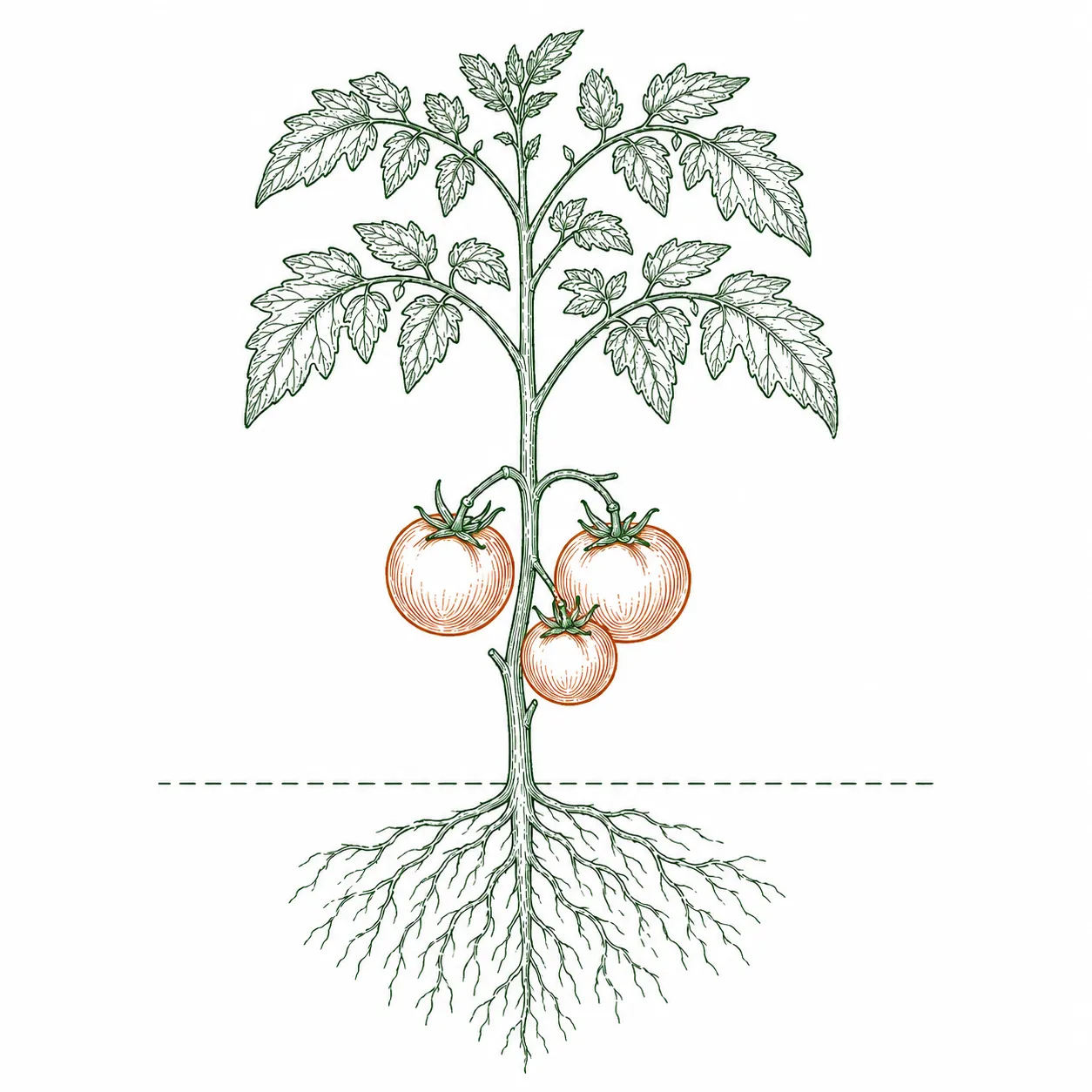
A tomato plant from leaves to roots, showing where each nutrient does its work
Feeds Leaves and green growth

Nitrogen is the leaf and stem builder. It makes plants grow lush, green, and fast, which is exactly what you want from salad greens and anything you grow for its leaves.Nitrogen drives vegetative growth: it is the backbone of chlorophyll and protein, so it powers leaves, stems, and deep green color. Leafy crops want the most of it.

Sign you're short

Short on nitrogen, the oldest leaves at the bottom turn yellow first and growth slows, because the plant moves what little it has to its newest leaves.Deficiency shows first in the oldest, lowest leaves, which yellow and fade as the plant moves nitrogen up to new growth; overall growth stalls.

Feeds Roots, flowers, and fruit set

Phosphorus is the root and flower builder. It helps young plants get established and helps them set flowers and fruit.Phosphorus fuels energy transfer, so it builds strong roots and powers flowering and fruit set. It matters most at establishment and at bloom.

Sign you're short

Short on phosphorus, plants grow slowly and stay small, often with a dull or purple tinge to the leaves, and they flower poorly.Deficiency reads as stunted, sluggish growth with a dull, often purple cast to leaves and stems, and poor flowering.

Feeds Fruit and overall vigor

Potassium is the whole-plant health nutrient. It helps plants handle stress, shrug off disease, and ripen good fruit.Potassium runs the plant's plumbing and regulation: water movement, disease and drought tolerance, and fruit quality. It is the all-around vigor nutrient.

Sign you're short

Short on potassium, the edges of the leaves turn brown and scorched, stems go weak, and the fruit is poor.Deficiency appears as scorched, browning leaf margins, usually on older leaves, with weak stems and poor, low-quality fruit.

Those three numbers on the bag are always nitrogen, then phosphorus, then potassium, written as a percentage. A balanced one like 10-10-10 works for most crops. A bigger first number feeds leaves; a bigger last number feeds fruit. Pick the ratio that matches what you want from the plant.The three numbers on any fertilizer are the percentage by weight of nitrogen, phosphorus, and potassium, always in that order. A balanced feed like 10-10-10 covers most crops; a higher first number pushes leafy growth, a higher last number favors fruit. Match the ratio to what you are growing for.

When and how

Feed steadily, and go easy.

Feed when you plant and then through the season as each crop needs it, and always water the fertilizer in so it gets down to the roots. More is not better. Too much nitrogen especially gives you big leafy plants with little fruit. A soil test from your local extension office is the only way to know what your soil is really missing.Feed at planting and then through the season at the crop's pace, and always water it in so it reaches the root zone. More is not better: excess nitrogen in particular drives lush foliage at the expense of fruit. The only way to know what your soil actually lacks is a soil test from your extension office.

Organic or synthetic?

Organic fertilizers like compost and manure feed your plants slowly and build healthy soil over time. Synthetic fertilizers act fast and give you exact numbers, but they do not improve the soil itself. Both work, and many gardeners use compost as a base and add a targeted fertilizer when a crop needs a boost.Organic fertilizers like compost, manure, and blood or bone meal release slowly and feed the soil life that in turn feeds the plant, improving structure over time. Synthetic fertilizers deliver precise, fast-available nutrients but do nothing for soil life. Both grow good food, and many gardeners pair a compost base with targeted feeding.

Feeding by crop

What each crop wants.

Alliums
Garlic 21-0-0 Nitrogen-forward Side-dress in spring
Leek 10-10-10 Balanced base, nitrogen-forward Side-dress once or twice during the long season
Onion Nitrogen-forward Side-dress periodically
Shallot Nitrogen-forward Side-dress twice early
Spring Onion / Scallion 10-10-10 Balanced, moderate nitrogen Light feeding during leaf growth
Beans & Peas
Broad Beans / Fava 5-10-10 Balanced pre-plant, little to no nitrogen low
Dry Beans 5-10-10 Balanced pre-plant, light nitrogen sidedress low
Edamame 5-10-10 Balanced pre-plant, soybean inoculant, little to no nitrogen low
Green Beans (Bush) 5-10-10 Balanced pre-plant, light nitrogen sidedress low
Pole Beans 5-10-10 Balanced pre-plant, light nitrogen sidedress low
Snow Peas 5-10-10 Balanced pre-plant, little to no nitrogen low
Sugar Snap Peas 5-10-10 Balanced pre-plant, little to no nitrogen low
Berries & Shrubs
Blackberry 10-10-10 Balanced, nitrogen-forward in spring Once or twice per year
Blueberry Complete, acidifying Twice per year
Elderberry 10-10-10 Balanced, with nitrogen Once per year
Raspberry 10-10-10 Balanced, nitrogen-forward in spring Once or twice per year
Brassicas
Broccoli 21-0-0 Nitrogen-rich fertilizer twice a season
Brussels Sprouts 21-0-0 Nitrogen-rich fertilizer every 3 to 4 weeks
Cabbage 10-10-10 Nitrogen-rich fertilizer once or twice during the season
Cauliflower 10-10-10 Nitrogen-rich fertilizer once or twice during the season
Kohlrabi 10-10-10 Balanced, then nitrogen twice a season
Citrus
Grapefruit 2-1-1 Citrus (nitrogen-forward, with iron, zinc, and manganese) split applications through the growing season
Lemon Citrus (nitrogen-forward) light doses several times through the growing season
Lime Citrus (nitrogen-forward) light, frequent doses through the growing season
Mandarin (Clementine) 2-1-1 Citrus (nitrogen-forward, with iron, zinc, and manganese) split applications through the growing season
Orange (Navel) 2-1-1 Citrus (nitrogen-forward, with iron, zinc, and manganese) split applications through the growing season
Companion & Pollinator
Bee Balm 10-10-10 Balanced, all-purpose light
Borage 10-10-10 Balanced or low-nitrogen light
Calendula 10-10-10 Balanced or low-nitrogen light
Chamomile 10-10-10 Low-nitrogen or none minimal
Cosmos 5-10-10 None to very low; usually unnecessary rarely
Echinacea (Purple Coneflower) 12-6-6 Balanced, low-nitrogen slow-release Low
Marigold 10-10-10 Balanced or low-nitrogen light
Sweet Alyssum 5-10-5 Balanced, low-nitrogen light
Sweet Pea Balanced, then bloom-oriented (moderate, avoid excess nitrogen) monthly
Zinnia 10-10-10 Balanced or low-nitrogen light
Corn
Field Corn Nitrogen-forward, sidedressed high
Flint Corn Nitrogen-forward, sidedressed high
Popcorn Nitrogen-forward, sidedressed high
Sweet Corn Nitrogen-forward, sidedressed high
Cucumbers
Cucumber 10-10-10 Balanced at planting, then nitrogen side-dress At planting, then side-dress once or twice
English Cucumber 10-10-10 Balanced at planting, then regular feeding high in nitrogen and potassium At planting, then feed steadily through the season
Pickling Cucumber 10-10-10 Balanced at planting, then nitrogen side-dress At planting, then side-dress once or twice
Slicing Cucumber 5-10-10 Balanced at planting, then nitrogen side-dress At planting, then side-dress once or twice
Edible & Harvest
Lavender None to minimal rarely
Nasturtium None to low-nitrogen rarely
Sunflower 10-10-10 Balanced moderate
Viola 5-10-10 Balanced or low-nitrogen light
Fig & Subtropical
Fig 10-10-10 Balanced granular (e.g. 10-10-10) 2-3x per year, spring to midsummer
Persimmon 10-10-10 Balanced granular (e.g. 10-10-10) 1-3x per year
Pomegranate 10-10-10 Balanced granular (e.g. 10-10-10) 1-2x per year
Fruit
Strawberry 16-16-16 Balanced granular At planting and through the first season for new plantings; for established June-bearing beds, once a year at renovation.
Fruiting Veg
Eggplant / Aubergine 10-10-10 Balanced at planting, then nitrogen at fruit set At planting, then side-dress at fruit set
Okra 10-10-10 Balanced at planting, then a light side-dress once pods begin At planting, then side-dress after first pods
Tomatillo 10-10-10 Balanced vegetable fertilizer every 4 weeks
Herbs
Basil 5-10-5 Balanced or slightly nitrogen-forward liquid every 3-4 weeks
Chives 5-10-5 Balanced or low-nitrogen fertilizer light, once or twice per season
Cilantro / Coriander 21-0-0 Nitrogen-rich fertilizer once or twice per crop
Dill Light balanced feeding once per crop, or none
Lemongrass Nitrogen-forward soluble every 1-2 weeks
Mint 16-16-16 Balanced granular fertilizer Once or twice per season
Oregano None to minimal rarely
Parsley 5-10-5 Balanced vegetable fertilizer once or twice per season
Rosemary None to minimal rarely
Sage None to minimal rarely
Thyme None to minimal rarely
Leafy Greens
Arugula 21-0-0 Nitrogen-rich fertilizer once or twice per crop
Bok Choy 10-10-10 Nitrogen-rich fertilizer once or twice per crop
Celery 10-10-10 Nitrogen-rich balanced high
Collards (Collard Greens) 10-10-10 Nitrogen-rich fertilizer every 3 to 4 weeks
Kale 21-0-0 Nitrogen-rich fertilizer every 4 to 6 weeks
Lettuce (Leaf) 10-5-5 Nitrogen-rich fertilizer every 3 weeks
Spinach 21-0-0 Nitrogen-rich fertilizer once or twice per crop
Swiss Chard 21-0-0 Nitrogen-rich fertilizer at planting, then side-dress through the long harvest
Melons
Cantaloupe / Rockmelon 5-10-10 Lower-nitrogen at planting, then nitrogen side-dress At planting, then side-dress before vines run and again after fruit set
Honeydew Melon 5-10-10 Lower-nitrogen at planting, then nitrogen side-dress At planting, then side-dress once or twice
Watermelon 5-10-10 Lower-nitrogen at planting, then nitrogen side-dress At planting, then side-dress once or twice
Native & Specialty
Mulberry 10-10-10 Balanced granular (e.g. 10-10-10), sparingly 0-1x per year
Pawpaw 10-10-10 Balanced granular (e.g. 10-10-10) 2-4x in the first half of the season while young; 1x per year once established
Peppers
Banana Pepper 10-10-10 Balanced at planting, then calcium nitrate at fruit set At planting, then side-dress after fruit set
Bell Pepper 5-10-10 Balanced at planting, then calcium nitrate at fruit set At planting, then side-dress after fruit set
Cayenne Pepper 10-10-10 Balanced at planting, then a light nitrogen side-dress at fruit set At planting, then side-dress after fruit set
Habanero Pepper 10-10-10 Balanced at planting, then a light nitrogen side-dress at fruit set At planting, then side-dress after fruit set
Jalapeño 5-10-10 Balanced or low-nitrogen at planting, then nitrogen at fruit set At planting per soil test, then side-dress after fruit set
Pome Fruit
Apple 10-10-10 Balanced annual
Pear (Asian) 10-10-10 Balanced annual
Pear (European) 10-10-10 Balanced annual
Root Vegetables
Beet 10-10-10 Balanced low
Carrot 5-10-10 Balanced low-nitrogen low
Parsnip 5-10-10 Balanced low
Potato 10-10-10 Balanced, moderate nitrogen Moderate
Radish 5-10-10 Balanced low-nitrogen low
Sweet Potato 5-10-10 Low nitrogen, higher potassium Low
Turnip 10-10-10 Balanced low
Squash
Acorn Squash 10-10-10 Balanced at planting, then nitrogen side-dress At planting, then side-dress once or twice
Butternut Squash 10-10-10 Balanced at planting, then nitrogen side-dress At planting, then side-dress once or twice
Pumpkin 13-13-13 Balanced at planting, then nitrogen side-dress At planting, then side-dress once or twice
Spaghetti Squash 10-10-10 Balanced at planting, then nitrogen side-dress At planting, then side-dress once or twice
Yellow Summer Squash 10-10-10 Balanced At planting, then one side-dressing
Zucchini / Courgette 10-10-10 Balanced At planting, then one side-dressing
Stone Fruit
Apricot 10-10-10 Balanced granular (e.g. 10-10-10) 1x per year
Cherry (Sour) 10-10-10 Balanced granular (e.g. 10-10-10) 1x per year
Cherry (Sweet) 10-10-10 Balanced granular (e.g. 10-10-10) 1x per year
Nectarine 10-10-10 Balanced granular (e.g. 10-10-10) 1-2x per year
Peach 10-10-10 Balanced granular (e.g. 10-10-10) 1-2x per year
Plum 10-10-10 Balanced granular (e.g. 10-10-10) 1-2x per year
Tomatoes
Beefsteak Tomato 5-10-10 Tomato fertilizer every 2 weeks
Cherry Tomato 5-10-10 Tomato fertilizer every 2 weeks
Grape Tomato 5-10-10 Tomato fertilizer every 2 weeks
Heirloom Tomato 5-10-10 Tomato fertilizer every 2 weeks
Roma Tomato 5-10-10 Tomato fertilizer every 2 weeks

These are the crops with verified growing guides. We add each crop's feeding as its guide is checked against university extension sources, so the list keeps growing.

Feeding only works if the plant can take the nutrients up, and that is governed by soil pH. The wrong pH locks nutrients away even when they are present.

See soil pH →
FAQ

Common questions

They are the percentage by weight of three nutrients, always in the same order: nitrogen, phosphorus, and potassium (N-P-K). So 10-10-10 is 10 percent of each, a balanced feed; 5-10-10 is lower in nitrogen. A higher first number pushes leafy growth, a higher last number favors fruit.

Nitrogen, phosphorus, and potassium, the three nutrients plants need in the largest amounts. Nitrogen builds leaves and green growth, phosphorus builds roots and powers flowering and fruit set, and potassium drives fruit quality and overall vigor.

It depends on the crop and your soil. Heavy feeders like tomatoes often want feeding every couple of weeks once they set fruit, leafy greens roughly every few weeks, and light feeders like carrots little or none. Feed at planting, then through the season at the crop’s pace, and always water it in.

Usually too much nitrogen. Nitrogen drives leafy growth, so an excess gives lush green plants that never settle into flowering and fruiting. Switch to a feed with a lower first number and a higher last number (more potassium), and ease off the nitrogen.

Organic fertilizers like compost and manure release slowly and build healthy soil over time. Synthetic fertilizers act fast and give precise nutrient numbers but do not improve the soil itself. Both grow good food; many gardeners use compost as a base and add a targeted fertilizer when a crop needs a boost.

Less, but usually still some. Rich, compost-fed soil carries light and moderate feeders a long way. Hungry, fruiting crops like tomatoes and peppers still benefit from feeding through the season. A soil test from your extension office is the only way to know what your soil actually needs.

Sources

Backed by university extensions

Every recommendation on this page is drawn from land-grant university Cooperative Extension services, the public agricultural research arm of US state universities.

Sources are graded by reliability. Tier 1 is primary research from a land-grant university Cooperative Extension.

Growing notes, weekly.

Zone-aware seasonal nudges, what's worth planting now, and the occasional recipe from the harvest. No spam, ever.

plant.lifestyle · feeding & fertilizer reference