Pick your zone and the dates re-calibrate.
The Guide Berries Vol. 003

Blueberry

in Zone 12, this week

Blueberries are bushes, not annual plants, and a healthy one can fruit for decades. They are easy to grow once you nail two things: very acidic soil and the right type for your climate. Plant at least two different varieties so they pollinate each other, and you are set for years. Blueberries are long-lived, acid-loving woody shrubs that reward patience: a well-sited bush can produce for decades. Success turns on three things most growers underestimate: matching the type to your winter chill, getting the soil acidic enough, and planting more than one cultivar for cross-pollination.
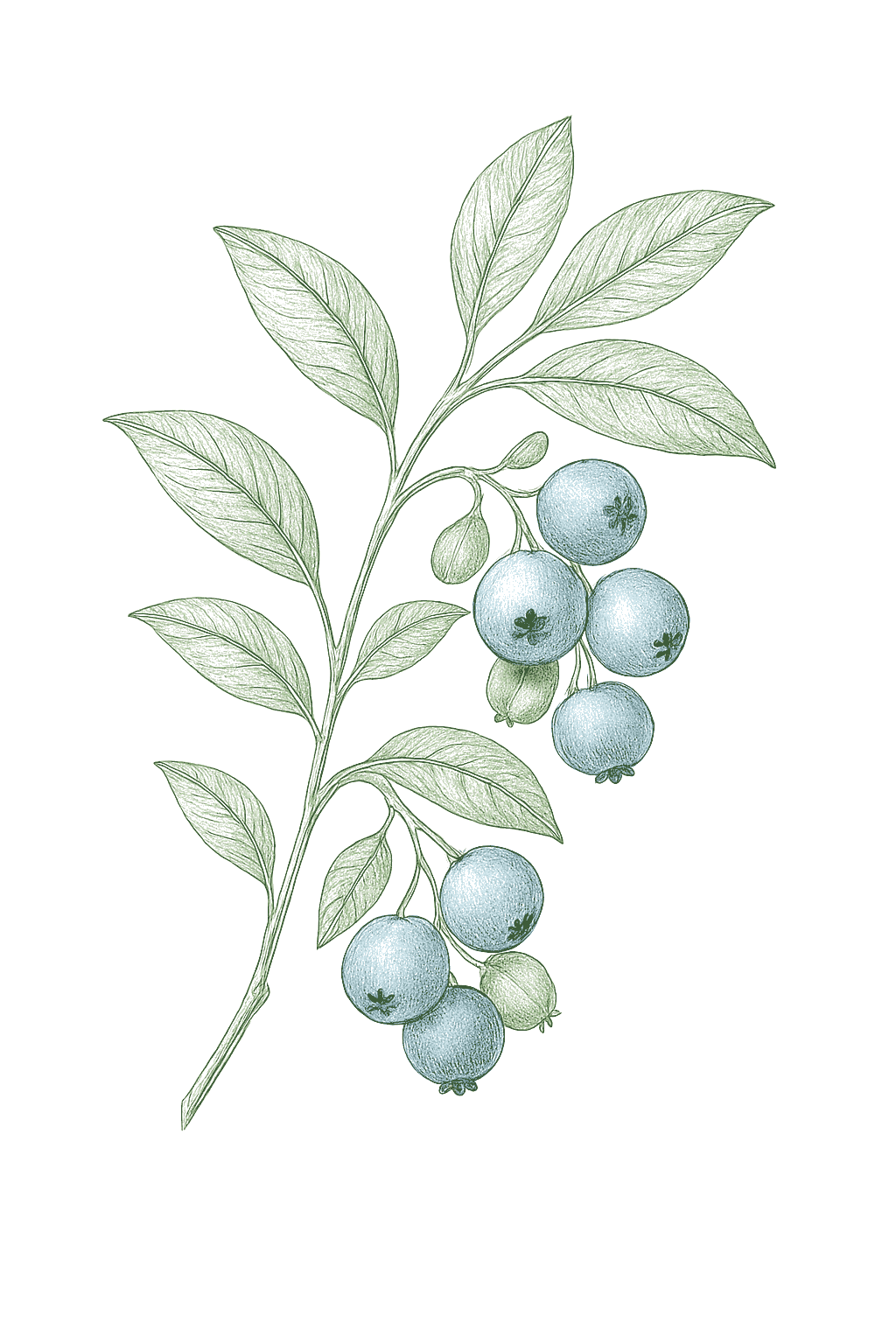
Blueberry mature plant
Fig. 01 · Blueberry, mature Zone 12
Container
20 gal
min 15 gal pot
Sunlight
Full sun
6-8 hrs daily
Water
Moderate
2 inches / week
Spacing
48-72"
between plants
Soil pH
4.5-5.5
slightly acidic
Today · in your zone

What's happening right now

July 24 · Zone 12 · Stage 01 · Planting

Off-season for blueberry in zone 12.

Chill hours

Will your winter chill these blueberries?

Blueberries need a stretch of cold winter weather before they will flower and fruit, measured in chill hours (time below 45°F). Each type needs a different amount: northern highbush needs a lot of cold, southern highbush very little, rabbiteye somewhere in between. This is why choosing the type that matches your climate matters so much.Chill hours are the hours of winter temperature below 45°F a blueberry needs to break dormancy and bloom normally. The requirement varies sharply by type: northern highbush wants roughly 800 to 1000 hours, rabbiteye about 350 to 650, and southern highbush as little as 150 to 600. Too little chill for the type gives weak, erratic bloom and little fruit; the figure is the single best predictor of whether a given cultivar will crop where you live.

Your winter banks ~0 – 150 hrs
02505007501000
Northern highbush
Duke~800–1000Bluecrop~800–1000Patriot~1000Jersey~800–1000Northblue~800–1000Northland~800–1000

These need more chill than your winter dependably delivers. In a mild winter they bloom unevenly and crop lightly.

Rabbiteye
Premier~550Powderblue~550–650Brightwell~350–400Tifblue~600–700

These need more chill than your winter dependably delivers. In a mild winter they bloom unevenly and crop lightly.

Southern highbush Best for your chill
Emerald~250Jewel~200Sharpblue~150–300

These need more chill than your winter dependably delivers. In a mild winter they bloom unevenly and crop lightly.

The growing year

Your blueberry year, month by month

Evergreen, leaves year round HI: Tropical, Zone 12

In Hawaii, blueberries are a fun specialty crop you plant once and keep for years, grown almost always in pots with special low-chill or no-chill varieties, and the bush stays green all year. It flowers, ripens its berries, then settles into a calmer stretch of light care and feeding, staying in leaf the whole time. Keep an eye out for a leaf disease called rust in cool, damp spots, and enjoy it as something a little out of the ordinary.In Hawaii blueberry is a niche, long-lived evergreen crop, planted once and kept for years, grown almost always in containers from roughly 250 to 4000 feet; only low-chill and no-chill southern highbush fruit here, and they hold their leaves year round. The year runs from bloom to harvest, then a care period of light shaping and feeding, the bush staying in leaf the whole time. Watch for blueberry rust in cool, wet sites, and treat it as a rewarding specialty.

Once established, your blueberries follow the same yearly rhythm. Choose a cultivar by chill class above, then use this calendar for the season-to-season timing.


Jan
Feb
Mar
Apr
May
Jun
Jul
Aug
Sep
Oct
Nov
Dec
▲ We are here
Bed’s year
growing
bloom
harvest
care
growing
BloomGrowingHarvestCare
Plant crowns
year-round
Bloom
February to April
Harvest
April to July
Protect the blossoms Frost is not a factor in Hawaii. During bloom and fruiting the practical concerns are choosing genuinely low-chill or no-chill cultivars and managing blueberry rust in cool, wet, high-elevation sites.
From seed to fruit

The growing journey

Stage 01 · Planting
01
Planting
Your new blueberry plant going into the ground in soil you have already made acidic and well-draining.A dormant or container-grown nursery plant going into prepared, acidified, well-drained soil. In most regions this is late winter to spring; container plants can also go in during fall.
Plant your blueberry in acidic, loose soil, at the same depth it was in its pot. Water it well and spread pine bark or pine straw mulch around it (but not touching the stem).Test and acidify the soil before planting, set the plant at the same depth it grew in the nursery, water it in, and mulch with an acidic mulch like pine bark or pine straw. Do not add lime or fresh manure.
FROM PLANT · Make the soil acidic before planting, ideally the fall before, by mixing in elemental sulfur. Fixing it later, once the bush is in the ground, is much harder.Acidify before you plant, not after. Work elemental sulfur into the bed the fall before planting so it has the winter to react; correcting pH around established roots is slow and far less effective.
FROM PLANT · Plant at least two different blueberries of the same type so they pollinate each other. Set them at the same depth they were in their pots, in loose, acidic soil.Plant two or more cultivars of the same type for cross-pollination, and set each plant at its nursery depth in well-drained, acidic soil amended with peat or pine bark.
02
Establishment (years 1 to 2)
Your young bush is busy growing roots and branches, not making a real crop yet. This stage lasts the first couple of years.Young bushes building roots and shoots rather than fruiting. Flower buds will form, but the plant's energy is best spent on growth. Full production is still years away.
For the first two years, pinch off the flowers so the plant grows bigger and stronger instead of fruiting. Keep it watered, keep the soil acidic, and feed lightly with azalea or blueberry food.Remove the flower buds during the first two seasons so the plant builds a strong framework. Keep the soil evenly moist and the pH low, mulch, and feed lightly with an acid fertilizer.
FROM PLANT · Pinch off the flowers the first two years. You give up a few early berries, but the bush grows much stronger and produces far more for years to come.Remove flower buds in years 1 and 2. It feels wasteful, but redirecting that energy into roots and shoots builds a bigger, more productive bush, and an established planting can fruit for decades.
03
Spring growth and budbreak
Each spring the buds swell and the bush leafs out, then puts on fast new growth.Bud swell and budbreak on last year's wood as the plant leafs out each spring. Shoot growth is rapid now and slows by midsummer. This is the feeding window.
When the buds swell and leaves appear, feed with an acid (azalea or blueberry) fertilizer, then feed again about six weeks later. Keep the soil damp. If new leaves turn yellow with green veins, your soil is not acidic enough.Apply the first acid fertilizer at budbreak and a second feeding about six weeks later. Keep soil evenly moist as growth accelerates. Watch new leaves for the yellowing-with-green-veins sign of high-pH iron chlorosis.
FROM PLANT · When buds swell, feed with an acid (azalea or blueberry) fertilizer, and again about six weeks later. Keep it light, and never use lime.Feed at budbreak with an ammonium-form acid fertilizer, then again about six weeks later, keeping amounts light. Avoid lime and nitrate nitrogen, which raise pH and injure blueberries.
FROM PLANT · If new leaves turn yellow with green veins, the soil is not acidic enough. Test and add sulfur, and use an iron leaf spray for a quick temporary fix.Watch the newest leaves: pale yellow with green veins means high-pH iron chlorosis, the top blueberry failure. Test and acidify the soil; a chelated-iron foliar spray buys time while sulfur works.
04
Bloom
White, bell-shaped flowers open on the bush. Bees visit them, and they need a second blueberry nearby to make a good crop.Urn-shaped flowers open in spring, tip buds of one-year-old wood first. Flowers are receptive for only 3 to 5 days each and need bees plus a second cultivar for good fruit set. Open bloom is frost-vulnerable.
Let the bees do their work and make sure another blueberry of the same type is blooming nearby. If a frosty night is coming while flowers are open, cover the bushes that evening.Make sure pollinators can reach the flowers and a compatible second cultivar is blooming nearby. If a late frost threatens open bloom, cover the bushes, since open flowers are easily frost-killed.
FROM PLANT · Blueberry flowers are easily killed by a late frost. If frost is coming while the bush is blooming, cover it that night.Open flowers are frost-tender and receptive for only 3 to 5 days each. If a late frost threatens during bloom, cover the bush overnight to protect the crop.
05
Fruit set and sizing
The flowers turn into tiny green berries that slowly grow bigger over the next few weeks.Pollinated flowers drop their corollas and set small green fruit, which then size up through three developmental phases (cell division, seed development, cell expansion). This is the most water-sensitive period.
Keep the soil evenly damp while the berries grow, or they will end up small. Put bird netting over the bush before the berries start to turn blue.Keep moisture steady and consistent while berries size; drought now means small, soft fruit. Put up bird netting before berries begin to color, since birds are the number-one blueberry pest.
FROM PLANT · Cover the bush with bird netting before the berries turn blue, and tuck it in at the bottom. Birds can strip a bush fast.Get netting up before berries color. Birds are the number-one blueberry pest and can clear a ripening bush in days; secure the netting at the base so they cannot slip underneath.
FROM PLANT · Keep the soil evenly damp while the berries grow, or they will be small. Blueberry roots are shallow and dry out fast.Hold moisture steady while berries size. This is the most water-sensitive window, and drought now produces small, soft fruit; blueberry's shallow roots dry out quickly.
06
Ripening and harvest
Berries turn blue and sweet. They ripen a few at a time over several weeks, so you pick repeatedly.Berries turn from green through pink to fully blue and sweeten over a ripening window that spans roughly two months after bloom, picked over multiple passes. Berries do not ripen further once picked.
Pick the berries that are fully blue and come off easily, every few days. Pick in the morning, leave any with red near the stem, and refrigerate them soon. Keep the netting on.Pick only fully blue berries that detach easily, every few days, in the cool morning after dew dries. Leave reddish berries to ripen. Refrigerate promptly and keep netting on through the season.
FROM PLANT · Only pick berries that are fully blue and come off easily. Red near the stem means not ready, and they will not ripen after picking. Pick every few days.Pick only fully blue berries that detach with a gentle roll of the thumb; reddish fruit at the stem is underripe and will not sweeten after picking. Harvest every few days over the roughly two-month window.
FROM PLANT · Pick in the morning once the dew dries, and get the berries into the fridge soon. Heat and rough handling make them spoil faster.Harvest in the cool morning after dew dries and refrigerate promptly. Field heat shortens shelf life, and wet berries bruise and decay; gentle handling is everything.
07
Post-harvest growth and bud set
Once the berries are done, the bush grows leaves and quietly forms the buds that will become next year's flowers.After harvest the plant resumes vegetative growth and sets next year's flower buds in late summer as days shorten. Late-summer growth must slow for good bud set; late flushes are frost-tender in fall.
After picking, keep the bush watered and healthy. You can feed lightly in warm regions, but stop feeding by late summer. A healthy bush now means more flowers next spring.Keep the plant healthy with steady moisture; a light post-harvest feeding can help in long-season regions, but stop feeding well before fall so growth hardens off. Good late-summer conditions mean more flower buds, hence next year's crop.
FROM PLANT · After picking, the bush forms next year's flower buds. Keep it watered and healthy, but stop feeding by late summer so it toughens up before winter.Late-summer conditions set next year's crop: the plant forms flower buds now as days shorten. Keep it healthy with steady moisture, but stop feeding in time for growth to harden off before fall frost.
08
Winter dormancy and chilling
In cold-winter areas the bush loses its leaves and rests for winter, soaking up the cold it needs to bloom well next spring. In mild areas it just slows down.In cold regions the bush drops its leaves and goes fully dormant, banking the chill hours its type requires (northern highbush 800 to 1000, rabbiteye and southern highbush far fewer). In mild evergreen regions it slows but may not truly go dormant.
Not much to do in winter. Keep mulch on, do not let the roots sit in soggy soil, and protect potted plants from deep freezes.Little is needed: avoid waterlogging the dormant roots, keep mulch in place, and protect potted plants from hard freezes while still letting them get their winter chill.
FROM PLANT · In cold areas, let the bush rest over winter so it gets the cold it needs to bloom well. Keep mulch on and do not let the roots sit in soggy soil.Let a cold-region bush go fully dormant to bank its chill hours; northern highbush needs roughly 800 to 1000 hours below 45°F. Keep mulch in place and do not waterlog the dormant roots.
09
Dormant-season pruning
In late winter, while the bush is still leafless, you trim it to keep it healthy and productive.Late in the dormant season (typically late winter), when buds are recognizable, the annual structural pruning is done: remove weak and poorly placed wood, balance cane ages, and open the canopy. Mature rabbiteye gets cane renewal.
In late winter, cut out thin, dead, or crowded branches to open up the bush. On older bushes, remove a few of the oldest, thickest canes each year. Also rake up any old shriveled berries under the bush to prevent disease.Prune in late winter: remove small spindly and dead wood, thin crowded center canes for light, and on mature bushes remove one to three of the oldest canes to renew the plant. This is also the moment to clean up fallen mummified fruit to reduce mummy berry.
FROM PLANT · Trim in late winter: cut out thin, dead, and crowded branches and open up the middle. On older bushes, remove a few of the oldest, thickest canes each year.Prune in late winter when buds are visible: remove weak, dead, and crowded wood and open the center for light. On mature bushes, take out one to three of the oldest canes each year to keep the plant renewing.
FROM PLANT · While pruning, rake up the old shriveled berries under the bush and add fresh mulch. This helps prevent mummy berry disease in spring.Pair pruning with sanitation: rake up and remove fallen mummified berries under the bush before spring, burying remaining sources with fresh mulch to cut mummy berry pressure.
Beginner
Know your soil

Your soil

Identify yours

Not sure what soil you have? Grab a small handful of damp soil from your garden bed and squeeze it. If it crumbles apart easily, it's sandy. If it holds together but breaks when you poke it, it's loam (what most vegetables want). If it stays in a hard, slippery ball, it's clay.

What this crop wants

Blueberries want loose, acidic soil that drains well and is rich in organic matter. Their roots are shallow and delicate, so heavy clay or soggy ground is a problem. Mixing in peat moss or aged pine bark before planting helps a lot.

If your soil doesn't match

You have sandy soil

Mix 2-3 inches of compost into the top 6 inches of your bed before planting. Compost holds moisture (which sandy soil drains too fast) and adds the nutrients sandy soil tends to lack. Repeat each season. Compost breaks down over time.

You have clay soil

Mix 2-3 inches of compost AND a few inches of coarse sand or perlite into the top 6 inches of your bed. The compost feeds the plants; the sand breaks up the clay so air and water can move through. Don't add sand without compost. It can compact like concrete.

Containers and raised beds

If amending your soil sounds like too much work, or if your soil is heavy clay, full of rocks, or contaminated, build over it. A raised bed at least 12 inches deep filled with a 50/50 mix of compost and sandy loam gives you ideal growing soil with no battles. A 5-gallon container with quality potting mix does the same for one plant at a time. Both bypass your native soil entirely.

Learn more about your soil
The specs

Care guide

The numbers that matter, at a glance.

Sunlight
Full sun · 6-8 hrs/day
Water
moderate
Spacing
48-72 inches
Soil pH
4.5 to 5.5
Container OK?
Yes · 15+ gal pot
Soil chemistry

Soil pH for blueberry

Preferred
4.5 to 5.5
Tolerated
4 to 5.5

Blueberries are fussy about one thing above all: they need very acidic soil, around pH 4.5 to 5.5. Most garden soil is not acidic enough. Get a cheap soil test before you plant. If your soil reads higher, mix in peat moss and add garden sulfur a few months ahead of planting to bring the acidity down. Get this right and the rest is easy.This is the make-or-break detail. Blueberries need a soil pH of roughly 4.5 to 5.5, far more acidic than most garden plants. Test your soil first. If the pH is above that range, lower it with elemental sulfur or by working in peat moss, and do it several months before planting, because sulfur takes time to act. Above about pH 5.5 the plant cannot take up iron and the leaves yellow between the veins.

Verified · 3 sources View
Steady hand on the hose

Watering

When & how much
Frequency
Water regularly so the soil stays evenly moist but never soggy, roughly 1 to 2 inches a week. Water more often during hot, dry spells.Keep the soil consistently moist, about 1 to 2 inches of water per week, more in heat. The critical window is from fruit swell through harvest.
Amount
About 1 to 2 inches a week, including rain.1 to 2 inches per week, adjusted for rainfall, heat, and soil drainage.
Method
A soaker hose or drip line at the base works best. A thick mulch layer keeps the roots cool and damp between waterings.Drip or soaker irrigation keeps the shallow root zone evenly moist without wetting foliage. Mulch heavily to hold moisture and moderate soil temperature.
Signs of trouble
Too much water
If leaves yellow and the soil stays wet and heavy, the plant may be drowning. Blueberries hate soggy roots.Yellowing, wilting despite wet soil, and root rot point to overwatering or poor drainage; blueberries will not tolerate standing water.
Too little water
Crispy leaf edges and small, shriveled berries mean the plant is too dry, especially while the fruit is sizing up.Drought stress shows as scorched leaf margins, undersized berries, and early leaf drop; berry size suffers most during the swell-to-ripen window.
Feeding rhythm

Feeding

Frequency
Twice per year
Type
Complete, acidifying
When to start
split: at budbreak in spring and again about six weeks later

Feed blueberries with a fertilizer made for azaleas, rhododendrons, or blueberries. These are acid-forming, which is exactly what blueberries want. Skip ordinary garden fertilizer and never add lime. Go light, especially on young plants, and feed in spring when the buds start to swell.Blueberries take up nitrogen in the ammonium form rather than nitrate, so feed with an acid-forming fertilizer such as ammonium sulfate or a blend made for azaleas and rhododendrons. Avoid nitrate fertilizers and anything containing lime, which raise pH and can injure the plant. Young bushes need very little; increase the amount gradually as the plant grows. Split the season's feeding between budbreak and about six weeks later.

Acidic, ammonium-based

Use an azalea or rhododendron food (an acid fertilizer).An acid-forming complete fertilizer; ammonium-form nitrogen, not nitrate.

Try ammonium sulfate or an acid-forming fertilizer blended for azaleas and rhododendrons
Who grows well together

Companion planting

Blueberries do not need companion plants to do well. The one thing that matters is keeping them away from large shade trees, whose roots crowd them out and cut down on fruit (pine trees are fine). If you want neighbors, other acid-loving plants like azaleas and rhododendrons share the same soil and look good together. Blueberry is not a heavy-companion crop; the main siting rule is what to keep it away from. Plant it clear of hardwood tree roots, which compete heavily and sharply reduce fruiting (pines are the exception and are compatible). Its best neighbors are other acid-loving Ericaceous plants such as azaleas and rhododendrons that share the same acidified bed, more for shared culture and aesthetics than any tested yield gain. Do not crowd the shallow root zone.

Structural
Pine
Pines pair unusually well with blueberries: they shed acidifying needles and do not crowd the root zone the way hardwoods do. UF/IFAS notes the two are compatible neighbors, whereas bushes set near hardwood roots fruit poorly. Research-backed
anytime
Other
Rhododendron
Rhododendrons and azaleas love the same acidic soil as blueberries, so they make easy, good-looking neighbors in the same bed.Rhododendron is a natural blueberry companion because the two are close relatives in the heath family and want the same ground: strongly acidic (about pH 4.5 to 5.5), rich in organic matter, moist but well-drained. That shared chemistry is the real benefit, you can build and maintain one acidic bed and both thrive, where most plants would struggle in soil that acidic. They bloom around the same time to share pollinators, and the rhododendron's foliage shades blueberry's shallow, heat-sensitive roots. Match it to blueberry on sun and keep larger rhododendrons from casting the berries into shade. Research-backed
Azalea
Azaleas thrive in the same acidic, well-drained soil blueberries need, so they fit naturally alongside them.Azalea works with blueberry for the same reason rhododendron does, they are heath-family cousins that demand the same acidic, organically rich, moisture-retentive soil blueberry needs, so one well-built acid bed serves both. Azalea tolerates a little more shade than blueberry and brings a heavy spring bloom that draws pollinators during the berry's flowering window. It is a slightly smaller-scale choice than rhododendron where space is tighter. Keep both in at least four hours of sun and avoid letting the azalea overshade the fruit. Research-backed
Provenance tagged inline · see methodology for the labeling system Key
Harvest signals

When to pick

A blueberry is ready when it is completely blue and falls off into your hand with a gentle roll of the thumb. Berries turn blue a few days before they are truly sweet, so give them a little longer, then taste one. Pick over the bush every several days as more ripen.Ripe berries turn fully blue and develop a dusty bloom, and they detach with a light roll of the thumb. Color comes a few days before full sweetness, so wait until they part easily from the cluster. Pick every 5 to 10 days through the ripening window; rabbiteye flavor improves with a slightly longer interval.

Yield

What to expect

How much you get depends on the type and the plant's age. A mature highbush bush gives about 5 to 10 pounds a year. Rabbiteye, the warm-climate type, can give a lot more, often 12 to 25 pounds. One bush keeps producing for decades.Yield depends heavily on type and age. A mature northern highbush bush yields roughly 5 to 10 pounds of fruit per year; southern highbush is similar, often exceeding 8 pounds with good care. Rabbiteye is the most productive, commonly 12 to 25 pounds on a mature, well-grown bush. A single bush can produce for decades.

Blueberries take their time. You will get a small crop around year 3 or 4 and a full crop around years 6 to 8. After that, a healthy bush keeps producing for decades.Blueberries are slow to reach full production. Expect a light crop in years 3 to 4 and full bearing around years 6 to 8, after which a well-tended bush stays productive for 20 to 50 years. Rabbiteye in particular keeps building yield as the bush matures. Do not expect berries the first two years. In fact, you should pinch off the flowers in years 1 and 2 so the plant puts its energy into growing a strong bush. It feels harsh, but it gives you far more fruit down the road. A few berries may show up in year 3.Expect no real harvest in years 1 and 2. The recommended practice is to remove the flower buds during the first two seasons after planting so the plant channels its energy into building roots and shoots; this sacrifice pays back in stronger growth and higher yields later. A few berries may come in year 3.

What changes yield
Type and cultivar: rabbiteye out-yields highbush at maturity; cultivars differ in productivity and berry size.Plant age: full production arrives around years 6 to 8, with little to no crop in years 1 to 2.Cross-pollination: two or more cultivars of the same type with overlapping bloom raise yield, berry size, and earliness; rabbiteye needs it to crop at all.Chill match: a type whose chill requirement fits the region blooms and sets fruit reliably; a mismatch costs the crop.Annual dormant pruning: balancing cane ages and opening the canopy sustains berry size and yield over the bush's life.Consistent moisture during fruit sizing: drought stress while berries are swelling reduces both size and total yield.
Verified · 4 sources View
Pick your variety

Recommended varieties

Pick the type that matches your climate, then choose two or more varieties of that same type so they pollinate each other. Getting an early one and a late one of the same type gives you berries over a longer stretch of summer. For very cold areas or for growing in pots, look for the compact half-high varieties.Choose by type first, then by season. Match the type to your winter chill (northern highbush for cold winters; southern highbush or rabbiteye for mild ones), then plant at least two cultivars of that type with overlapping bloom for cross-pollination. Mixing early, mid, and late cultivars within a type stretches the harvest over many weeks. Half-high cultivars (here listed under northern highbush) are the answer for the very coldest gardens and for containers.
Duke
fresh and freezing
Bluecrop
fresh and freezing
Patriot
fresh
Jersey
fresh and baking
Northblue
fresh
Northland
fresh and baking
Emerald
fresh
Jewel illustration
Jewel
fresh
Sharpblue
fresh
Premier
fresh and processing
Powderblue
fresh and processing
Brightwell
fresh and processing
Tifblue
fresh and processing
Off the vine

Storing your harvest

Room temp
Blueberries do not last on the counter. Leave them out only while you are eating them, and put the rest in the fridge. They will not get any sweeter sitting out, because blueberries do not ripen after picking.Blueberries are highly perishable and keep poorly at room temperature; their thin skins and high moisture invite softening and mold within a day or two. Hold them out only briefly for serving and refrigerate the rest. Note that blueberries do not ripen further after picking, so warmth buys nothing in flavor.
Fridge
In the fridge, blueberries keep for about 10 to 14 days if you store them right. Leave them unwashed and dry until you eat them, keep them in a vented container, and pick out any mushy ones so they do not spoil the rest. Rinse just before eating.Refrigerated, well-handled blueberries hold a shelf life of roughly 10 to 14 days. Store them dry and unwashed in a breathable or vented container on a middle shelf, not in the door, and sort out any soft or moldy berries that can spread decay. Field heat shortens storage life, so cool the harvest promptly and avoid picking wet fruit.
Freezer
Blueberries freeze beautifully. Spread them on a tray (do not wash first), freeze until hard, then pour them into a freezer bag. Freezing them this way keeps them from clumping. They get soft once thawed, so use frozen berries in baking or smoothies. They keep for about a year.Blueberries freeze excellently and are one of the easiest fruits to put up. Dry-pack them whole without washing first: spread on a tray, freeze until solid, then bag and seal with the air pressed out. Freezing whole keeps them loose rather than clumped. Texture softens on thawing, so use thawed berries in baking, smoothies, or sauces; frozen berries keep good quality for about a year.
Verified · 3 sources View
When something goes wrong

Common problems

Yellow leaves with green veins (iron chlorosis from high pH)
01 of 05
What happened The newest leaves turned yellow but the veins stayed green, and the bush stopped growing well. This is the number-one reason home blueberries struggle: the soil is not acidic enough, so the plant cannot take up iron even though it is there.New leaves turned pale green to yellow while the veins stayed green, with new growth affected first and leaves often smaller than normal; severe cases scorch at the edges and the plant stunts. This is iron chlorosis, and it is the single most common reason backyard blueberries fail. The iron is in the soil but locked up and unavailable because the soil pH is too high (above about 5.5). Next season Make the soil more acidic, which is the actual problem. Test your soil and add elemental sulfur (best applied in fall), and feed with an acid (azalea or blueberry) fertilizer. A chelated-iron spray on the leaves is a quick temporary fix. Never add lime, and skip aluminum sulfate. Best of all, test and acidify the soil before you plant.Fix the soil pH, which is the real cause. Test the soil, then lower the pH with elemental sulfur (apply in fall so it reacts over winter, or to the bed surface around established plants) and maintain it with an ammonium-form acid fertilizer. A chelated-iron foliar spray gives temporary green-up while the sulfur works. Never use lime, and avoid aluminum sulfate (aluminum toxicity). The lasting answer is to test and acidify before planting next time.
Little or no fruit
02 of 05
What happened Your bush is growing fine but makes few or no berries. Usually this is because the type does not match your winter cold, or because there is only one blueberry and it has nothing to cross-pollinate with.The bush grew but set few or no berries. The two usual causes are a chill mismatch (a type whose chill requirement does not fit the region, so it blooms erratically or not at all) and lack of cross-pollination (only one cultivar, or no compatible second cultivar of the same type blooming alongside it). Rabbiteye in particular will barely crop without a second rabbiteye. Next season Make sure you have the right type for your winters, and plant at least two different blueberries of the same type so they pollinate each other. If you only have one rabbiteye, add another. Also cover the flowers if a late frost is coming.Confirm the type fits your region's chill (see the type guidance), and plant at least two different cultivars of the same type with overlapping bloom. If you have a lone rabbiteye, add a second rabbiteye. Protect open bloom from late frosts, which can also kill the crop.
Wilting, dieback, and decline in wet soil
03 of 05
What happened The bush wilted, yellowed, and started dying back, and the roots were brown and rotten. This is root rot from soil that stays too wet.Leaves yellowed or reddened, growth stunted, branches died back, and the plant declined or died, with brown to black rotted roots when checked. This is the classic picture of Phytophthora root rot in heavy or poorly drained soil where roots stay waterlogged. Next season You cannot save rotted roots, so focus on drainage next time. Plant in raised beds with soil that drains well, never let the bush sit in soggy soil, and start with healthy plants.Root rot cannot be reversed, so move to prevention. Replant on raised beds or mounds in well-drained, acidic soil; never let blueberries sit in waterlogged ground; and start with clean nursery stock. Improving drainage is the durable fix.
Fruit disappearing as it ripens
04 of 05
What happened The berries disappeared right as they ripened, often all at once. This is almost always birds getting at unprotected fruit.Berries vanished from the bush just as they ripened, often the whole crop in a few days, sometimes with pecked fruit left behind. This is almost always birds, the number-one blueberry pest, reaching unprotected fruit. Next season Cover the bush with bird netting before the berries turn blue, and tuck it in at the bottom. Netting works much better than shiny tape or fake owls.Net the bushes before berries begin to color next season. Drape bird netting over the plant or a frame and secure it at the base; physical exclusion is far more reliable than scare devices, which birds quickly ignore.
Weak growth from wrong soil or fertilizer
05 of 05
What happened The bush grew weakly and looked off, even in decent soil. Often this is the wrong fertilizer (one with lime or the wrong kind of nitrogen) or feeding a young plant too much.The bush grew poorly, with pale or off-color foliage, despite seeming healthy soil. Beyond high pH, common causes are using the wrong fertilizer (nitrate-form nitrogen or anything containing lime, which raise pH and stress blueberries) or over-fertilizing young plants. Next season Use an acid (azalea or blueberry) fertilizer and feed lightly, especially on young plants. Never use anything with lime. Keep the soil acidic with pine bark or pine straw mulch.Switch to an acid-forming, ammonium-form fertilizer made for blueberries or azaleas, and feed lightly, especially on young plants. Stop using anything with lime or nitrate nitrogen. Mulch with an acidic mulch and keep the pH in the 4.5 to 5.5 range.
Verified · 7 sources View
The usual suspects

Pests & diseases

Pests
Birds
P · 01
Symptoms Birds eating your berries, often clearing the bush right as the fruit ripens.Ripening and ripe berries stripped from the bush, often the entire crop in a few days as fruit colors up. Pecked and partly eaten berries left behind. Cause Birds love ripe blueberries and are the biggest blueberry pest there is.Birds (robins, cedar waxwings, and others) are drawn to ripening blueberries and are widely rated the number-one blueberry pest by growers. Organic treatment Cover the bush with bird netting before the berries turn blue, and tuck it in at the bottom so birds cannot sneak in. Netting works far better than scare devices.Netting is the most effective control. Drape bird netting (about 1/2 to 3/4 inch mesh) over the bush or a frame before berries begin to color, and secure it at the base so birds cannot get underneath. Prevention Put netting up every year before the fruit ripens. Shiny tape and fake owls stop working once birds get used to them, so netting is the dependable fix.Install netting pre-ripening every season. Scare tactics (reflective tape, decoys) help only briefly as birds habituate; physical exclusion is the reliable answer.
Spotted-wing drosophila (SWD)
P · 02
Symptoms Tiny maggots inside ripe berries, with fruit going soft and mushy. The adult is a small fly with a spot on the wing.Small white maggots inside ripe berries; fruit softens, collapses, and leaks when squeezed. A tiny vinegar-fly-like adult, the male with a dark spot near each wingtip. Damage often unseen until fruit is opened. Cause A small invasive fruit fly that lays eggs in good, ripe berries (not just rotten ones), and the maggots feed inside.Spotted-wing drosophila (Drosophila suzukii), an invasive vinegar fly whose females cut into healthy ripe fruit to lay eggs, unlike common fruit flies that only use rotting fruit. Organic treatment Pick ripe berries often and clean up any fallen or overripe ones (seal them in a bag, do not compost). Very fine netting keeps the flies off. You can monitor with a cup of apple cider vinegar as a trap.Harvest frequently and completely (every one to three days) so ripe fruit is not left on the bush, and remove and destroy any fallen or overripe berries (bag them, do not compost). Fine exclusion netting (less than 1 mm mesh) over fruiting plants reduces egg-laying. Monitor with apple-cider-vinegar traps. Prevention Grow early varieties when you can, keep the ground clear of fallen berries, and pick often. Fine netting before ripening is the best prevention.Choose early-ripening cultivars to dodge peak fly pressure, keep the planting clean of dropped fruit, and harvest on a tight schedule. Combine monitoring with exclusion before berries ripen.
Blueberry maggot
P · 03
Symptoms Small white maggots in ripening berries, from a little banded-wing fly that shows up in summer.White, legless maggots inside ripening fruit; infested berries soften. The adult is a small fly, roughly 3/16 inch, with dark bands across the wings, active from June or July through August. Cause A native fruit fly that lays eggs in nearly ripe berries, and the maggots feed inside the fruit.Blueberry maggot (Rhagoletis mendax), a native fruit fly. The female deposits one egg just beneath the skin of each almost-ripe berry, and the larva develops inside the fruit before dropping to the soil to pupate. Organic treatment Pick often and clean up dropped or buggy berries (do not compost them). Yellow sticky traps put up before the berries ripen help you spot the flies.Harvest promptly and frequently, and remove infested and dropped fruit so larvae cannot complete their cycle in the soil. Do not compost infested berries, since pupae survive composting. Monitor with baited yellow sticky traps before ripening. Prevention Watch for the fly with sticky traps before harvest, keep fallen fruit picked up, and harvest often. Netting keeps the flies off too.Monitor with yellow sticky traps starting a few weeks before ripening, keep fallen fruit cleaned up, and harvest on a tight schedule. Netting also excludes the adult fly.
Aphids
P · 04
Symptoms Tiny soft bugs on new shoots and the undersides of leaves, sometimes with sticky residue.Small soft-bodied insects clustered on tender new growth and leaf undersides, sometimes distorting new shoots and leaving sticky honeydew. Mainly a concern as virus vectors rather than for direct feeding damage. Cause Small sap-sucking insects whose bigger risk is spreading plant viruses.Several aphid species feed on blueberry sap; their main importance is the potential to transmit blueberry viruses. Organic treatment Spray them off with water, let ladybugs help, or use insecticidal soap if there are a lot. Do not over-fertilize, which makes the soft new growth they love.Knock light infestations off with a strong spray of water, encourage natural predators like ladybugs, and use insecticidal soap if needed. Avoid over-fertilizing with nitrogen, which fuels soft growth aphids prefer. Prevention Do not over-feed, encourage helpful bugs, and check new growth in spring.Keep plants healthy without excess nitrogen, support beneficial insects, and inspect new growth in spring. Manage nearby weeds that host aphids.
Scale insects
P · 05
Symptoms Little hard bumps stuck to the stems, sometimes with black sooty mold nearby.Small, immobile bumps on stems and older wood, sometimes with associated sooty mold on honeydew. Heavy infestations can weaken canes and reduce vigor. Cause Sap-sucking insects that stick to the branches and can weaken the bush.Several scale insects attach to blueberry wood and feed on sap, secreting honeydew that supports sooty mold. Organic treatment Cut out badly infested branches in winter, and spray dormant oil to smother them. Helpful insects keep them in check too.Prune out and destroy heavily infested wood during dormant pruning, and apply dormant horticultural oil to smother overwintering scale. Encourage natural enemies. Prevention Prune for good airflow and check older branches in winter.Keep bushes vigorous and well pruned for good air movement and light, and inspect older canes during dormant pruning.
Diseases
Mummy berry
D · 01
Symptoms In spring, new shoots and flowers suddenly wilt and turn brown as if frost-hit. Later, berries shrivel into hard tan mummies and fall off.In spring, newly emerging shoots, leaves, and flower clusters suddenly wilt, brown, and die as if frosted, later dusted with gray spores. Infected berries look normal at first, then turn tan or reddish, shrivel, and drop as hard gray mummies. Cause A fungus that lives in old shriveled berries on the ground over winter, then infects new shoots and flowers in spring.The fungus Monilinia vaccinii-corymbosi, which overwinters in mummified berries on the ground and infects in two phases: emerging shoots first, then flowers, which spread it to the fruit. Organic treatment Clean up and throw away the old shriveled berries under the bush, and rake or add fresh mulch in late winter to bury them before they release spores. Choose resistant varieties.Sanitation is the core organic control: rake up and destroy fallen mummies, and shallowly cultivate or mulch under bushes in late winter to bury overwintering mummies before their spore cups form. Remove highly susceptible cultivars from mixed plantings. Prevention Pick resistant varieties, keep fallen berries cleaned up, mulch under the bush, and prune for airflow. It is worst in cool, rainy springs.Choose resistant cultivars, keep the ground under bushes clean of mummies, mulch to bury spore sources, and improve air movement. Cool, wet spring weather worsens it.
Phytophthora root rot
D · 02
Symptoms Leaves yellow or redden, the bush stunts and dies back, and the roots turn brown and rotten. It strikes plants in soggy soil.Aboveground: yellowing or reddening leaves, stunted growth, branch dieback, defoliation, and eventual plant death. Belowground: roots turn brown to black and rot. Most common in heavy or poorly drained soils. Cause A soil disease that rots the roots when the soil stays too wet.Soilborne Phytophthora water molds that attack roots in wet, poorly drained soil. Southern highbush is more susceptible than rabbiteye. Organic treatment There is no fixing rotted roots, so it is all about prevention: plant in raised beds with good drainage, and replace dead plants with healthy ones in a drier spot.There is no organic cure once roots are rotted; management is preventive. Improve drainage, plant on raised beds or mounds, and remove and replace dead plants with clean nursery stock on a better-drained site. Prevention Plant in raised beds with soil that drains well, never let the bush sit in soggy soil, and buy healthy plants. Good drainage prevents it.Plant only in well-drained, acidic soil; use raised beds in heavy ground; avoid overwatering and waterlogging; and start with disease-free nursery plants. Good siting is the whole game.
Botrytis blossom blight (gray mold)
D · 03
Symptoms Flowers turning brown and getting a fuzzy gray mold in cool, damp weather.Blighted, browned flowers and blossom clusters, sometimes covered with fuzzy gray mold in cool, wet conditions. Can lead to fruit rot. Frost-injured blossoms are especially vulnerable. Cause A gray-mold fungus that attacks flowers in cool, wet, crowded conditions.The fungus Botrytis cinerea, favored by cool, wet, humid weather during bloom and by frost-damaged or dense, poorly ventilated tissue. Organic treatment Prune to open up the bush so air flows, water at the base rather than over the flowers, and remove moldy flower clusters.Improve air circulation through pruning, avoid overhead watering that wets blossoms, and remove blighted clusters. Good spacing and canopy openness reduce the humidity it needs. Prevention Keep the bush open and airy, water low, and protect flowers from frost. Dry flowers do not get moldy.Prune for an open canopy, water at the base, avoid excess nitrogen, and protect bloom from frost. Dry, well-ventilated flowers rarely blight.
Anthracnose (ripe rot)
D · 04
Symptoms Ripe berries developing soft sunken spots and rotting, sometimes with orange ooze, on the bush or soon after picking.Ripening and ripe berries develop soft, sunken spots, often with salmon to orange spore masses; fruit rots on the bush or quickly after picking. Lesions can also appear on leaves and stems. Cause A fungus that infects in wet weather and rots the berries as they ripen or in storage.The fungus Colletotrichum (anthracnose), which infects during bloom and wet weather and shows up as fruit rot at ripening; it is also a common post-harvest rot. Organic treatment Open up the bush for airflow, water at the base, pick ripe berries promptly, and refrigerate them fast. Throw away rotted berries.Prune for air movement, avoid overhead irrigation, harvest promptly, and cool fruit quickly after picking to slow the rot. Remove and destroy rotted fruit. Prevention Keep the bush airy, water low, pick on time, and chill berries right away. Some varieties resist it better.Improve canopy ventilation, manage moisture during bloom and ripening, harvest on time, and cool fruit immediately. Some cultivars are more resistant.
Stem blight and twig dieback
D · 05
Symptoms Branches and twigs dying back, with reddish-brown patches spreading down the wood.Branches, twigs, and canes die back with reddish-brown lesions that spread from smaller wood toward larger branches; affected canes wilt and die. Can kill young plants outright. Cause Fungi that get into the branches through wounds or winter-damaged wood and cause dieback.Fungal canker pathogens (including Botryosphaeria stem blight and Phomopsis twig blight) that enter through wounds and stressed or winter-injured wood. Organic treatment Cut out dying branches well below the damage, clean your pruners between cuts, and keep the bush healthy so it resists infection.Prune out affected wood well below the lesion into healthy tissue, disinfecting tools between cuts, and remove debris. Keep plants vigorous and unstressed; avoid winter injury. Prevention Grow healthy, well-adapted plants, prune out diseased wood cleanly, and avoid stressing the bush. Some varieties resist it better.Plant adapted, vigorous cultivars; avoid drought and winter stress; prune cleanly and remove diseased wood; and keep good air movement. Resistance is variety-led.
Verified · 10 sources View
Seasoned
Where to plant next year

Crop rotation

Crop rotation is for vegetables you replant each year. A blueberry is a bush that lives in one spot for decades, so just pick a good site at the start and leave it there.Rotation does not apply to blueberries. Unlike annual vegetables, a blueberry is a long-lived perennial shrub that occupies the same site for 20 to 50 years. Choose the planting spot carefully for drainage and acid soil up front, because you will not be moving it.

Avoid following
This does not apply to blueberries. You plant a blueberry bush once and it stays for many years, so there is nothing to rotate.Not applicable. A blueberry is a permanent woody shrub planted once and left in place for decades, so it is not part of any crop rotation and there is no prior crop to avoid following.
Verified · 2 sources View
In the app · pre-launch

When plant taps you on the shoulder

The plant app sends a timely reminder at every critical moment of your blueberry season. The wording adjusts to whichever you pick: beginner or seasoned. Here are three you'll see in Zone 12.

p
plant
0 days after planting
Test and acidify soil before you plant
Before you plant, check your soil pH. If it is too high, mix in elemental sulfur (best done in fall) to make it acidic. This one step prevents the most common blueberry problem.
p
plant
0 days after first growth
Feed your blueberry in spring
When the buds swell in spring, feed with an acid (azalea or blueberry) fertilizer, then feed again about six weeks later. Go light on young plants, and never add lime.
p
plant
0 days after first growth
Check new leaves for yellowing
Watch the new leaves. If they turn yellow with green veins, your soil is not acidic enough. Test it and add sulfur; an iron spray on the leaves helps for now.
Get personalized alerts.

plant sends the right notification at exactly the right moment, for your zone, your weather, your crops. Founding members lock the rate forever.

Back the Kickstarter →
Ask the gardener

Common questions

Got a question we missed?

We're building this guide with real growers. Got a question we missed? Ask here. We read every one and add the best answers right to this page.

Grown this before?

Share a tip

Learned something the hard way? Pass it on. Real growers' tips make this guide better for the next person, and we credit you by name when yours goes live.

Seasoned
Spot something wrong?

Report a problem

If you've grown this crop and you see a date, a temperature, a companion claim, or a recommendation that doesn't match your experience, tell us. Real growers' corrections make this guide better for the next person.

How we built this guide

Methodology & sources

Every date, temperature, spacing, and recommendation on this page is sourced from university cooperative extension publications, peer-reviewed agricultural research, NOAA climate data, and direct extension calendars. Where claims are softer (traditional gardening wisdom not formally documented), we say so.

Research-backed Documented in cooperative extension publications or peer-reviewed research
Well-grounded A known agronomic principle, but not formally tested for this specific pair
Traditional Time-tested gardening wisdom, limited formal research support
Last reviewed
June 23, 2026
Data version
crops_data_final · v1.0 · schema 2.9
Sources cited on this page
16 publications
Verified entries
Companion-planting claims tagged inline · zone dates verified against 5+ extensions
See all sources cited on this page
  • University of Minnesota Extension umn_ext
  • University of Maryland Extension umd_ext
  • Cornell Cooperative Extension cornell_ext
  • Iowa State University Extension iastate_ext
  • Michigan State University Extension msu_ext
  • NC State Extension ncsu_ext
  • Penn State Extension psu_ext
  • U. of Illinois Urbana-Champaign Extension uiuc_ext
  • UC Davis Postharvest Center ucd_postharvest
  • Texas A&M AgriLife Extension tamu_agrilife
  • Virginia Cooperative Extension 426-331 vce_426_331
  • Piedmont Master Gardeners piedmont_mg
  • UGA Vegetable Garden Calendar uga_calendar
  • Clemson Home & Garden Information Center clemson_hgic
  • UC IPM Statewide IPM Program uc_ipm
  • NOAA 1991-2020 Climate Normals noaa_normals

Growing notes, weekly.

Zone-aware seasonal nudges, what's worth planting now, and the occasional recipe from the harvest. No spam, ever.

Vol. 003 · Blueberry · plant.lifestyle