Today · in your zone
What's happening right now
Off-season for broccoli in zone 5.
Tap to switch. plant calibrates to where you are in the journey.
Broccoli is a cool-weather vegetable grown for its green head, which is really a cluster of flower buds you pick before they open. It grows best in spring and fall, not summer heat, and keeps making smaller side shoots after you cut the main head. Broccoli is a cool-season brassica grown for its tight head of immature flower buds, harvested before the buds open. It performs best in the cool shoulders of spring and fall, bolts or fails to head in summer heat, and rewards a steady supply of moisture and nitrogen. After the central head is cut, most types keep producing smaller side shoots.
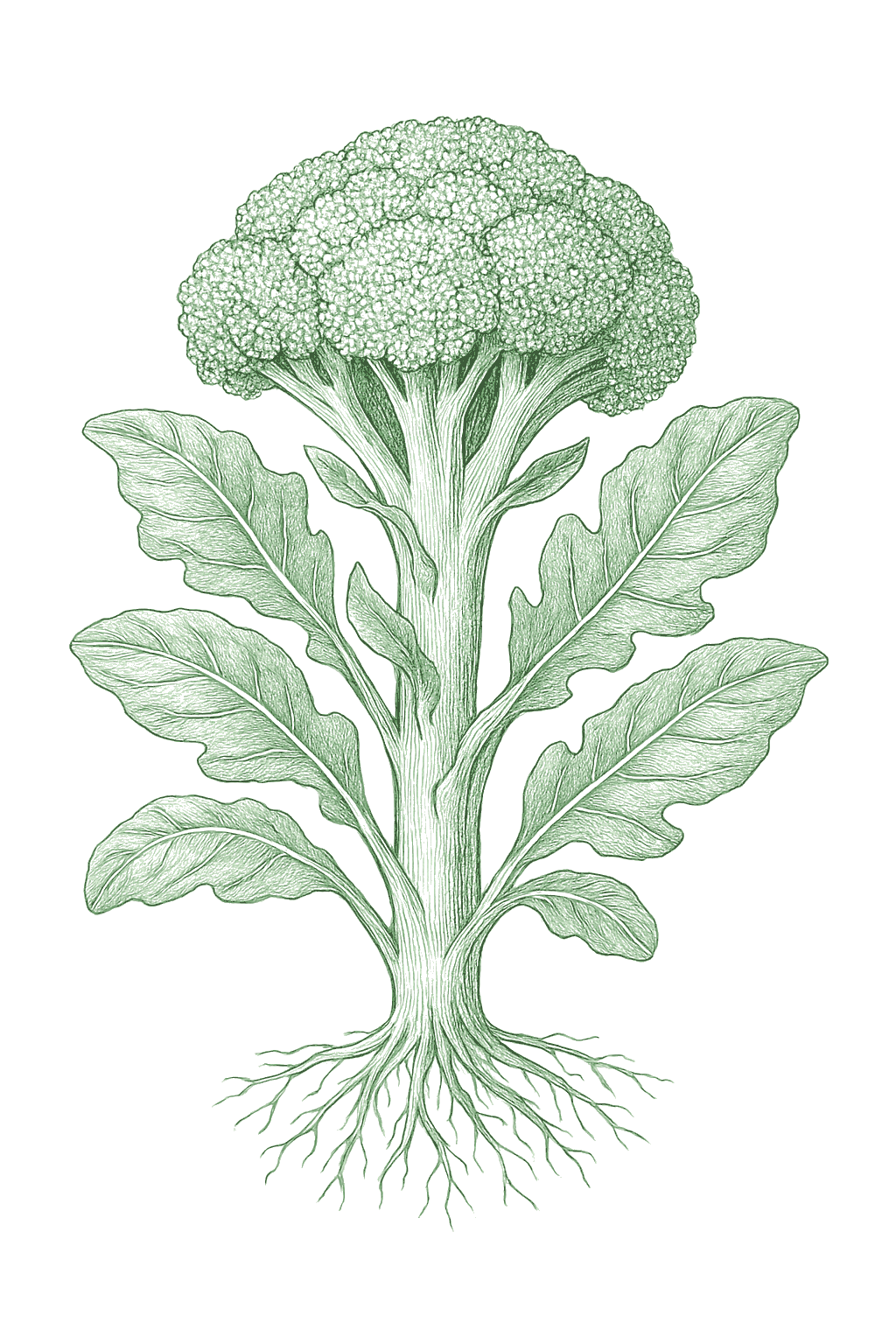
Off-season for broccoli in zone 5.
In Zone 5, broccoli can be planted March through April, then again August, skipping the summer heat. Start indoors Feb 25 - Mar 18. Harvest runs May through June.
Plant broccoli in spring and again in late summer for fall, in small batches a couple of weeks apart, instead of all at one time. Skip the hottest part of summer, since broccoli will not form good heads in the heat.Broccoli crops in the cool shoulders of the year, so plant in small batches every 2 to 3 weeks within the spring window and again in late summer for fall, rather than all at once. The spring window is short because heads must size up before summer heat arrives, so most gardens fit only a sowing or two before the midsummer gap; the fall planting, heading into cooling weather, is often the more reliable crop.
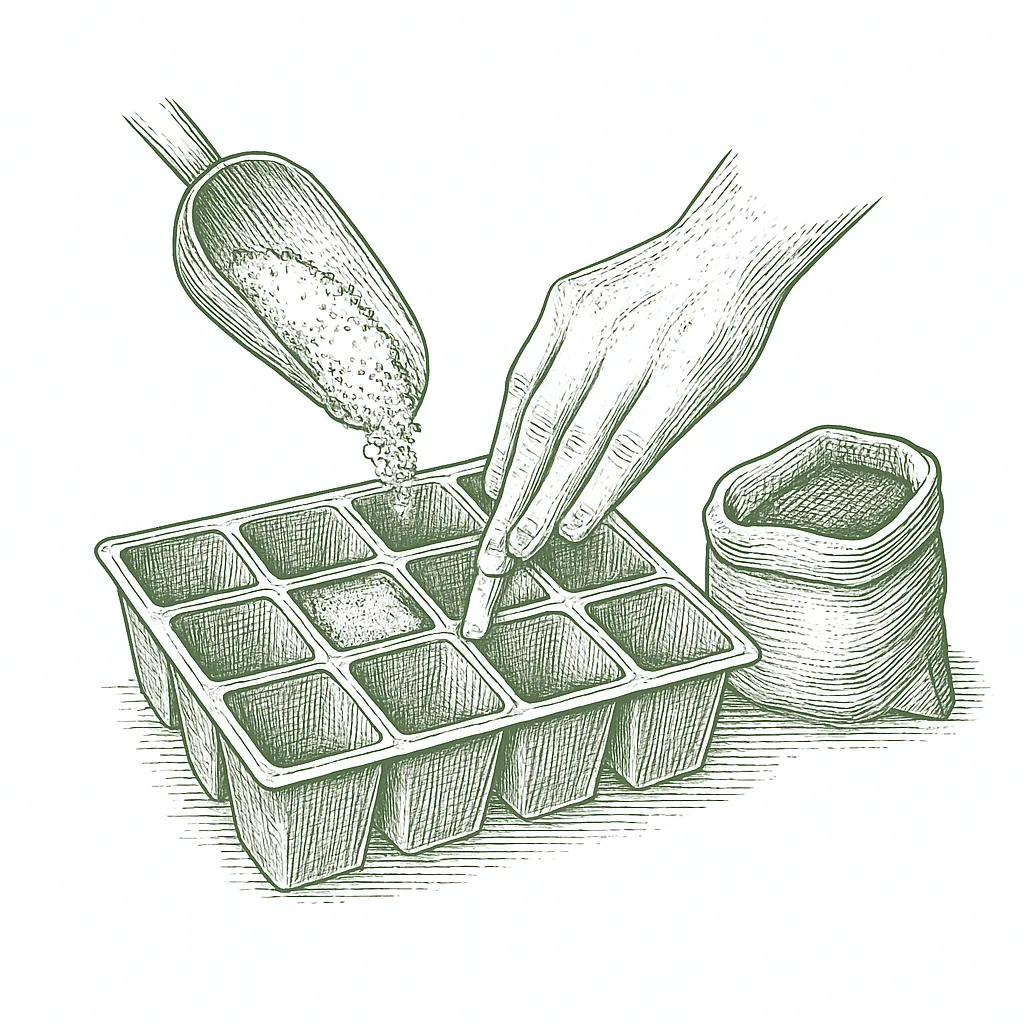
You can start broccoli indoors or buy young plants. For a spring crop, start seeds about 5 to 7 weeks before you plant out, and set plants in the garden a couple of weeks before your last frost. For fall, start them in mid to late summer and plant out as the heat eases. Use small, healthy plants, not big leggy ones, and let them get used to the outdoors over a week before planting.For the spring crop, start seeds indoors about 5 to 7 weeks before setting out and transplant roughly 2 to 4 weeks before the last frost; broccoli tolerates light frost. For fall, start transplants in mid to late summer, about 4 to 6 weeks before setting them out as the heat breaks, or direct sow. Set out young, well-rooted transplants with 4 to 6 true leaves, since oversized or cold-shocked transplants are prone to buttoning (tiny premature heads). Harden plants off over 7 to 10 days.







Not sure what soil you have? Grab a small handful of damp soil from your garden bed and squeeze it. If it crumbles apart easily, it's sandy. If it holds together but breaks when you poke it, it's loam (what most vegetables want). If it stays in a hard, slippery ball, it's clay.
Broccoli likes rich, loose soil that holds moisture but drains well. Mix in compost before planting.
Mix 2-3 inches of compost into the top 6 inches of your bed before planting. Compost holds moisture (which sandy soil drains too fast) and adds the nutrients sandy soil tends to lack. Repeat each season. Compost breaks down over time.
Mix 2-3 inches of compost AND a few inches of coarse sand or perlite into the top 6 inches of your bed. The compost feeds the plants; the sand breaks up the clay so air and water can move through. Don't add sand without compost. It can compact like concrete.
If amending your soil sounds like too much work, or if your soil is heavy clay, full of rocks, or contaminated, build over it. A raised bed at least 12 inches deep filled with a 50/50 mix of compost and sandy loam gives you ideal growing soil with no battles. A 5-gallon container with quality potting mix does the same for one plant at a time. Both bypass your native soil entirely.
The numbers that matter, at a glance.
Broccoli grows best in slightly acidic to near-neutral soil. A simple soil test tells you where you stand.Aim for a pH near 6.0 to 6.5. Broccoli still does fine across 5.5 to 6.8, and holding the soil at or above roughly 6.8 to 7.0 also helps suppress clubroot, a key brassica soil disease.
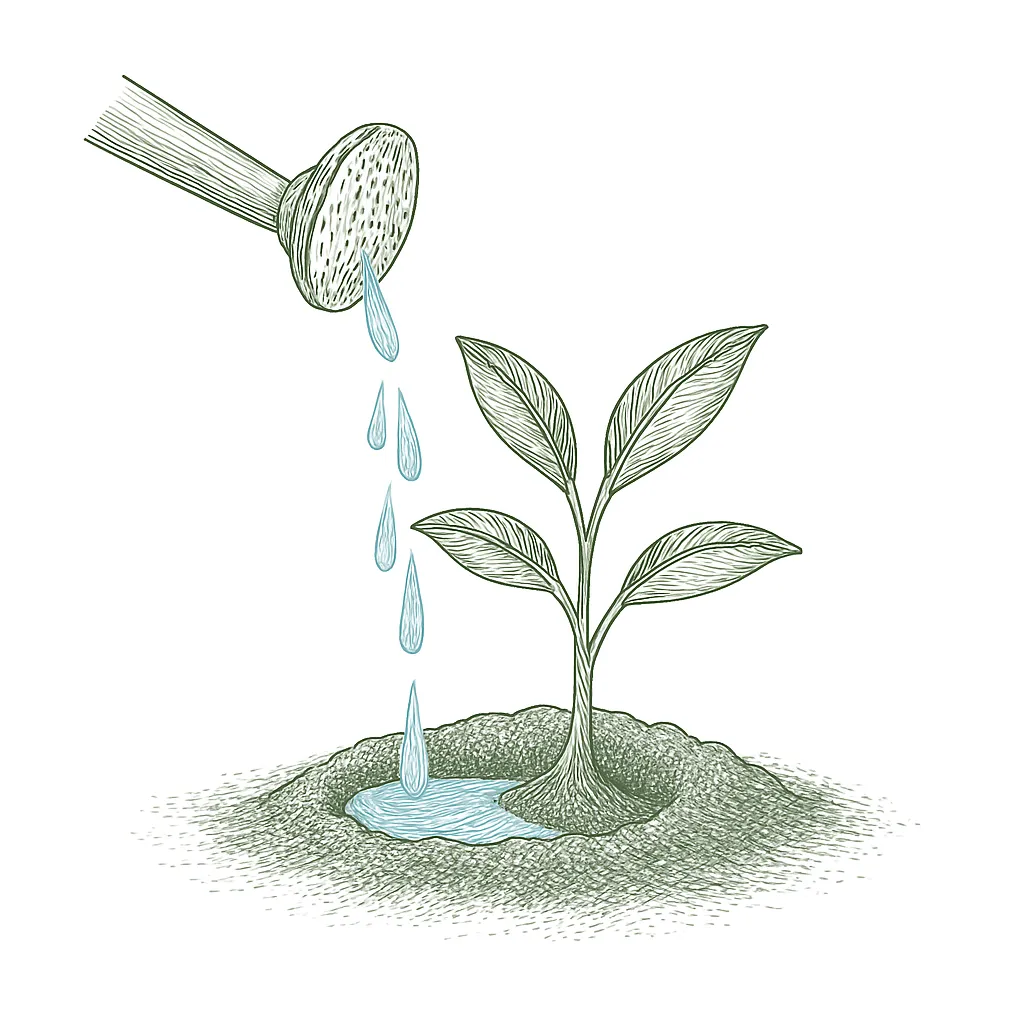
Broccoli is hungry and needs steady feeding. Give it a feed when you transplant, again about 3 weeks later, and once more after you cut the main head so it makes side shoots.Broccoli is a heavy feeder with a high nitrogen requirement and a small root zone, so place feed near the plant. Use a starter fertilizer at transplanting, side-dress with nitrogen about 3 weeks later, and feed again after cutting the central head to push side shoots. Avoid overdoing nitrogen, which can give soft, poor-quality growth.
Use a nitrogen-rich feed such as blood meal or a balanced vegetable fertilizer.High N for leafy growth; e.g. 21-0-0 side-dress or blood meal. Starter feed at transplant.
Broccoli does well next to aromatic herbs, onions, and quick cool-season crops like lettuce. The main things to keep it away from are other cabbage-family plants, which share its diseases. Most broccoli companion pairings are traditional rather than research-tested. The pairings worth acting on are practical ones: aromatic herbs and alliums as scent-based deterrents, and lettuce or spinach as cool-season intercrops that use space and light before broccoli fills in. The well-grounded caution is to separate broccoli from other brassicas, which share clubroot and cabbage-family pests, a rotation and disease principle more than a tested adjacency effect.
Cut the main head while it is firm, green, and tight, before the little buds open into yellow flowers. More small shoots grow afterward.Cut the central head while the buds are tight, blue-green, and still closed, before any yellow flowers show, taking about 6 inches of stem. Side shoots then form for later picking.
Each plant gives you one main head about 4 to 8 inches wide, and then a few weeks of smaller side shoots after you cut that main head. How much you get depends a lot on the variety and on the weather staying cool.Expect one central head of roughly 4 to 8 inches across per plant, followed by a steady run of smaller side shoots over several weeks once the main head is cut. Total yield depends heavily on variety and on whether the weather stays cool enough to keep the side shoots coming.
The big harvest is the main head, which fills out over a week or two. After you cut it, the side shoots come on strongest in the following cool weeks, then slow down once it gets hot or freezes. Some varieties, like De Cicco, are bred to make lots of side shoots.The central head matures across a week or two as it reaches full size, and that is the single largest harvest. Side-shoot production then peaks in the cool weeks after the main cut, especially on side-shoot-heavy varieties like De Cicco and Calabrese, and tails off as heat or hard frost arrives. Here's the key thing: cutting the main head while its buds are still tight is what makes the plant produce side shoots, so harvesting on time gives you more overall. It's easy to wait too long and let the head bloom, which makes it less tasty and cuts the side-shoot harvest short.Cutting the central head while the buds are still tight is what triggers the side shoots, so a timely first harvest actually increases total yield. New growers often wait too long and let the head loosen or flower, which both ends the side-shoot run early and gives a coarser main head.
Green Magic and Belstar are easy, dependable choices. For spring, pick a fast or heat-tolerant variety so it heads before it gets hot; for fall, a hardy one like Waltham 29 works well. De Cicco gives lots of small side shoots over a longer time.Match the variety to the slot: fast, heat-tolerant types like Green Magic for spring, and longer-cycle, cold-hardy types like Waltham 29 for fall. Side-shooting heirlooms such as De Cicco stretch the harvest, while hybrids give more uniform central heads. Where clubroot or other brassica diseases are a concern, look for resistant cultivars.
The ladder troubleshoots from the gentlest solution to the strongest. Start with the gentlest option and only move on when and if it doesn't work.
Clear away old cabbage-family plants after harvest, since the pupae shelter in the debris.
Broccoli does not need bees, so you can leave the cover on the whole time. Tuck the edges down so the butterflies and moths cannot get under it to lay eggs.Broccoli needs no pollination, so the cover can stay on through harvest; seal the edges to exclude the egg-laying adults.
Check the undersides of the leaves and pick off the green caterpillars and eggs.
Bt kills only caterpillars and is safe for you and for bees, but it washes off, so spray again after rain.Bt is selective for caterpillars; reapply after rain or a flush of new growth, since it does not persist.
Use spinosad only if Bt and handpicking have not held. Spray in the evening when bees are not flying.A stronger organic option once the softer rungs have not held; time it to dusk to spare bees.
The bottom rungs are products with label rules: timing, pollinators, and days to wait before harvest. Before you spray →
The ladder troubleshoots from the gentlest solution to the strongest. Start with the gentlest option and only move on when and if it doesn't work.
Go easy on nitrogen fertilizer; the soft, lush growth it pushes is what aphids swarm to.
Blast colonies off with a strong jet of water, hitting under the leaves and inside the head where they hide.Aim under the leaves and into the head; the waxy gray-green cabbage aphid is the hardest to dislodge and to wash out of a cut head.
Ladybugs and lacewings usually clean up aphids on their own if you do not spray them off.
For heavier clusters, coat the aphids directly under the leaves; repeat every few days.
A contact alternative to insecticidal soap for the same aphids; coat the leaf undersides where they cluster and repeat, and spray at dusk so you do not wet foraging bees.
The bottom rungs are products with label rules: timing, pollinators, and days to wait before harvest. Before you spray →
The ladder troubleshoots from the gentlest solution to the strongest. Start with the gentlest option and only move on when and if it doesn't work.
Pull weedy cabbage-family relatives nearby that feed the beetles.
Cover seedlings from day one. The real goal is getting them big and tough enough to outgrow the shot-hole damage.Exclude beetles from transplanting; the aim is carrying seedlings past the vulnerable stage.
Only if the beetles are thick enough to stunt the seedlings.
A last resort, mainly at the seedling stage, when flea beetles can kill young plants before they get going. Spot-treat only the affected plants rather than blanket-spraying, since a broad spray can flare cabbage aphids on broccoli. Read the label and mind the days-to-harvest wait.Reserve for a seedling-stage outbreak that the softer rungs have not held, since young broccoli can be killed outright. Spot-treat affected plants; blanket coverage risks flaring cabbage aphids by knocking out their predators. Observe the label pre-harvest interval.
The bottom rungs are products with label rules: timing, pollinators, and days to wait before harvest. Before you spray →
The ladder troubleshoots from the gentlest solution to the strongest. Start with the gentlest option and only move on when and if it doesn't work.
The fly builds up where cabbage-family plants grew last year, so move the bed.
Seal the cover at the edges right at transplanting so the low-flying fly cannot reach the stem base to lay eggs. Broccoli needs no bees, so it can stay covered.Seal row cover at the edges from transplanting to block egg-laying at the stem base; no pollination is needed, so it stays on.
A tar-paper or cardboard disk laid flat on the soil around each transplant blocks the cabbage fly from laying eggs at the stem base.
No spray for this one. Prevention is the control.
The ladder troubleshoots from the gentlest solution to the strongest. Start with the gentlest option and only move on when and if it doesn't work.
The soil germ lasts for years, so keep broccoli and its cabbage-family relatives out of an infested bed for at least 3 years, longer where clubroot has been bad.Long rotations of at least 3 years, and longer where clubroot is established, let soil inoculum decline; there is no cure once plants are infected.
Liming the soil toward neutral (pH 7.0 or above) holds clubroot back, but does not cure it.
Clubroot-resistant cabbage-family varieties exist and are worth choosing where the disease keeps returning.
Pull and destroy infected plants, and knock soil off tools and boots so you do not carry spores to clean beds.
No spray for this one. Prevention is the control.
The ladder troubleshoots from the gentlest solution to the strongest. Start with the gentlest option and only move on when and if it doesn't work.
Rotate away from where cabbage-family crops grew recently.
Remove and destroy infected plants, and stay out of the bed when the foliage is wet, since that spreads the bacteria.Rogue out infected plants and avoid working among wet foliage, which moves the bacteria.
Start with clean, certified seed and resistant varieties; black rot often rides in on the seed.
Space plants so the leaves dry fast; the bacteria spread fastest in warm, wet conditions.
Copper is a protectant that can slow spread, not a cure. It will not overcome infected seed, so the cultural steps come first.Copper acts only as a protectant against bacterial spread and cannot rescue systemic or seedborne infection; lead with sanitation and clean seed.
The bottom rungs are products with label rules: timing, pollinators, and days to wait before harvest. Before you spray →
The ladder troubleshoots from the gentlest solution to the strongest. Start with the gentlest option and only move on when and if it doesn't work.
Space plants for good air movement and keep the heads dry; downy mildew needs long leaf wetness to take hold.Set spacing and site at planting for airflow, and water at the soil line so foliage dries quickly.
Choose resistant varieties where downy mildew shows up most years.
Strip off the worst-affected leaves as soon as you see the fuzzy gray growth underneath.
A copper spray can slow spread in a wet spell, but it is hard to stop once the humidity stays high.
The bottom rungs are products with label rules: timing, pollinators, and days to wait before harvest. Before you spray →
Do not plant broccoli or other cabbage-family crops in the same spot year after year. Waiting a few years between them helps avoid soil diseases like clubroot.Rotate so brassicas do not follow brassicas for at least 3 years, and longer where clubroot is present, since the clubroot organism persists in soil for years. Keeping soil pH at or above about 6.8 also helps suppress it.
The plant app sends a timely reminder at every critical moment of your broccoli season. The wording adjusts to whichever you pick: beginner or seasoned. Here are three you'll see in Zone 5.
plant sends the right notification at exactly the right moment, for your zone, your weather, your crops. Founding members lock the rate forever.
We're building this guide with real growers. Got a question we missed? Ask here. We read every one and add the best answers right to this page.
Learned something the hard way? Pass it on. Real growers' tips make this guide better for the next person, and we credit you by name when yours goes live.
If you've grown this crop and you see a date, a temperature, a companion claim, or a recommendation that doesn't match your experience, tell us. Real growers' corrections make this guide better for the next person.
Every date, temperature, spacing, and recommendation on this page is sourced from university cooperative extension publications, peer-reviewed agricultural research, NOAA climate data, and direct extension calendars. Where claims are softer (traditional gardening wisdom not formally documented), we say so.
Spot a data point that doesn't match your experience? Submit a correction; accepted corrections earn full author credit on the page.
Zone-aware seasonal nudges, what's worth planting now, and the occasional recipe from the harvest. No spam, ever.