The GuideMicrogreens Vol. 012

Microgreens mix

grown indoors, any week of the year

Cilantro microgreens are baby cilantro plants that you harvest young, once the first little leaves are open, for a strong, fresh cilantro flavor. If you cook with cilantro, this is the microgreen for you, but be warned: cilantro is one of the slowest microgreens to grow. It sprouts slowly and unevenly and usually takes about 3 to 4 weeks, much longer than quick types like radish or broccoli. The round cilantro seed is actually a little dry fruit holding two seeds; some growers crack it into halves or soak it to help it sprout more evenly. You grow it indoors all year on a shallow tray, with no outdoor season or weather to worry about, so it grows the same way no matter where you live, it just takes patience.Cilantro microgreens are the young seedlings of Coriandrum sativum (cilantro, a member of the carrot and parsley family, Apiaceae), grown indoors and cut at the cotyledon to first-true-leaf stage for true, concentrated cilantro flavor. They are the crop for cooks who love cilantro, but they are also one of the slowest and most demanding microgreens: germination is slow and uneven, the blackout runs long, and a typical tray takes about 21 to 28 days, far longer than the 1 to 2 weeks of fast brassicas. The seed is really a small dry fruit that holds two seeds, sown whole or split (cracked) into halves; splitting or a soak can even out the ragged germination. Because there is no frost, season, or hardiness zone involved, the same tray grows identically on a windowsill anywhere, it just asks for patience.

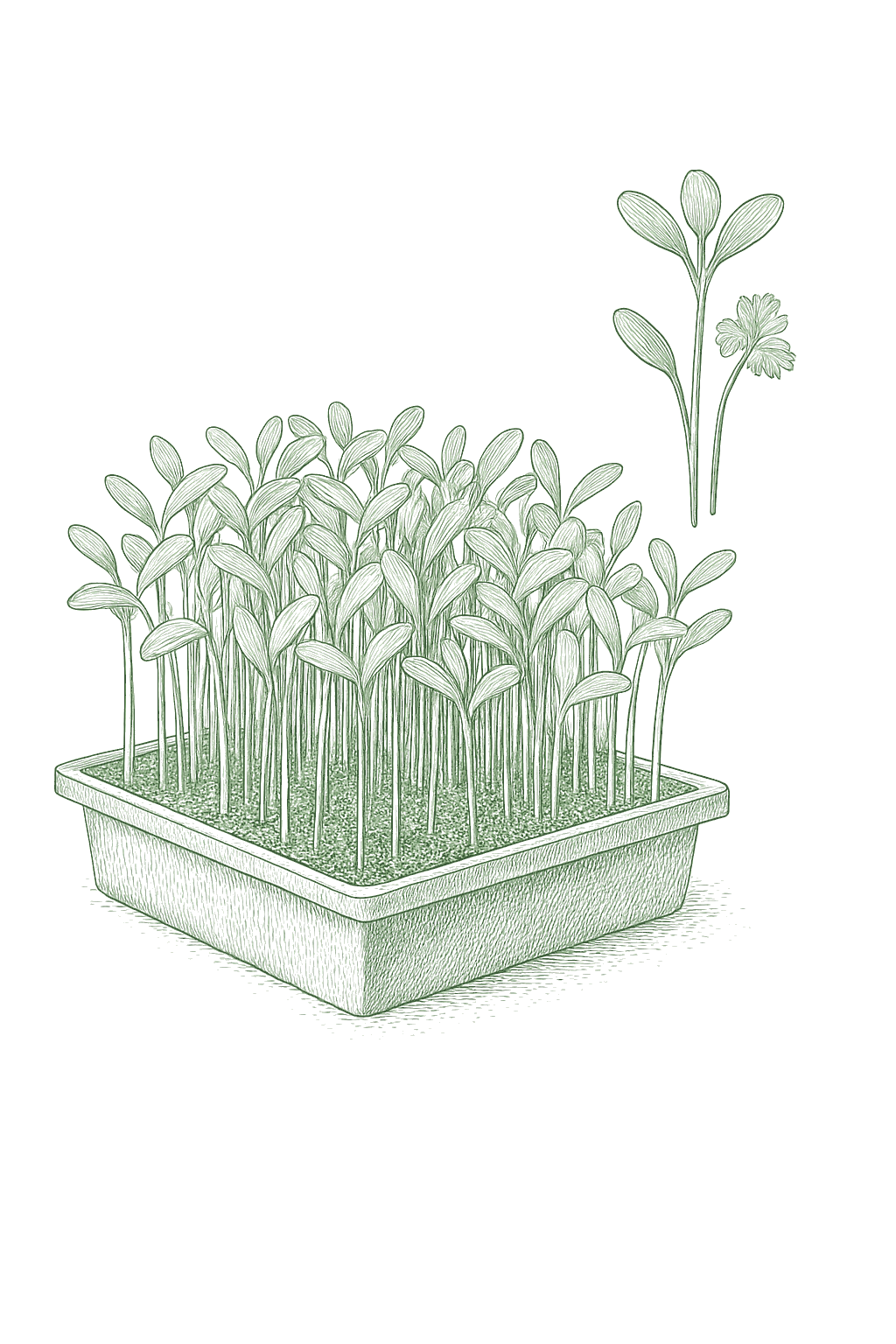
Cilantro Microgreens, ready to cut
Fig. 01 · Cilantro MicrogreensIndoor
Ready in
21-28
days, sow to harvest
Difficulty
Medium
beginner crop
Grows
Indoors
year round, any season
Resow
2 wks
for a steady supply
The cycle, start to finish

Sow, dark, light, harvest, then again

Indoors, every week of the year. Most mixes are ready in 21 to 28 days; start a fresh tray every 2 weeks for a steady supply.

  1. Step 01 Day 0

    Sow

    An even, crowded scatter of round tan seed across the whole surface, over evenly damp mix with no standing water.A dense, even layer of coriander seed on moist medium, no bare patches.

    From plant Dampen the growing medium so it feels like a wrung-out sponge, then scatter cilantro seeds thickly and evenly, about 28 grams per tray. You do not have to soak them, but a soak or split seed can help. Press the seeds so they touch the surface, but do not cover them with soil.Pre-moisten the medium to wrung-sponge feel, then broadcast cilantro seed densely and evenly at about 28 grams per 1020 tray. No presoak is required, though a 6 to 12 hour soak or split (cracked) seed can speed and even the slow germination. Press seed into contact but do not bury it.
  2. Step 02 Covered · ~74°F

    Germination

    A few white roots and pale stems appearing here and there at first, with more following over the next several days. Patchy early germination is completely normal for cilantro.Slow, staggered radicle emergence over several days; early patchiness expected.

    From plant Put the cover on and keep the tray warm (around 74 °F) and dark. Mist lightly so the surface stays damp but not wet. Cilantro is slow, so do not worry if it takes many days to sprout. A small weight on the cover helps it come up more evenly.Cover the tray and keep it warm (about 74 °F) and dark. Mist to hold even surface moisture, never soggy. Cilantro germinates slowly and unevenly, so expect this stage to run longer than most microgreens; a light weight on the cover keeps seed in firm contact for the most even stand you can get.
  3. Step 03 1 to 4 days · dark

    Blackout

    A stand of pale, stretched stems slowly filling in and evening out under the cover over a week or more. Still pale, not green.Blanched stems gradually evening the stand under an extended blackout; pre-greening.

    From plant Keep the covered tray in the dark for cilantro's long dark phase, about 1 to 2 weeks. The darkness makes the stems grow taller and helps even out the patchy sprouting before you give them light.Hold the weighted cover in the dark for the long cilantro blackout, roughly 7 to 14 days, then flip the cover off the canopy so it shades without touching. The extended dark stretch lengthens the stems and helps even out cilantro's ragged germination before greening.
  4. Step 04 18 h light · 68 to 72°F

    Light

    Seed leaves turning green over a day or two, standing on slender stems, with the fresh, citrusy smell of cilantro developing.Cotyledons greening; slender stems; first true leaf may form; characteristic cilantro aroma.

    From plant Uncover the tray into bright light for about 18 hours a day at 68 to 72 °F, and start watering from the bottom so the leaves stay dry. Keep a gentle fan going to prevent mold, since cilantro sits for weeks. Cut when the first little leaves are open, around 3 to 4 weeks.Uncover into 18 hours of bright light at 68 to 72 °F and switch from misting to bottom-watering so foliage stays dry. Run a gentle fan the whole time; over cilantro's long grow the dense canopy plus high humidity is a prolonged damping-off window. Harvest at cotyledon to first true leaf, about 21 to 28 days from sowing.
  5. Step 05 Day 21 to 28

    Harvest

    Open, narrow, forked green seed leaves about one to two inches tall, tasting brightly of cilantro. A few late sprouts among them are fine.Open forked cotyledons at 1-2 in; full cilantro flavor; minor lag acceptable.

Then start again. Sow a fresh tray every 2 weeks, and there is always a crop a few days out.
The specs

Care guide

The numbers that matter, at a glance.

Sunlight
bright indirect light or a grow light
Water
keep the medium evenly moist; bottom-water once greened to keep leaves dry
Days to maturity
21-28 days
Container OK?
Yes
Germination temp
68-74°F
Soil chemistry

Soil pH for cilantro microgreens

You do not need to worry about soil pH for cilantro microgreens. The mixes and mats sold for microgreens are already fine as is.pH is not a practical lever for a single indoor microgreen cycle on a soilless medium; standard seed-starting mixes and coir sit in a workable range and need no adjustment, even over cilantro's longer run.

Verified · 1 source View
Steady hand on the hose

Watering

When & how much
Frequency
While the seeds are sprouting, lightly mist the surface once or twice a day so it stays damp. This lasts longer for cilantro than most microgreens. After you move the tray into the light, water from the bottom whenever it starts to dry out.Mist once or twice daily through the long germination and blackout to hold even surface moisture; once greened, bottom-water as the tray dries. Expect many more watering days than a fast crop.
Amount
Just enough to keep the soil damp like a wrung-out sponge, never soggy. After bottom-watering, tip out any water left sitting in the tray.Enough to keep the medium at wrung-sponge moisture, never saturated; pour off any standing water after bottom-watering.
Method
Mist the top while the seeds are sprouting, then water from the bottom once the leaves are up so the leaves stay dry.Mist during germination and blackout; switch to bottom-watering once the canopy is up so foliage stays dry through the extended grow.
Signs of trouble
Too much water
Water sitting in the tray, a bad smell, fuzzy white mold, or seedlings flopping over mean it is too wet. Cut back on water and improve airflow right away.Standing water, a sour smell, fuzzy white growth on the medium or stems, and collapsed seedlings all signal overwatering and the damping-off that follows it, a bigger threat over cilantro's long cycle.
Too little water
Limp, curling leaves and soil that has shrunk away from the sides mean it got too dry. Water from the bottom right away.Curling, limp cotyledons and a medium that has pulled away from the tray edges indicate the canopy has dried too far between waterings.
Feeding rhythm

Feeding

Frequency
none
Type
none needed
When to start
not applicable

You do not need to feed cilantro microgreens. The seed carries enough food to reach harvest, and over the long grow adding fertilizer just invites algae and mold.Even though cilantro runs longer than the fast brassicas, it is still harvested at the seedling stage on the seed's own reserves, so no fertilizer is needed for a single cycle. Added nutrients over the long grow mainly raise the risk of algae, off-flavors, and mold.

Harvest signals

When to pick

Your cilantro microgreens are ready when the first little seed-leaves are open and the first true leaf is just showing, usually about 3 to 4 weeks after sowing. Snip them just above the soil with clean scissors and eat them fresh. They do not grow back, so you start a new tray each time.Cut at the cotyledon to first-true-leaf stage, typically 21 to 28 days from sowing, one of the longest waits among microgreens. Snip just above the medium with clean scissors; the stand will not regrow, so the tray is a single cut.

Verified · 1 source View
Yield

What to expect

You measure cilantro microgreens by the tray, not by each plant. A full tray gives a modest amount, roughly a few handfuls, and cilantro yields less than most microgreens.Yield is measured per tray, not per plant, and cilantro is one of the lowest-yielding microgreens: a well-sown 1020 tray returns roughly 4 to 8 ounces, less than the fast brassicas, and one Penn State trial recorded under 2 ounces.

Each tray gives one harvest at its best. To keep a steady supply, start new trays on a schedule, spaced out because cilantro is slow.Every tray is a single harvest at peak; continuous supply comes from staggered sowings, not from regrowth, and cilantro's long cycle means wider gaps between trays. There is no waiting period with microgreens. Your very first tray works like the rest; you will just get a feel for how slow cilantro is and how much to sow and water after a few tries.There is no establishment year; the first tray performs the same as any later tray. Expect to dial in seeding rate, patience, and watering over the first few cycles, since cilantro is less forgiving than fast microgreens.

What changes yield
seeding density (too sparse wastes the tray; too dense traps moisture and invites mold over the long grow)even moisture and the mist-to-bottom-water transitionconstant gentle airflow across the extended cycleseed form (whole vs split) and freshnesspatience through cilantro's slow, uneven germinationlight intensity and the full 18-hour daily duration
Verified · 2 sources View
Pick your variety

Recommended varieties

You do not need a special cilantro variety for microgreens. The fancy slow-bolt types sold for the garden do not matter here, since you cut the plants while they are tiny. What helps is the seed itself: regular whole coriander seed sprouts slowly and unevenly, while split (cracked) seed usually comes up faster and more evenly. Just make sure the seed is sold for sprouting or microgreens (not treated garden seed), and be patient, since cilantro is one of the slowest microgreens.For microgreens the garden distinction between slow-bolt cultivars (such as 'Leisure', 'Santo', or 'Calypso') is irrelevant, because you cut at the seedling stage long before bolting matters. What matters is seed form and quality: whole coriander seed is a two-seeded dry fruit that germinates slowly and unevenly, while split (cracked) seed is the fruit broken into single halves and tends to come up faster and more even. Either way, buy untreated seed sold for sprouting or microgreens, use it fresh, and plan for cilantro to be one of the slowest, lowest-yielding types you grow.

Whole (unsplit) coriander seed
The standard round seed. Each one is a dry fruit holding two seeds, so it germinates slowly and unevenly. No presoak required; some growers soak 6 to 12 hours to even it out. 21 to 28 days.
Split (cracked) coriander seed
The fruit cracked into single halves, sold as splits. Growers report faster, more even germination and a denser tray. Same true cilantro flavor; 21 to 28 days.
Untreated sprouting or microgreen seed
Whatever the form, buy seed sold untreated and intended for sprouts or microgreens (not fungicide-treated garden seed), since the crop is eaten raw.
Off the vine

Storing your harvest

Room temp
Do not leave cut cilantro microgreens out on the counter. They go limp fast, so put them in the fridge right after cutting.Do not hold cut cilantro microgreens at room temperature; the tender greens wilt within hours. Refrigerate immediately after cutting.
Fridge
Keep cut cilantro microgreens in the fridge in a container with a paper towel to soak up extra moisture. They last about 5 to 7 days and taste best fresh.Refrigerate dry in a vented container lined with a paper towel; the tender leaves keep about 5 to 7 days. Harvest only what you will use soon, since the flavor is best fresh.
Freezer
Do not freeze cilantro microgreens. Freezing turns them mushy and dulls the flavor. Eat them fresh.Not recommended. Freezing collapses the delicate cells and ruins both texture and the fresh cilantro aroma. They are a cut-and-eat crop.
Verified · 2 sources View
The usual suspects

Pests & diseases

Pests
Fungus gnats
P · 01
What it is Tiny dark flies that show up around constantly damp soil. Their larvae live in the wet mix. They are the main bug you might see indoors, and cilantro's long grow gives them extra time to appear.Small dark flies whose larvae live in persistently wet medium and feed on organic matter and tender roots. They are the main indoor microgreen pest, and cilantro's long 3 to 4 week cycle gives them more time to build up than a fast brassica does.
Diseases
Damping-off and moldDamping-off and surface mold
D · 01
What it is The most common microgreen problem, and a real risk for cilantro because it grows so slowly. In wet, crowded, stuffy conditions, tiny fungi rot the baby plants at the base, and you often see fuzzy white or gray mold on the surface too.Soil-borne fungi (Rhizoctonia, Botrytis, and others) rot seedlings at the soil line under wet, crowded, still conditions, often alongside fuzzy white or gray surface mold. It is the number-one microgreen failure, and cilantro is especially exposed because its long blackout and 3 to 4 week grow keep a humid, dense canopy in place far longer than a fast crop.
Verified · 2 sources View
Ask the gardener

Common questions

Got a question we missed?

We're building this guide with real growers. Got a question we missed? Ask here. We read every one and add the best answers right to this page.

Grown this before?

Share a tip

Learned something the hard way? Pass it on. Real growers' tips make this guide better for the next person, and we credit you by name when yours goes live.

Seasoned
Spot something wrong?

Report a problem

If you've grown this crop and you see a date, a temperature, a companion claim, or a recommendation that doesn't match your experience, tell us. Real growers' corrections make this guide better for the next person.

How we built this guide

Methodology & sources

Every date, temperature, spacing, and recommendation on this page is sourced from university cooperative extension publications, peer-reviewed agricultural research, NOAA climate data, and direct extension calendars. Where claims are softer (traditional gardening wisdom not formally documented), we say so.

Research-backed Documented in cooperative extension publications or peer-reviewed research
Well-grounded A known agronomic principle, but not formally tested for this specific pair
Traditional Time-tested gardening wisdom, limited formal research support
Last reviewed
July 2, 2026
Data version
crops_data_final · v1.0 · schema 2.9
Sources cited on this page
16 publications
Verified entries
Companion-planting claims tagged inline · zone dates verified against 5+ extensions
See all sources cited on this page
  • University of Minnesota Extension umn_ext
  • University of Maryland Extension umd_ext
  • Cornell Cooperative Extension cornell_ext
  • Iowa State University Extension iastate_ext
  • Michigan State University Extension msu_ext
  • NC State Extension ncsu_ext
  • Penn State Extension psu_ext
  • U. of Illinois Urbana-Champaign Extension uiuc_ext
  • UC Davis Postharvest Center ucd_postharvest
  • Texas A&M AgriLife Extension tamu_agrilife
  • Virginia Cooperative Extension 426-331 vce_426_331
  • Piedmont Master Gardeners piedmont_mg
  • UGA Vegetable Garden Calendar uga_calendar
  • Clemson Home & Garden Information Center clemson_hgic
  • UC IPM Statewide IPM Program uc_ipm
  • NOAA 1991-2020 Climate Normals noaa_normals

Growing notes, weekly.

Zone-aware seasonal nudges, what's worth planting now, and the occasional recipe from the harvest. No spam, ever.

Vol. 012 · Cilantro Microgreens · plant.lifestyle