Pick your zone and the dates re-calibrate.
The Guide Flowers Vol. 003

Nasturtium

in Zone 3, this week

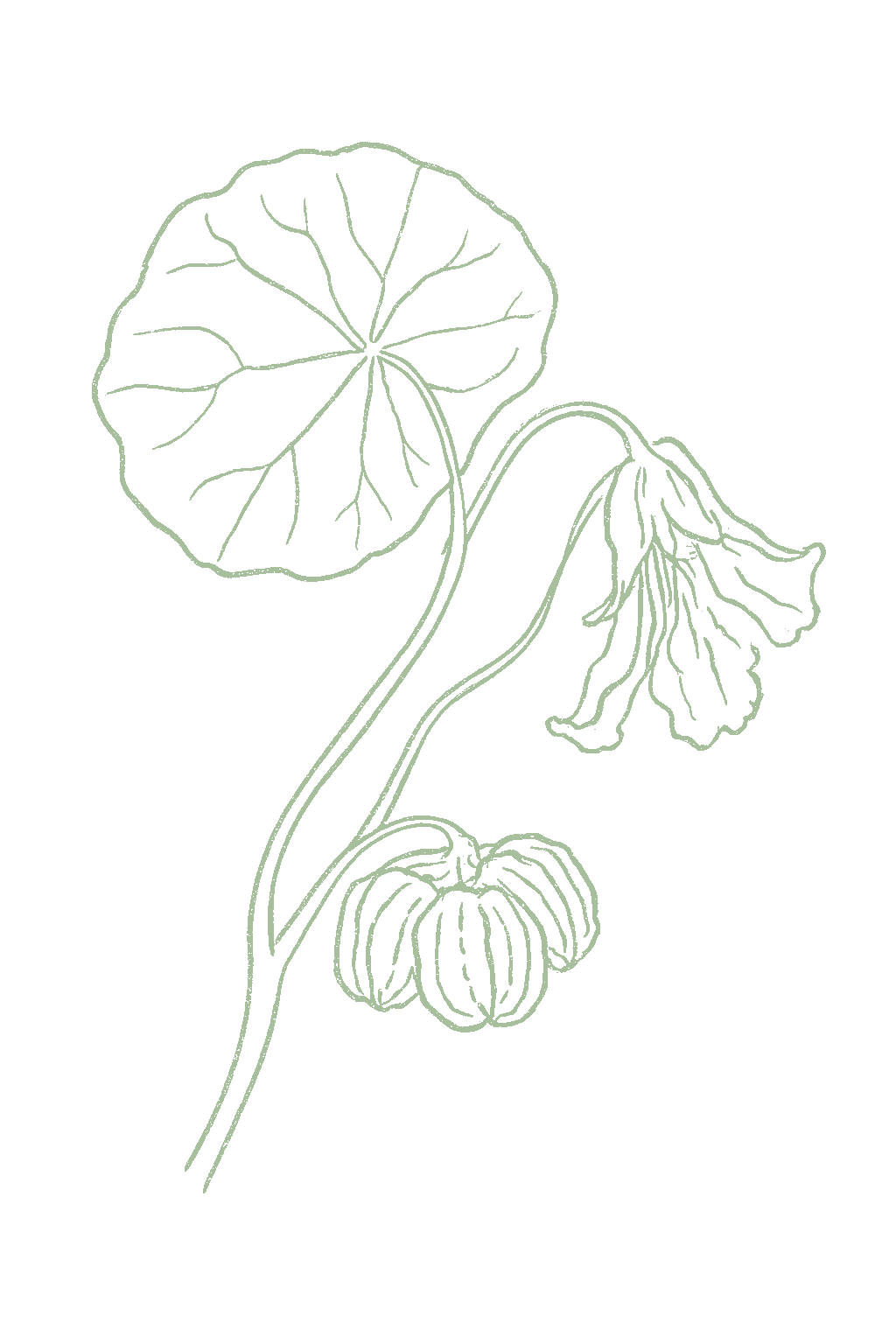
Nasturtiums are some of the easiest flowers to grow, and the whole plant is edible with a peppery, watercress-like taste: the round leaves, the bright flowers, and even the green seed pods, which you can pickle like capers. They come in two styles: trailing kinds that spill from baskets and climb low supports, and bushy kinds that stay about a foot tall. The big surprise with nasturtiums is that they flower best in poor soil. Rich soil or fertilizer gives you lots of leaves but few flowers, so do not feed them. They also make a famous companion plant: aphids love nasturtiums, so gardeners use them as a sacrificial trap to pull aphids away from beans, cabbage-family crops, and squash. Sow the big seeds right where they will grow, since nasturtiums do not like being moved. They love cool weather, slow down in extreme summer heat, and die at the first frost. Nasturtium (Tropaeolum majus) is an easy, fast-growing, frost-tender annual in the Tropaeolaceae family, native to the Andes of South America. It comes in two habits: trailing or climbing types that scramble several feet across the ground, up low trellises, or out of hanging baskets, and compact bush or mounding types that hold to about a foot. It is grown for three things at once: cheerful long-spurred flowers in warm yellows, oranges, and reds; an entirely edible plant with a peppery, watercress-like bite in its leaves, flowers, and seed pods; and a well-known companion role as an aphid trap crop. A counterintuitive key to flowering: nasturtium blooms best in lean, poor soil, and rich soil or extra fertilizer drives lush leaves at the expense of flowers. It is a cool-preference plant that flowers most freely in spring and fall, slows or stops in extreme summer heat, and is killed by the first frost.
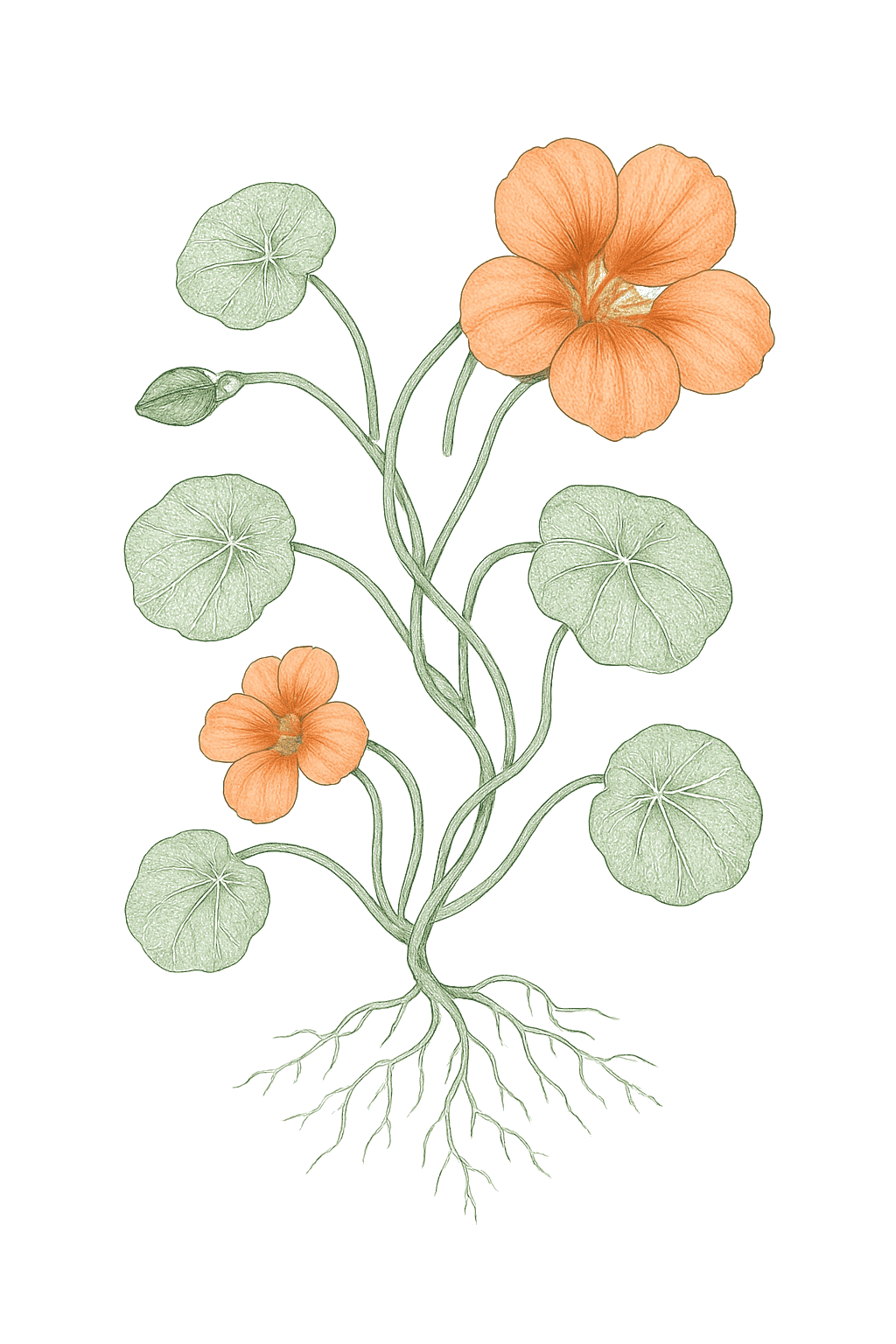
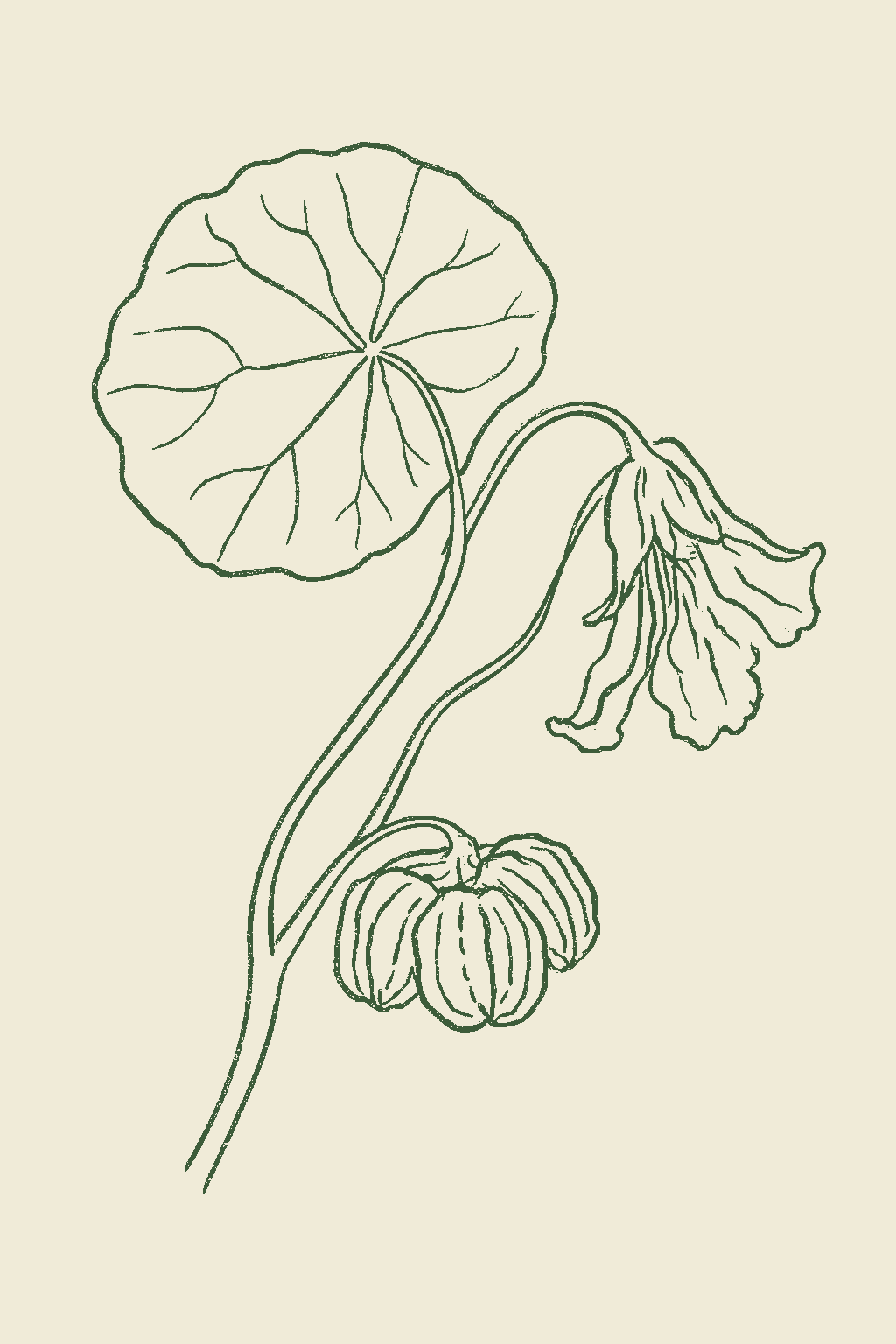
Nasturtium mature plant
Fig. 01 · Nasturtium, mature Zone 3
Mature in
35-60d
from transplant
Sunlight
Full sun to partial shade
4-8 hrs daily
Water
Moderate
Spacing
10-12"
between plants
Soil pH
6-7.5
slightly acidic
Today · in your zone

What's happening right now

July 24 · Zone 3 · Stage 01 · Germination

Off-season for nasturtium in zone 3.

The season at a glance

Planting calendar

In Zone 3, nasturtium can be planted June through July. Start indoors Apr 20 - May 4. In bloom August through September.

Jan
Feb
Mar
Apr
May
Jun
Jul
Aug
Sep
Oct
Nov
Dec
plant
too cold
too cold
too cold
indoors
indoors
plant
plant
too late
too late
too cold
too cold
too cold
bloom
bloom
bloom
indoors
plant out
bloom
Keep them blooming Deadhead spent blooms through the bloom window to keep new flowers coming.
Seasoned
Stagger your sowings

Succession planting

For a steady supply, plant a new small batch of seeds every 2 to 3 weeks during the cool parts of the season. Fresh young plants give the best leaves and flowers. In hot-summer areas, plant in spring and again in fall and skip the hottest part of summer.Sow successively every 2 to 3 weeks through the cool growing windows to keep fresh, vigorous plants coming; older plantings tire and grow leggy. Unlike heat-loving annuals, nasturtium favors cool weather, so in hot-summer regions concentrate sowings in spring and fall and pause through peak heat.

Every 2 weeks · sow a short new rowUp to 12 sowings a seasonToo hot to sow midsummer
Jan
Feb
Mar
Apr
May
Jun
Jul
Aug
Sep
Oct
Nov
Dec
sow
bloom
keep sowing
too hot
continuous bloom
The season, mapped

Seed to garden

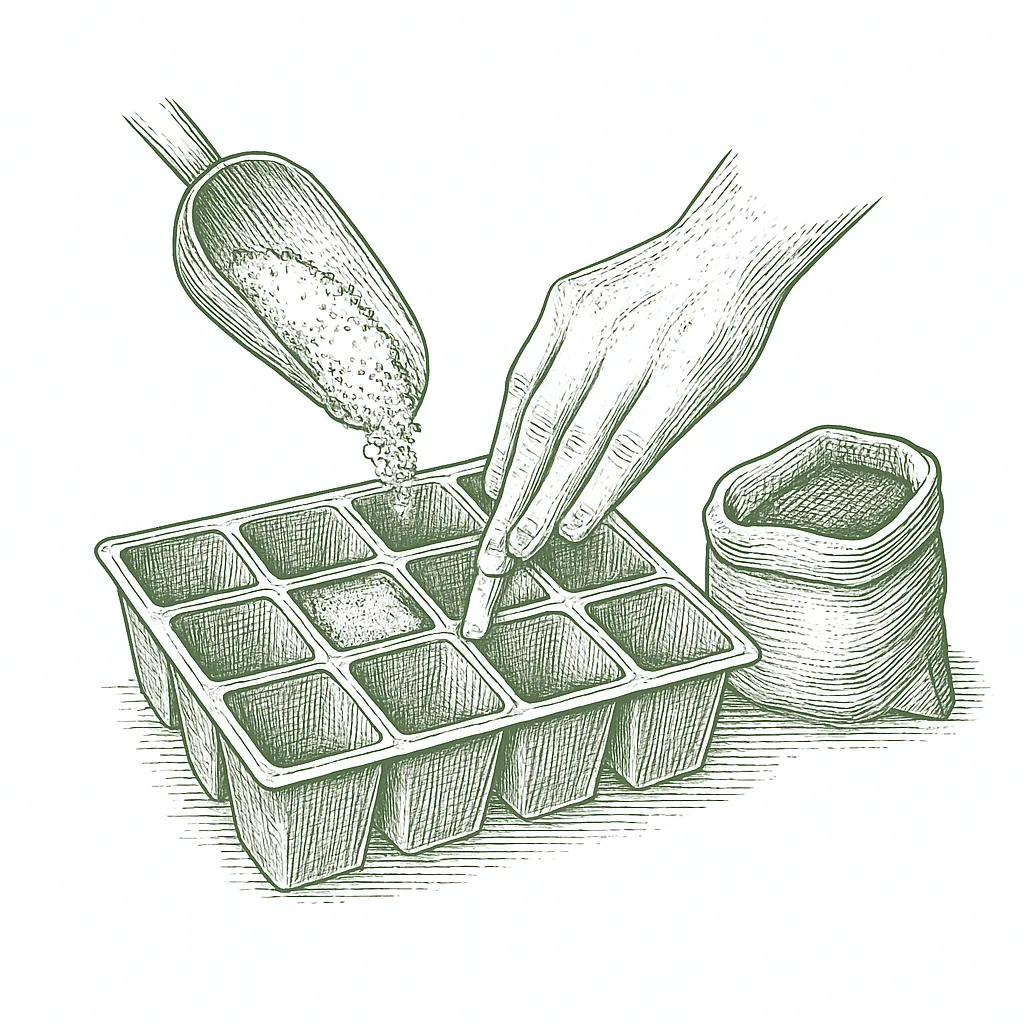
The best way to grow nasturtiums is to plant the big seeds right where they will grow, about half an inch deep, after your last frost. They do not like having their roots disturbed, so direct sowing works best. Soaking the seeds overnight helps them sprout, usually in one to two weeks. If your season is very short, you can start them indoors about a month early, but use biodegradable pots and plant the whole pot so the roots are not disturbed.Direct sowing is strongly preferred: nasturtium has a sensitive root system and resents transplanting, so sow the large seeds in place, about 1/2 in deep, after frost once soil is near 55 to 65 °F. Soaking seeds overnight speeds germination, which takes roughly 7 to 12 days. In very short-season areas you can gain a few weeks by starting indoors about 4 weeks before last frost, but only in biodegradable pots set out intact to avoid root shock.
  1. 01
    Sow indoors →
    Apr 20 - May 4
    Start about 4 weeks before your last frost
  2. 02
    Transplant out →
    Jun 4 - Jun 25
    After hardening off
  3. 03
    First harvest
    From Aug 6
    35-60 days from transplant
Start method
Both
Soil temp
55-65°F
Hardening off
7-10 days
If you started plants indoors, harden them off first: set them outside for a little longer each day over about a week before planting them out, and move them in their biodegradable pots so you do not disturb the roots.
From seed to fruit

The growing journey

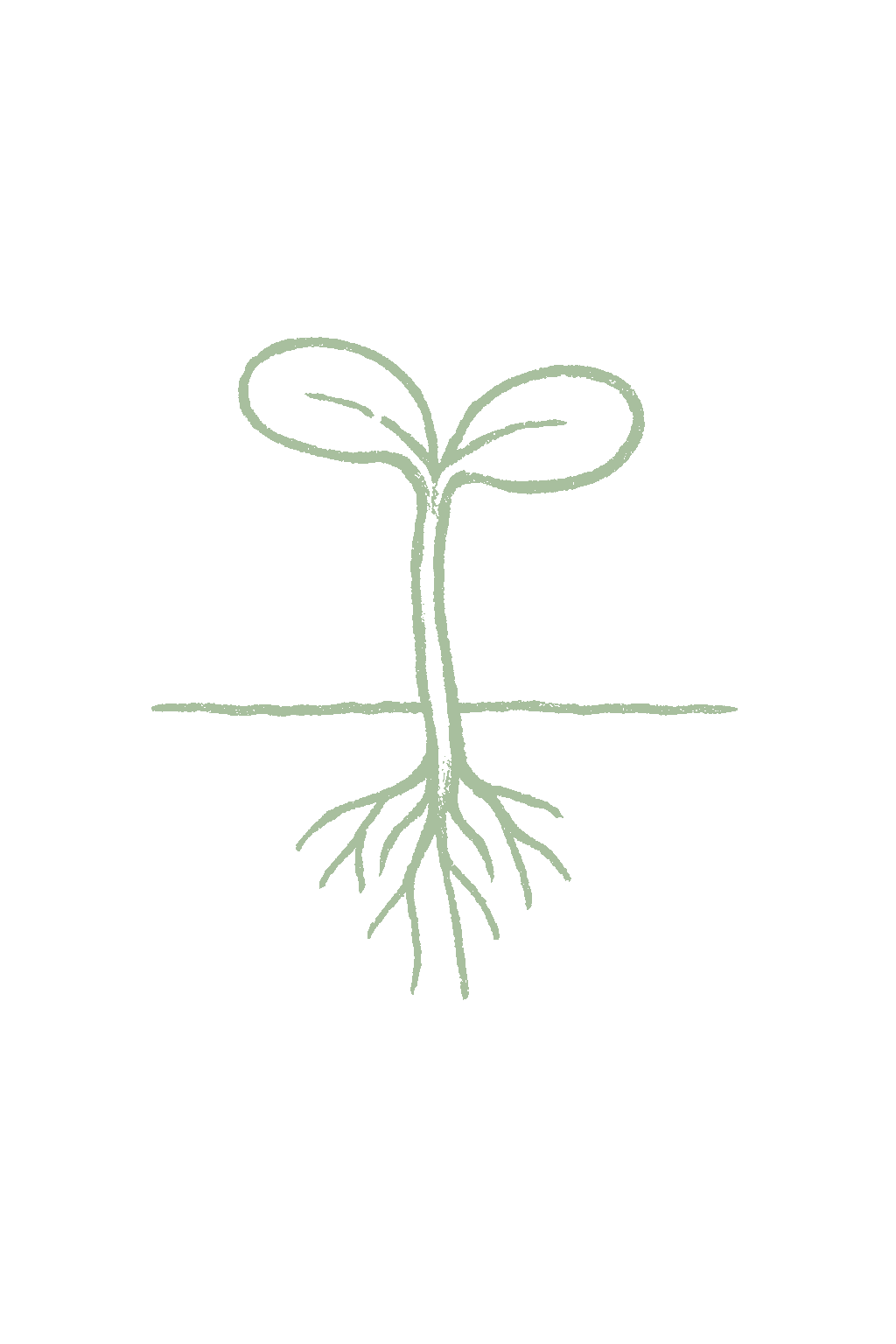
Stage 01 · Germination
01
Germination
Days 7-14 · current stage
The first leaves push up through the soil in one to two weeks.Seed leaves emerge from warm soil within roughly 7 to 12 days; soaked seed comes up faster.
Plant the soaked seeds half an inch deep right where they will grow, and keep the soil damp until they sprout.Direct-sow 1/2 in deep into soil near 55 to 65 °F; soak seed overnight first and keep soil evenly moist until emergence. Do not disturb the roots later.
FROM PLANT · Plant the seeds right where you want the plants, about half an inch deep, after your last frost. Nasturtiums do not like being moved, so do not start them in trays unless you use biodegradable pots. Soaking the seeds overnight helps them sprout.Direct-sow where plants are to grow: nasturtium resents root disturbance, so seeding in place avoids transplant shock. Sow 1/2 in deep after frost into soil near 55 to 65 °F; soaking seed overnight speeds the 7 to 12 day germination.
FROM PLANT · Plant in plain, poor soil and do not add compost or fertilizer. Rich soil makes nasturtiums grow leaves instead of flowers.Sow into lean, unenriched soil. Resist the urge to amend with compost or fertilizer at planting; rich soil sets the plant up to grow leaves instead of flowers from the start.
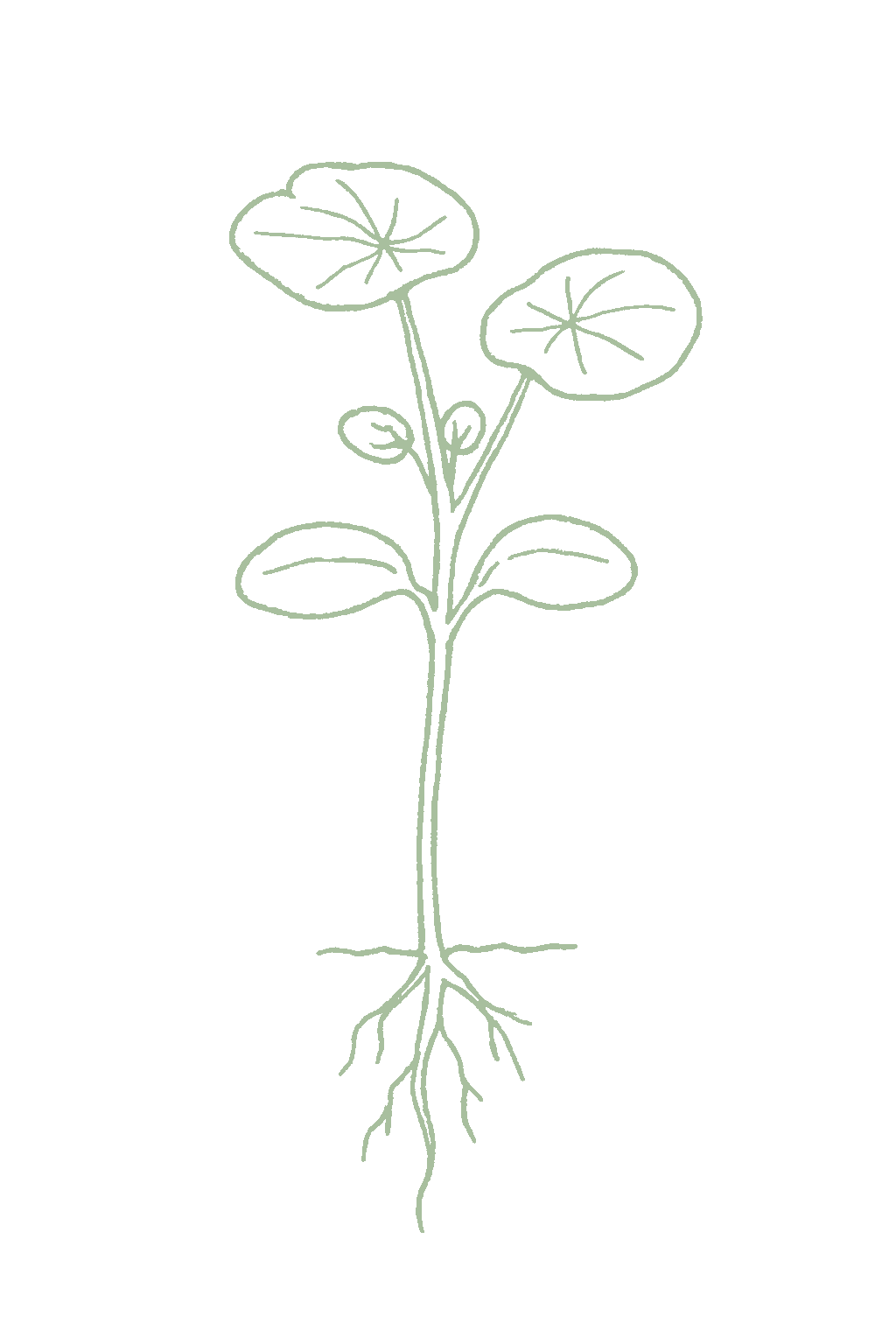
02
Seedling
Days 14-25
Round, lily-pad-like leaves appear and the little plant starts to spread.Rounded, long-stemmed true leaves develop; the young plant begins to mound or run.
Space plants about 10 to 12 inches apart and do not feed them. Watch for slugs and aphids.Thin or space to 10 to 12 in. Do NOT fertilize. Watch for slugs and for the first aphids, especially on a trap stand.
FROM PLANT · Do not feed your nasturtium seedlings. The number one reason nasturtiums make leaves but no flowers is too much food. Space them about 10 to 12 inches apart.Do not fertilize, even now. The most common cause of an all-leaves, no-flowers nasturtium is rich soil or feeding; lean conditions are what trigger bloom. Space plants 10 to 12 in for airflow and to limit slugs.
FROM PLANT · Keep an eye on young nasturtiums for slugs and snails in damp weather, and for aphids. Hand-pick slugs at night or use a pet-safe iron-phosphate bait.Watch young plants for slugs and snails in damp weather and for the first aphids; tender seedlings and a sprawling habit invite both. Hand-pick slugs at night or use iron-phosphate bait.
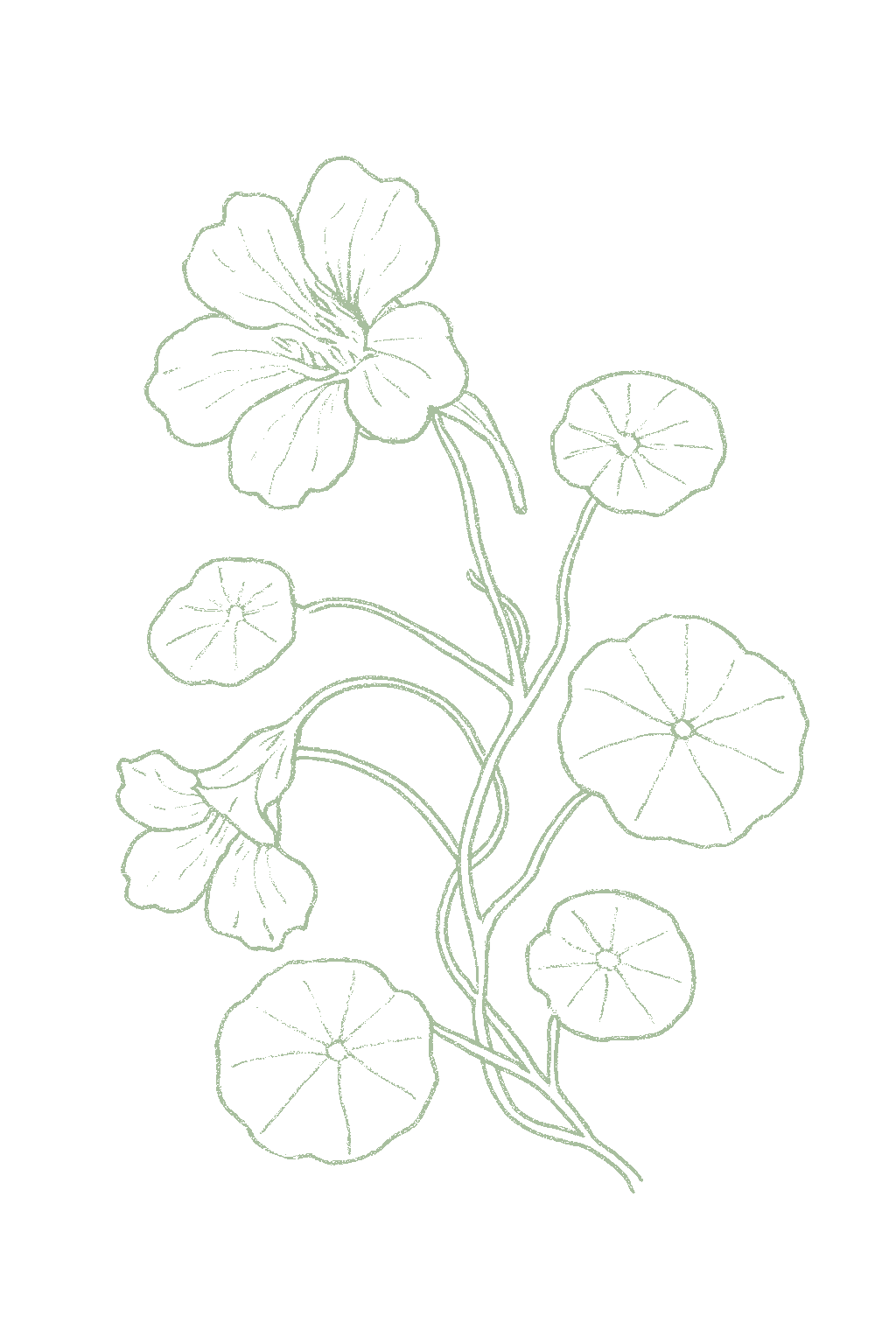
03
Established / vegetative
Days 22-38
The plant gets bigger, either mounding up or trailing out. Lots of leaves but no flowers means the soil is too rich.Plant fills in; bush types mound, trailing types extend running stems. Lush, dark, flowerless growth signals soil that is too rich.
Still do not fertilize. Guide trailing stems onto a support or let them hang, and start picking a few young leaves to eat.Keep withholding fertilizer; let lean soil drive flowering. Direct trailing stems to supports or let them spill. Begin harvesting young leaves.
FROM PLANT · Keep not feeding your nasturtiums. Lean, hungry soil is what makes them flower. If a plant is big and leafy with no flowers, the soil is too rich, so do not add anything and be patient.Keep starving them, in the good sense: withholding fertilizer and keeping soil lean is the single biggest lever for flowering. If a plant is lush, dark, and flowerless, the soil is too rich, so stop feeding and wait it out.
FROM PLANT · If you want nasturtiums to fight aphids, use them as a trap: plant a patch a few feet away from your beans, cabbage, or squash, watch it, and pull it out once it is covered in aphids. Do not plant it right next to your crops.To use nasturtium against aphids, treat it as a trap crop: grow a stand a few feet off from beans, brassicas, or cucurbits, monitor it, and pull and destroy it once aphids load up. Set too close, the trap just funnels pests onto the crop.
04
Budding
Days 30-50
Flower buds with a little tail (spur) start to form.Long-spurred flower buds form on slender stalks above or among the foliage.
Keep the soil evenly moist as buds form, and water more in hot weather to keep flowers coming.Keep moisture even at bud point; in heat, water more and consider light afternoon shade to sustain flowering.
FROM PLANT · Keep the soil evenly moist as buds form, and water more in hot weather. Nasturtiums like it cool and can stop flowering in extreme heat, so a little afternoon shade and more water help.Keep moisture even as buds form, and step watering up in heat: nasturtium is cool-preference and stalls in extreme heat, so deep watering and light afternoon shade help it keep setting flowers.
05
Flowering and harvest
Days 35-60
Flowers open about six to eight weeks after planting and keep coming, best in cooler weather.Open flowers from roughly 5 to 8 weeks after sowing, continuing through the season; bloom is heaviest in cool spring and fall and slows in peak heat.
Pick flowers and young leaves to eat, snip off faded flowers, and watch for the green seed pods to pickle.Pick flowers and young leaves regularly for the kitchen, which also keeps plants tidy and blooming; deadhead spent flowers. Watch for young green seed pods to harvest for pickling.
FROM PLANT · Pick and eat your nasturtiums: the young leaves, the flowers, and the green seed pods. Picking often keeps more flowers coming, and the youngest leaves and flowers taste the best.Harvest by eating: pick young leaves, open flowers, and tender green seed pods regularly. Frequent picking and deadheading keep the plant tidy and blooming, and the young growth is the mildest and best on the plate.
FROM PLANT · To make poor man's capers, pick the green seed pods while they are still young and soft, then pickle them in vinegar. Older pods get tough. Leave a few to dry on the plant if you want seeds for next year.For poor man's capers, harvest the immature green seed pods while still soft, ideally in trios behind spent flowers, and pickle them in spiced vinegar; older pods toughen and dry. Leave a few pods to dry on the plant if you want to save seed.
06
Seed saving and pods (optional)
Days 55-90
Round green seed pods form where flowers were. Left alone they dry out and fall, and you can save them to plant next year.Green seed pods follow the flowers; left on the plant they ripen, dry to tan, and drop. Most older types come true from saved seed.
Pick young green pods to pickle as capers, or let a few dry on the plant to save the big seeds for next year.Harvest young green pods for pickling, or leave some to dry on the plant and collect the large seeds; expect open-pollinated types to come true, hybrids less so.
FROM PLANT · To save seeds, leave some pods on the plant until they dry and turn tan, then collect the big seeds. Heirloom types grow true to the parent; hybrids may not. In mild areas, nasturtiums often reseed themselves.To save seed, leave some pods on the plant to ripen and dry to tan, then collect the large seeds; open-pollinated and heirloom types come true, while hybrids may not. Nasturtium often self-sows where winters are mild.
Beginner
Know your soil

Your soil

Identify yours

Not sure what soil you have? Grab a small handful of damp soil from your garden bed and squeeze it. If it crumbles apart easily, it's sandy. If it holds together but breaks when you poke it, it's loam (what most vegetables want). If it stays in a hard, slippery ball, it's clay.

What this crop wants

Nasturtiums are happiest in poor, lean, well-drained soil. This is the opposite of most flowers: rich, fertile soil or added fertilizer makes them grow lots of leaves and very few flowers. Ordinary or even sandy, sandy-loam soil that drains well is ideal, and you do not need to add compost or feed. Just make sure water drains away and does not pool, since soggy soil rots the roots.

If your soil doesn't match

You have sandy soil

Mix 2-3 inches of compost into the top 6 inches of your bed before planting. Compost holds moisture (which sandy soil drains too fast) and adds the nutrients sandy soil tends to lack. Repeat each season. Compost breaks down over time.

You have clay soil

Mix 2-3 inches of compost AND a few inches of coarse sand or perlite into the top 6 inches of your bed. The compost feeds the plants; the sand breaks up the clay so air and water can move through. Don't add sand without compost. It can compact like concrete.

Containers and raised beds

If amending your soil sounds like too much work, or if your soil is heavy clay, full of rocks, or contaminated, build over it. A raised bed at least 12 inches deep filled with a 50/50 mix of compost and sandy loam gives you ideal growing soil with no battles. A 5-gallon container with quality potting mix does the same for one plant at a time. Both bypass your native soil entirely.

Learn more about your soil
The specs

Care guide

The numbers that matter, at a glance.

Sunlight
Full sun to partial shade · 4-8 hrs/day
Water
moderate
Spacing
10-12 inches
Soil
sandy loam, loam
Days to maturity
35-60 days from transplant
Soil pH
6 to 7.5
Container OK?
Yes · 1+ gal pot
Germination temp
55-65°F
Soil chemistry

Soil pH for nasturtium

Preferred
6 to 7.5
Tolerated
5.5 to 7.8

Nasturtiums are not picky about soil pH (how acidic or alkaline the soil is). A normal garden range, roughly 6.0 to 7.5, is fine, and they tolerate a bit outside it. You usually do not need to change anything.Nasturtium performs across a broad pH band and is essentially unfussy; roughly 6.0 to 7.5 is ideal, and it tolerates mildly acidic to mildly alkaline soil. No pH adjustment is typically warranted. Soil fertility and drainage matter far more to flowering than pH does.

Verified · 2 sources View
Steady hand on the hose

Watering

When & how much
Frequency
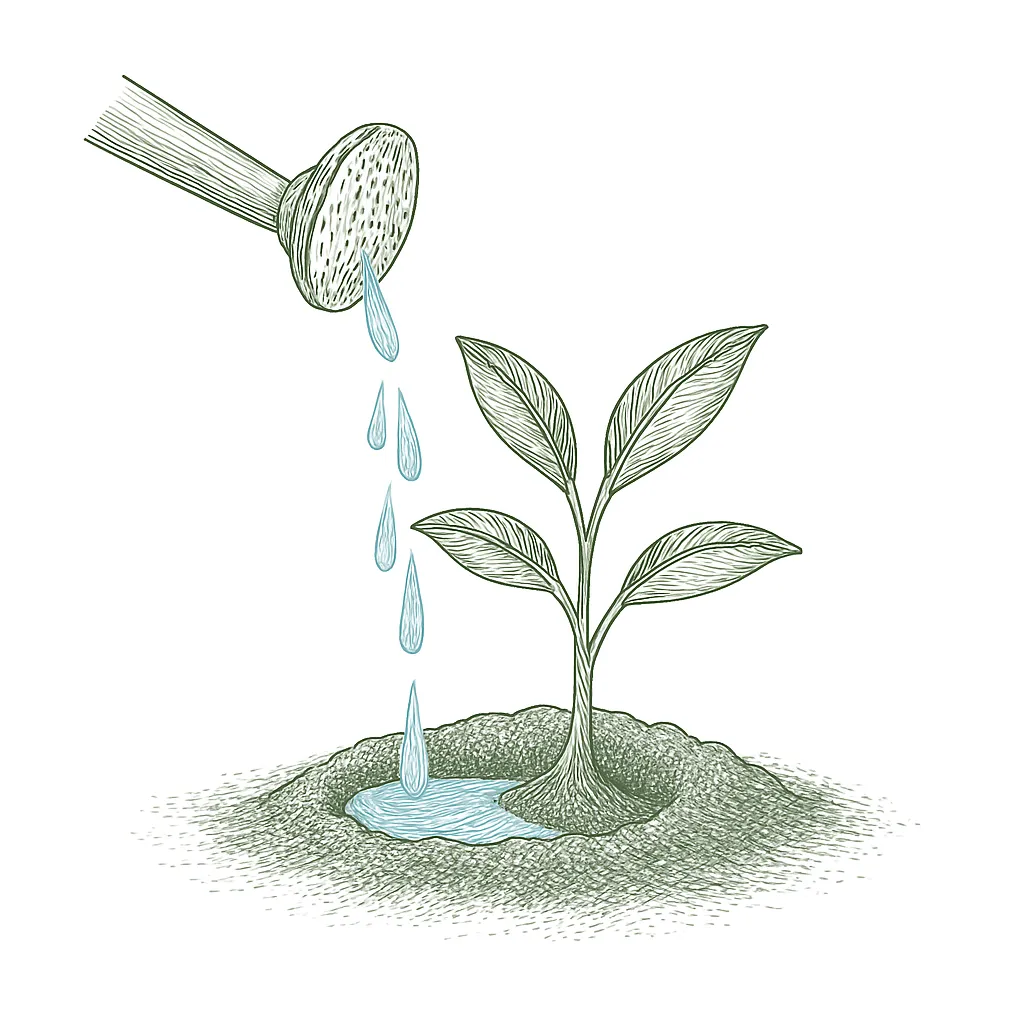
Keep the soil damp while seeds sprout and plants get going. After that, water when the top inch of soil is dry. Grown nasturtiums handle short dry spells, but they flower and taste better with steady moisture, especially in hot weather.Keep soil evenly moist through germination and establishment, then water moderately; established nasturtiums tolerate some drought and even neglect, but bloom and leaf quality suffer if they dry out badly. In heat, watering becomes more important, not less, and keeps plants flowering longer.
Amount
About one inch of water a week, counting rain. Water deeply rather than a little every day, and let the top of the soil dry a bit between waterings. Water more in hot, dry weather to keep flowers and leaves coming.Roughly one inch of water per week from rain plus irrigation during active growth, applied deeply; let the surface dry slightly between waterings. Raise frequency during hot, dry spells, when consistent moisture sustains bloom and keeps the edible parts tender rather than bitter.
Method
Water the soil around the plant, not the leaves. A watering can or soaker hose at the base works best. If the leaves get wet, water in the morning so they dry by midday.Water at the base with a can, drip, or soaker hose and keep water off the foliage where practical; the dense trailing mat of a vigorous plant stays wet and invites slugs and leaf problems. Morning watering lets any wet foliage dry quickly.
Signs of trouble
Too much water
If lower leaves turn yellow, the plant wilts even though the soil is wet, or the base looks soft and mushy, you are overwatering or the soil drains poorly. A big leafy plant with no flowers usually means the soil is too rich, not too wet.Yellowing lower leaves, wilting despite wet soil, and soft, rotting stems signal overwatering or poor drainage; nasturtium rots readily in saturated soil. Lush, dark, flowerless foliage usually points to over-rich soil rather than water.
Too little water
Nasturtiums that are too dry wilt in the afternoon, look dull, and make fewer, smaller flowers, and the leaves can taste sharp and tough. A good deep watering usually perks them up.Wilting in the heat of the day, dulling leaf color, and smaller, sparser flowers indicate underwatering; bitter, tough leaves and a flowering pause in heat are also relieved by deeper, more frequent watering.
Feeding rhythm

Feeding

Frequency
rarely
Type
None to low-nitrogen
When to start
Generally not needed

Do not fertilize nasturtiums. They flower best in poor soil, and feeding them, especially with nitrogen, gives you a big leafy plant with few flowers. Only if your soil is very poor and sandy might one light feeding help. In normal garden soil, give them nothing.Nasturtium is the rare flower that should not be fed: it blooms best in lean soil, and added nitrogen or fertilizer drives leafy growth at the expense of flowers. On genuinely poor or sandy soil, at most one light, low-nitrogen feeding can help, but in average soil skip fertilizer entirely. Over-feeding is the most common reason a healthy-looking nasturtium refuses to bloom.

Low nitrogen, lean soil

The three numbers on fertilizer (N-P-K) are nitrogen, phosphorus, and potassium. For nasturtiums the best choice is usually none at all. A high first number (nitrogen) is the worst thing for them, giving leaves instead of flowers.Nasturtium generally wants no supplemental feeding; if soil is genuinely impoverished, a single light, low-nitrogen application is the most it needs. High-nitrogen feeds favor foliage over bloom.

Flower care

Deadheading nasturtium

Flower form
single to double, long-spurred, funnel-shaped

For nasturtiums, deadheading and harvesting are the same thing: keep picking the flowers and young leaves to eat, and snip off faded flowers, and the plant keeps making more instead of going to seed. If trailing stems get long and tired, cut them back to spark fresh growth. Leave a few pods to ripen only if you want to save seeds, but pick them young and green if you want capers.Deadheading overlaps with harvest for nasturtium: picking flowers and young leaves for the kitchen, and snipping spent blooms, keeps the plant tidy, redirects energy from seed set into new flowers and growth, and sustains bloom through the season. Shear back leggy, tired trailing stems midseason to force fresh growth. Leave a few seed pods to mature only if you want to save seed or harvest them late; for capers, pick the pods young and green.

Who grows well together

Companion planting

Nasturtiums are a famous companion plant, mostly because aphids love them. The trick that actually works is to use nasturtium as a trap crop: plant a patch a few feet away from beans, cabbage-family crops, or squash, let the aphids gather on the nasturtiums instead of your vegetables, then pull and destroy the patch once it is covered in them. Plant the trap a little distance off, not right next to your crops, or the pests just hop over. Nasturtiums also bring in hoverflies and ladybugs that eat aphids. The old idea that their smell drives squash bugs and cucumber beetles away from squash and cucumbers is traditional garden lore, sometimes helpful but not proven. There is no plant you must keep nasturtiums away from, but remember that as a trap they draw pests, so site the trap stand thoughtfully. Nasturtium's companion value rests on one well-supported function and several traditional ones. The supported function is as an aphid trap crop: aphids strongly prefer nasturtium, and extension sources report it reduces pest pressure when planted near brassicas, beans, and cucurbits, so it is used as a sacrificial decoy that is monitored and destroyed once loaded. Effective use is sequential and spatial, a stand set a few feet off from the protected crop, not a casual interplant right among it, because a trap concentrates pests (and aphid-borne viruses) where it sits. Nasturtium also recruits aphid predators (hoverflies, lacewings, ladybugs) as an insectary plant. The broader reputation, that nasturtium scent repels squash bugs and cucumber beetles from cucurbits, is traditional companion lore: occasionally borne out, not reliably documented. There is no biologically antagonistic companion to avoid; the main caution is trap placement.

Other
Brassicas and cucurbits (nasturtium as an aphid trap crop)
Aphids love nasturtiums more than they love your vegetables. Plant a patch of nasturtiums a few feet away from cabbage-family crops or squash so the aphids gather there instead, then pull and destroy the patch once it is loaded. This is the nasturtium trick that research actually supports.This is nasturtium's evidence-based pest function. Aphids strongly prefer nasturtium, so a stand grown as a sacrificial trap a few feet from brassicas or cucurbits pulls aphids off the protected crop; extension sources report reduced pest pressure with this use. It is a monitored, sequential treatment: site the trap at a distance (too close and pests simply move onto the crop), scout it, and pull and destroy the planting once it is heavily infested so it does not become a pest and virus reservoir. Research-backed
Aphid predators and pollinators (insectary value)
Nasturtium flowers bring in hoverflies, ladybugs, and lacewings, whose young eat aphids, plus bees. So even beyond the trap-crop trick, a few nasturtiums help the good bugs in your garden.Beyond the trap function, nasturtium acts as an insectary plant: its open, nectar-rich flowers recruit hoverflies, lacewings, and ladybugs whose larvae prey on aphids, alongside bees. Interplanted at the garden edge, it supports the beneficial community that helps manage soft-bodied pests on neighboring crops. A habitat benefit, well-grounded but inferred rather than directly measured for nasturtium. Well-grounded
Squash and cucumbers (traditional pest deterrence)
Gardeners have long planted nasturtiums with squash and cucumbers in the hope of keeping squash bugs and cucumber beetles away. This is traditional advice and not proven, so enjoy the flowers and the beneficial bugs, but do not rely on nasturtiums as a bug repellent.A traditional cucurbit pairing whose repellent claim is not extension-verified. Nasturtium is widely interplanted with squash and cucumbers on the belief that its scent deters squash bugs and cucumber beetles; this is companion lore, occasionally reported, not documented in trials. The honest, defensible benefits in a cucurbit bed are aphid trap-cropping and beneficial-insect habitat, not repellence. Treat the deterrent reputation as a bonus, not a control method. Traditional
Provenance tagged inline · see methodology for the labeling system Key
Cutting for the vase

When to cut

Nasturtiums are ready to pick a little at a time all season. Snip young leaves and open flowers in the morning and use them the same day, and pick the green seed pods while they are still soft to pickle as capers. Keep picking and the plant keeps making more, right up to frost.Nasturtium is harvested continuously and eaten fresh. Pick young leaves and fully open flowers in the cool of the morning, using them the same day; younger growth is the mildest. Harvest the immature green seed pods while still soft to pickle as poor man's capers. Regular picking and deadheading keep plants tidy and blooming to frost.

Verified · 2 sources View
Bloom yield

What to expect

One nasturtium gives you a steady supply of peppery leaves, lots of flowers (most in cool weather), and green seed pods to pickle, all season until frost. The trailing, climbing types grow much bigger and give you more than the small bushy types.A single nasturtium yields steadily over the season: a continuous supply of edible round leaves, a long run of flowers (heaviest in cool spring and fall), and successive flushes of green seed pods for pickling. Trailing and climbing types cover far more ground and produce more total foliage and bloom than compact bush types, and also make the most generous trap-crop stands.

Nasturtiums produce the same year you plant them. You can pick leaves within a few weeks and flowers in under two months, right up until frost. There is no waiting year.Nasturtium produces fully in its single season from seed, reaching first bloom in roughly 5 to 8 weeks; there is no establishment year. A spring sowing yields leaves within weeks and flowers from early summer to frost, with cooler regions and fall enjoying the heaviest bloom.

What changes yield
Soil fertility: lean soil gives the most flowers; rich soil or fertilizer shifts the plant to abundant foliage with few blooms.Habit: trailing and climbing types yield far more total leaf, flower, and pod than compact bush types.Season and heat: bloom peaks in cool spring and fall and slows in extreme summer heat; cooler regions flower most freely.Harvest cadence: regular picking of leaves and flowers, plus deadheading, sustains tender new growth and bloom.Water: steady moisture, especially in heat, keeps leaves tender and flowers coming; drought stress turns leaves bitter and curbs bloom.
Verified · 2 sources View
Pick your variety

Recommended varieties

Pick the type for your spot. Bushy types like Jewel and Tip Top stay about a foot tall and are great in pots, beds, and edging, with flowers that sit up where you can pick them. Trailing or climbing types grow several feet and are perfect for hanging baskets, fences, and trellises, and they make the biggest patches for trapping aphids. Some types, like Alaska with its variegated leaves, look good even without flowers. Every kind is edible.Choose by habit and use. Bush or mounding types (Jewel, Tip Top, Whirlybird, Alaska) stay near a foot and suit beds, edging, containers, and the kitchen, with flowers often held up above the foliage for easy picking. Trailing and climbing types (Tall Trailing / Climbing mixes) run 6 to 10 ft and are the choice for trellises, fences, spilling baskets, and quick screening, and they make the most generous trap-crop stands. Foliage-feature types such as Alaska (variegated) and Empress of India (dark leaves) earn their place even between flushes of bloom. All parts of all types are edible.

Jewel series
bush, Tagetes... Tropaeolum majus; compact mounding ~12 in, semi-double flowers held above the leaves, classic bedding and container type
Alaska series
bush; cream-and-green variegated leaves, single flowers, very ornamental foliage
Empress of India
bush; deep blue-green leaves and rich crimson-scarlet single flowers, heirloom
Tip Top / Whirlybird
bush; upward-facing flowers on compact plants, easy for cutting and eating
Climbing or Tall Trailing mix / 'Tall Single Mixed'
trailing-climbing; vigorous 6 to 10 ft stems for trellises, fences, and hanging baskets
Phoenix or Bloody Mary
novelty bush; split, fringed petals and bicolor flowers
In the vase

Vase life

You can eat the whole nasturtium plant, and it tastes peppery like watercress. Use the leaves and flowers fresh in salads or as a garnish; younger leaves are milder. The best part to store is the green seed pod: pick it young and pickle it in vinegar to make poor man's capers, which keep for months. When eating the flowers, pull out the inner parts and the white base of the petals, which can taste bitter.The whole plant is edible with a peppery, watercress-like bite. Use leaves and flowers fresh in salads, as a garnish, or stuffed; younger leaves are milder, while stressed or older leaves and hot-weather growth turn sharper. The standout keeper is the green, immature seed pod: harvested young and pickled in spiced vinegar, it becomes poor man's capers and stores for months. Remove interior flower parts and the bitter white petal base before eating the flowers.

Verified · 2 sources View
When something goes wrong

Common problems

Big leafy plant but hardly any flowersLush, leafy plant with few or no flowers
01 of 05
What happened The soil was too rich or the plant was fed. Nasturtiums make leaves instead of flowers when they get fertilizer or grow in rich soil. Too much shade can add to it.The classic nasturtium failure: soil too rich or fertilizer applied. High fertility and nitrogen drive vegetative growth and suppress bloom; too much shade compounds it. Next season Next time, plant in poor soil, do not fertilize at all, and give full sun. If it is already too leafy, just stop feeding and wait for flowers.Grow in lean, unamended soil, withhold all fertilizer, and give full sun. If a plant is already leafy, stop feeding and wait; lean conditions eventually trigger bloom.
Plant covered in aphids
02 of 05
What happened This is normal. Aphids love nasturtiums, which is why people use them to trap aphids. It is only a problem if you wanted to eat the plant or it is right next to your vegetables.Expected: aphids strongly prefer nasturtium, which is why it works as a trap crop. A problem only if the plant is one you meant to keep or eat, or if it sits too close to a susceptible crop. Next season Use nasturtiums as a trap plant a few feet from your vegetables and pull them when covered in aphids. On a plant you want to keep, spray the aphids off with water or insecticidal soap.Use it on purpose as a trap a few feet from the protected crop and remove it when loaded; on edible or ornamental plants, hose off aphids or use insecticidal soap and rely on the predators the flowers attract.
Plant stopped flowering in the summer heatFlowering stopped and leaves turned sharp in midsummer heat
03 of 05
What happened Nasturtiums like cool weather. In a hot summer they often stop flowering for a while and the leaves get sharper-tasting. In hot places, grow them in spring and fall instead of midsummer.Nasturtium is cool-preference; sustained extreme heat slows or halts bloom and intensifies leaf pungency. In the hottest regions it is best grown as a cool-season crop in spring and fall. Next season Water more in heat and give afternoon shade. In hot areas, plant for spring and fall instead of midsummer, and the flowers usually come back when it cools.Water deeply in heat, give light afternoon shade, and in hot-summer regions time plantings for the cool shoulders; bloom usually resumes as temperatures fall.
Frost killed or damaged the plantsPlants blackened by frost
04 of 05
What happened Nasturtiums cannot handle frost. A late spring frost or the first fall frost will damage or kill them.Nasturtium is frost-tender; frost at either end of the season, planting out too early in spring or the first frost in fall, kills or damages plants. Next season Plant only after your last frost in spring, and know the first fall frost ends the season. In mild areas they often reseed themselves.Direct-sow only after all frost danger has passed, and expect plants to end with the first fall frost; let them self-sow in mild-winter areas.
Few or no seeds sproutedSeeds failed to come up
05 of 05
What happened Usually the soil was too cold or dry, the seeds were too shallow, or they were not soaked. Nasturtium seeds need to be covered (they sprout in the dark) and like a soak first.Usually cold or dry soil, sowing too shallow (nasturtium needs darkness to germinate), or unsoaked hard seed; germination is slow and erratic below about 55 °F. Next season Soak the seeds overnight, plant them half an inch deep in warm, damp soil after frost, and keep the soil moist until they come up.Soak seed overnight, sow 1/2 in deep into warm (55 to 65 °F), evenly moist soil after frost, and keep it from drying during emergence.
Verified · 5 sources View
The usual suspects

Pests & diseases

Pests
Aphids
P · 01
Cabbage white caterpillars (imported cabbageworm)
P · 02
Flea beetles
P · 03
Slugs and snails
P · 04
Whiteflies and spider mites
P · 05
Diseases
Mosaic and aphid-borne viruses
D · 01
Bacterial wilt
D · 02
Aster yellows
D · 03
Seasoned
Where to plant next year

Crop rotation

You do not need to worry much about rotating nasturtiums, since they are in their own plant family and can follow almost anything. Just remember they pull in aphids on purpose when used as a trap, so clear away a heavily bug-covered patch at the end of the season.Rotation is low-stakes for a fast annual in its own botanical family; nasturtium can follow almost any crop and is a useful filler and edge plant. Used deliberately, it doubles as a trap crop, so plan its placement around the aphid-magnet role rather than around disease carryover, and remove spent infested stands promptly.

Family
Tropaeolaceae
Years between
1 years
in the same bed
Avoid following
Nasturtiums are in their own plant family, not related to the usual vegetables, so you can plant them almost anywhere and they will not pass on vegetable diseases. The one thing to watch is that, because they attract aphids, a heavily infested trap patch should be cleared away at the end of the season rather than left to spread aphids or virus.Nasturtium is in its own family (Tropaeolaceae), unrelated to the common vegetable families, so it fits almost anywhere in a rotation and shares few soilborne problems with vegetables. The main caution is the inverse of a benefit: because it concentrates aphids and aphid-borne viruses, do not site a trap stand where it will seed a virus problem into a susceptible following crop, and clear heavily infested plantings at season end.
Plant after
legumesleafy greensalliums
Verified · 2 sources View
In the app · pre-launch

When plant taps you on the shoulder

The plant app sends a timely reminder at every critical moment of your nasturtium season. The wording adjusts to whichever you pick: beginner or seasoned. Here are three you'll see in Zone 3.

p
plant
Last frost arrives
Time to plant nasturtiums
Your last frost has passed, so you can plant nasturtium seeds outside, about half an inch deep, right where they will grow. Soak them overnight first and do not add fertilizer.
p
plant
Established arrives
Remember: do not feed them
Now that your plants are growing, remember not to fertilize them. Feeding gives you leaves instead of flowers. A big leafy plant with no flowers means the soil is too rich.
p
plant
Flowering arrives
Time to pick and eat
Your flowers are opening. Start picking the peppery leaves and flowers to eat, and watch for green seed pods to pickle as capers.
Get personalized alerts.

plant sends the right notification at exactly the right moment, for your zone, your weather, your crops. Founding members lock the rate forever.

Back the Kickstarter →
Ask the gardener

Common questions

Got a question we missed?

We're building this guide with real growers. Got a question we missed? Ask here. We read every one and add the best answers right to this page.

Grown this before?

Share a tip

Learned something the hard way? Pass it on. Real growers' tips make this guide better for the next person, and we credit you by name when yours goes live.

Seasoned
Spot something wrong?

Report a problem

If you've grown this crop and you see a date, a temperature, a companion claim, or a recommendation that doesn't match your experience, tell us. Real growers' corrections make this guide better for the next person.

How we built this guide

Methodology & sources

Every date, temperature, spacing, and recommendation on this page is sourced from university cooperative extension publications, peer-reviewed agricultural research, NOAA climate data, and direct extension calendars. Where claims are softer (traditional gardening wisdom not formally documented), we say so.

Research-backed Documented in cooperative extension publications or peer-reviewed research
Well-grounded A known agronomic principle, but not formally tested for this specific pair
Traditional Time-tested gardening wisdom, limited formal research support
Last reviewed
June 29, 2026
Data version
crops_data_final · v1.0 · schema 2.9
Sources cited on this page
16 publications
Verified entries
Companion-planting claims tagged inline · zone dates verified against 5+ extensions
See all sources cited on this page
  • University of Minnesota Extension umn_ext
  • University of Maryland Extension umd_ext
  • Cornell Cooperative Extension cornell_ext
  • Iowa State University Extension iastate_ext
  • Michigan State University Extension msu_ext
  • NC State Extension ncsu_ext
  • Penn State Extension psu_ext
  • U. of Illinois Urbana-Champaign Extension uiuc_ext
  • UC Davis Postharvest Center ucd_postharvest
  • Texas A&M AgriLife Extension tamu_agrilife
  • Virginia Cooperative Extension 426-331 vce_426_331
  • Piedmont Master Gardeners piedmont_mg
  • UGA Vegetable Garden Calendar uga_calendar
  • Clemson Home & Garden Information Center clemson_hgic
  • UC IPM Statewide IPM Program uc_ipm
  • NOAA 1991-2020 Climate Normals noaa_normals

Growing notes, weekly.

Zone-aware seasonal nudges, what's worth planting now, and the occasional recipe from the harvest. No spam, ever.

Vol. 003 · Nasturtium · plant.lifestyle