Pick your zone and the dates re-calibrate.
The Guide Fruit trees Vol. 004

Persimmon

in Zone 7, this week

A persimmon is a good-looking fruit tree that drops its leaves each winter and gives you one of the easiest crops you can grow, with brilliant fall color and bright orange fruit that hangs on after the leaves fall. There are two main kinds. The Asian persimmon (Diospyros kaki) is the popular one for backyards: it fruits on its own, needs little winter cold, and handles down to about zone 7, with firm types eaten crisp like an apple (Fuyu) and soft types ripened until sweet and jelly-like (Hachiya). The American persimmon (Diospyros virginiana) is much hardier, down to about zone 4, but usually needs separate male and female trees, unless you plant a self-fruitful kind like Meader. Persimmon blooms late, in May or June, so it usually escapes the spring frosts that hurt earlier fruit trees, and it hardly ever has pest or disease trouble. It just needs full sun, well-drained soil, a little pruning, and a few years of patience. Persimmon (Diospyros) is a handsome, low-maintenance deciduous fruit tree that yields some of the easiest home fruit there is, plus fiery orange-to-scarlet fall color and bright fruit that clings decoratively after the leaves drop. It comes in two very different forms. The Asian or Oriental persimmon (D. kaki) is the dooryard favorite: self-fruitful, low-chill, hardy to about USDA zone 7, with large fruit in non-astringent types eaten crisp like an apple (Fuyu) or astringent types ripened to a sweet, jelly-soft pulp (Hachiya). The American persimmon (D. virginiana) is far more cold-hardy, to roughly zone 4, but is usually dioecious, so a female needs a male tree nearby unless you plant a self-fruitful selection like Meader. Persimmon blooms late, in May or June, so it largely dodges the spring frosts that plague earlier fruit, and it is famously untroubled by pests and diseases. It asks little: full sun, well-drained soil, light pruning, and patience for the first three to five years.

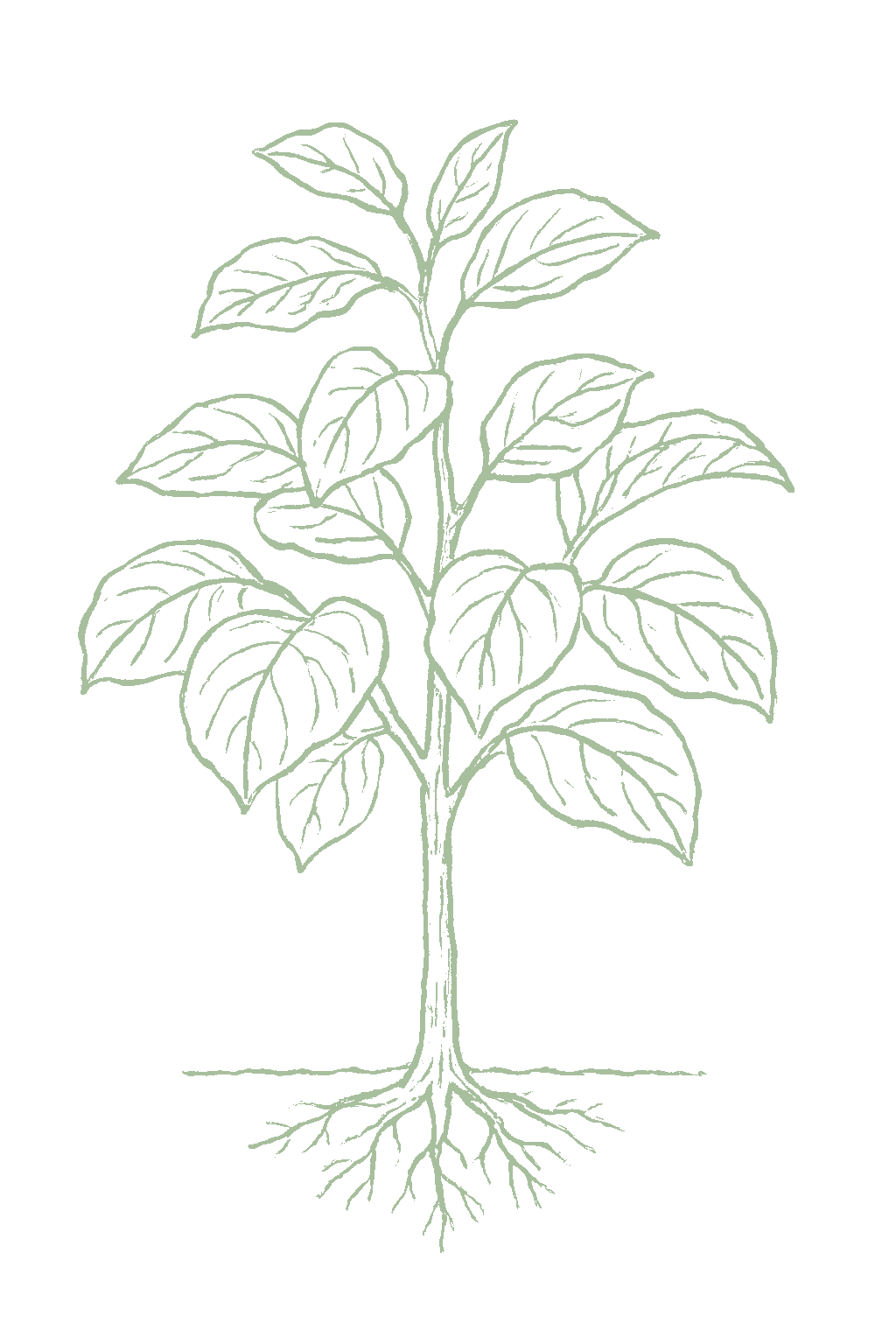
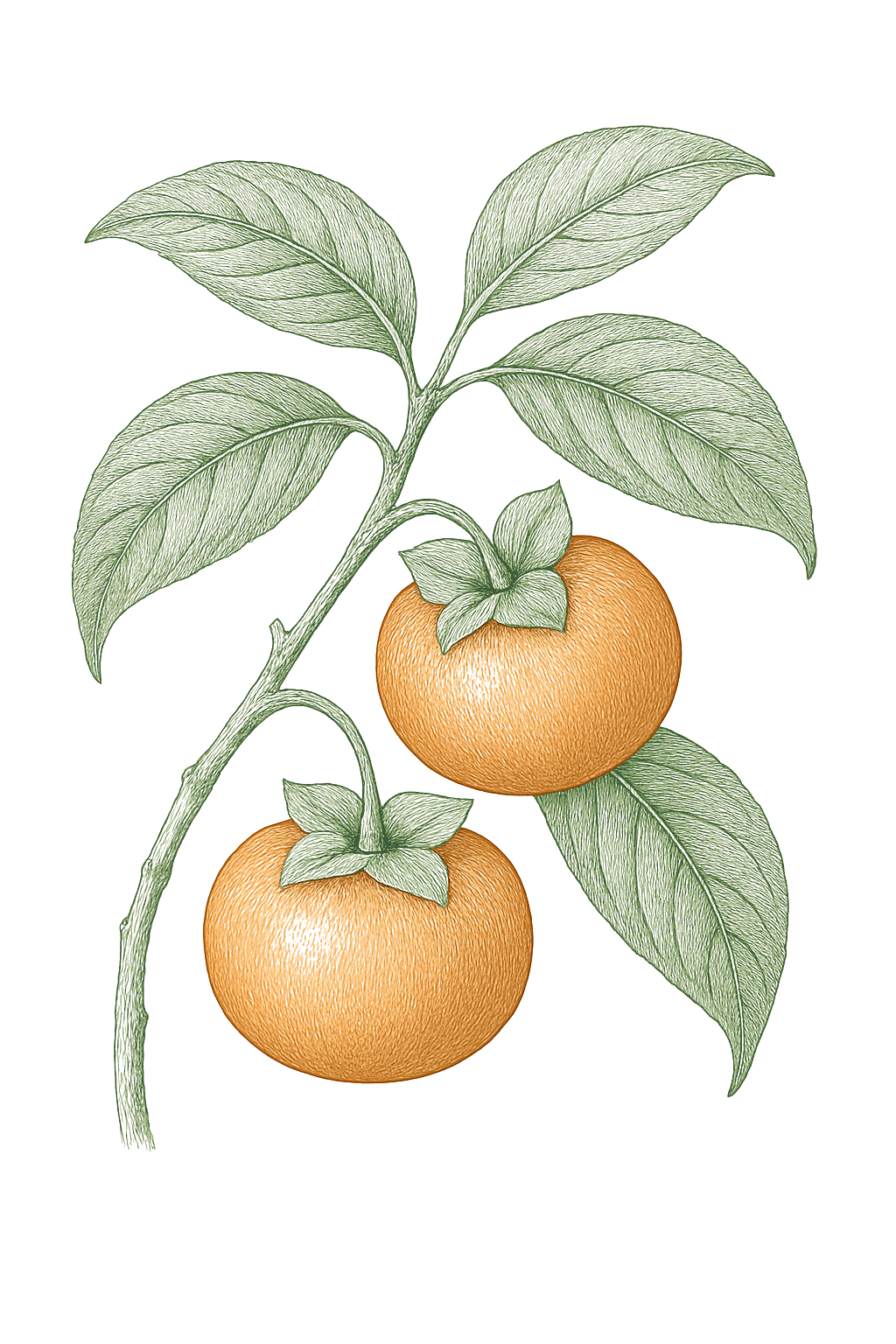
Persimmon mature plant
Fig. 01 · Persimmon, mature Zone 7
First fruit
3-5 yrs
to first harvest
Sunlight
Full sun
6-8 hrs daily
Water
Moderate
Spacing
15-20 ft
between trees
Soil pH
6-6.5
slightly acidic
Hardiness & fruiting range

Will it actually fruit here?

Hardiness tells you the tree will survive your winters. It does not tell you whether you will get fruit. Each zone carries its own verdict. Yours is marked.

3
survives,
rarely fruits
4
survives,
rarely fruits
5
reliable
6
reliable
Your zone
7
reliable
8
reliable
9
reliable
10
reliable
11
survives,
low chill
Fruits reliably
Fruits reliably Survives only Too warm
← colder winterswarmer, less chill →
Zone 7: The overlap zone where both types work: American persimmon thrives, and cold-hardy Asian kinds like Fuyu and Great Wall fruit reliably, especially on native roots. A long fall ripens even late fruit.The transition zone where both types succeed: American persimmon thrives, and cold-hardy Asian cultivars (Fuyu, Great Wall, Saijo), especially on native rootstock, fruit reliably. A long fall carries late-ripening fruit to full color.
The growing year

Your persimmon year, month by month

Northern Tier, Zone 7. Winters bank about 700 to 1200 chill hours; these varieties need about 100 to 700 chill hours. The overlap zone where both types work: American persimmon thrives, and cold-hardy Asian kinds like Fuyu and Great Wall fruit reliably, especially on native roots. A long fall ripens even late fruit.The transition zone where both types succeed: American persimmon thrives, and cold-hardy Asian cultivars (Fuyu, Great Wall, Saijo), especially on native rootstock, fruit reliably. A long fall carries late-ripening fruit to full color.

A fruit tree runs on the same rhythm every year: rest, prune, bloom, grow, harvest, then settle in again.

Jan
Feb
Mar
Apr
May
Jun
Jul
Aug
Sep
Oct
Nov
Dec
▲ We are here
Tree’s year
rest
prune
bloom
growing
harvest
care
Plant new tree
plant
plant
Dormant rest Prune Bloom Growing fruit Harvest Post-harvest care
Plant bare-root
Feb - Mar
Bloom
May 1 - May 20
Harvest
Oct 1 - Nov 15
Chill hours

Will your winter be cold enough?

Persimmon needs only a little winter cold (called chill hours) to bloom properly, which is why it grows in mild-winter places where peaches struggle. Asian persimmon needs only about 100 to 200 hours of cold below 45°F, and some kinds less. That low need, plus its late bloom, makes persimmon one of the most adaptable fruit trees. Only the warmest, nearly frost-free tropics (south Florida, lowland Hawaii) are too warm for the usual varieties to fruit.Persimmon has a low chilling requirement, which is a big reason it succeeds across mild-winter regions where high-chill stone fruit fails. Asian persimmon needs only about 100 to 200 hours below 45°F, and some cultivars less; American persimmon needs somewhat more but is still modest. This low chill, combined with late bloom, makes persimmon one of the most broadly adaptable temperate-to-subtropical fruits. Only the near-chill-free deep tropics (south Florida, lowland Hawaii) fall short for standard cultivars.

Your winter ~700 – 1200 hrs
0 250 500 750 1000
Dependable here
Fuyu (Jiro)200Izu100Hachiya200Great Wall200Meader400Prok400
!Borderline in a warm winter
None. Every variety in this roster gets enough chill here.
Bloom timing & cross-pollination

One tree is usually enough

Most persimmons are self-fruitful: a single tree sets a full crop with its own pollen, so you don’t need a second variety to get fruit. Bees still move the pollen from blossom to blossom, so strong pollinator activity through bloom is what drives a heavy set.

Bar length shows how long each variety blooms, roughly 8 to 14 days. Bars that overlap bloom at the same time.

▲ Tap a variety to see its bloom timing

Very early Early Mid Late Very late
The pollination rule

Pollination is the biggest difference between the two persimmon types, and it decides whether you need one tree or two. Asian persimmon (Diospyros kaki), including Fuyu and Hachiya, fruits on its own: a single tree makes a full crop by itself, and the main kinds make seedless fruit with no pollen at all. American persimmon (Diospyros virginiana) is the opposite: it usually has separate male and female trees, so a female needs a male American persimmon nearby to fruit. The exceptions are self-fruitful American kinds like Meader, which make seedless fruit with no male. The two species do not pollinate each other. For most gardeners the easy choice is one self-fruitful Asian tree; go with American (a female plus a male, or a self-fruitful kind like Meader) where winters are too cold for the Asian type.Pollination is the headline difference between the two persimmon types, and it decides whether you need one tree or two. Asian persimmon (D. kaki), including non-astringent Fuyu and astringent Hachiya, is self-fruitful: a single tree sets a full crop alone, and its main cultivars are parthenocarpic, forming seedless fruit with no pollen at all. American persimmon (D. virginiana) is the opposite: it is typically dioecious, carrying male and female flowers on separate trees, so a female needs a male American persimmon within roughly 50 to 200 feet to fruit. The exceptions are self-fruitful American cultivars such as Meader, bred to set seedless fruit with no male present. The two species do not cross-pollinate each other, and even among self-fruitful types, planting a pollinizer often gives heavier, seedier crops. For most home gardeners the simple path is one self-fruitful Asian tree; choose the American route (a hardy female plus a male, or a self-fruitful selection like Meader) where winters are too cold for Asian persimmon.

Pick your variety

Recommended varieties

Pick first by type and your climate. In zone 7 and warmer, an Asian persimmon is usually best: a self-fruitful, non-astringent Fuyu to eat crisp, or an astringent Hachiya to eat soft. In colder areas (zones 4 to 6), choose an American persimmon: a self-fruitful Meader for a single tree, or a hardy kind like Prok with a male tree nearby. Persimmon needs little winter cold, so most types suit most winters. Buy a named, grafted tree rather than a seedling so you know the fruit and, for American types, the sex.Choose first by type and climate. In zones 7 and warmer, an Asian persimmon (D. kaki) is the usual pick: a self-fruitful, non-astringent Fuyu for firm crisp eating, or an astringent Hachiya for soft-ripe fruit and baking. In colder zones (4 to 6), choose an American persimmon (D. virginiana): a self-fruitful Meader for a single tree, or a hardy female such as Prok with a male pollinizer. Match the cultivar's modest chill requirement to your winters, and favor named grafted cultivars over seedlings for known fruit quality and sex.

Fuyu (Jiro)
fresh eating (firm)
Izu
fresh eating (firm)
Hachiya
fresh eating (soft-ripe), baking, drying
Great Wall
fresh eating (soft-ripe), drying
Meader
fresh eating (soft-ripe)
Prok
fresh eating (soft-ripe)
Rootstock & size

How big will it get?

Asian persimmon is commonly grafted onto native D. virginiana for cold and wet-soil tolerance; choose rootstock for your soil and climate, not for tree size.

Recommended
Diospyros virginiana (American persimmon) standard
Mature height
20–30 ft
Bears
year 3–5
Container
in-ground
Diospyros lotus (date-plum) standard
Mature height
20–30 ft
Bears
year 3–5
Container
in-ground
Diospyros kaki (seedling) standard
Mature height
20–30 ft
Bears
year 3–5
Container
in-ground
Ask the nursery

Ask for your Asian variety grafted on native D. virginiana for cold-hardiness and wet-soil tolerance.

From seed to fruit

The growing journey

Stage 01 · Planting (bare-root or grafted, dormant)
01
Planting (bare-root or grafted, dormant)
A leafless young tree with firm buds and healthy roots. On a grafted tree, find the graft joint low on the trunk and keep it above the soil when you plant.A dormant tree with firm buds and healthy roots; on a grafted tree, the graft union (the swollen joint where the fruiting variety meets the rootstock) should sit above the final soil line.
Handle the roots gently, since persimmon does not like being disturbed. Dig a wide hole, set the tree at the depth it grew before with the graft joint above the soil, fill with the soil you dug out, and water well. No fertilizer in the hole. On heavy soil, plant on a mound.Handle the taproot gently (persimmon resents root disturbance), dig a hole wide enough to spread the roots, set the tree at nursery depth with the graft union above grade, backfill with native soil, and water in well. Do not fertilize in the hole. On heavy soil, plant on a raised mound.
FROM PLANT · Handle the roots gently and plant right away. Persimmon does not like having its roots disturbed, so getting it in the ground quickly helps it settle.Handle the taproot gently and plant promptly: persimmon resents root disturbance, so a bare-root tree established quickly outperforms one left to dry or sit.
FROM PLANT · Plant where the tree gets full sun and the soil drains well, or on a raised mound. Persimmon roots rot in soggy soil, especially the Asian kinds.Plant in full sun on a well-drained site or a raised mound; persimmon, especially Asian types, is prone to root and crown rot on wet ground.
02
Year-one establishment
Healthy new shoots and a tree settling in. Persimmon takes its time. Do not expect fruit yet, and pick off any that forms so the tree builds roots and branches.Steady new shoot growth and a strengthening root system. Persimmon establishes slowly; do not expect fruit, and remove any that sets so energy goes to roots and framework.
Water deeply and often this first season, keep a mulched, weed-free circle around the trunk with the mulch off the bark, and keep mowers and trimmers away from the trunk so borers have no wounds to enter.Water deeply and regularly through the first season (persimmon's most water-sensitive period), keep a weed-free mulched circle around the trunk without piling mulch on the bark, and protect the trunk from string-trimmer wounds that invite borers.
FROM PLANT · Water deeply and often the first couple of years, but let the soil dry a bit between waterings. Persimmon needs steady water to establish but rots in soggy soil.The first two seasons are the most water-sensitive; water deeply and regularly, but let the soil dry between soaks, since persimmon hates waterlogging.
FROM PLANT · Keep mowers and trimmers away from the bottom of the trunk. The wounds they leave let in borers, the one persimmon pest that can kill a young tree.Keep mowers and string trimmers off the trunk base: the wounds they leave are the entry point for persimmon borer, the one pest that can kill a young tree.
03
Training (years one to three)
Persimmon is usually trained to a modified central-leader or open, vase-like shape with evenly spaced main branches. The wood is a bit brittle, so building strong branches early matters once the tree carries heavy fruit.Persimmon is commonly trained to a modified central leader or open-center framework with well-spaced scaffolds. Its wood is somewhat brittle, so building a strong branch structure early pays off when heavy fruit loads arrive.
Each winter, prune lightly to keep a few well-spaced main branches and remove ones that cross or are weak. Persimmon needs much less pruning than peaches; you are just building a strong, open shape.Prune lightly in dormancy to select well-spaced scaffolds and remove crossing or weak wood. Persimmon needs far less pruning than stone fruit; the goal is a sound framework and good light penetration, not heavy annual renewal.
FROM PLANT · Build strong branches early. Persimmon wood is a bit brittle and heavy fruit can snap weak limbs, so keep the main branches well spaced and spread out.Build a strong framework early: persimmon wood is brittle and heavy fruit loads can break poorly structured limbs, so favor well-spaced, wide-angled scaffolds.
04
Winter dormancy
A bare, resting tree, often still holding bright orange fruit after the leaves have fallen, which looks striking. Persimmon needs only a little winter cold (about 100 to 200 hours for Asian types) to wake up properly in spring.A leafless tree at rest, often still holding bright orange fruit that clings decoratively after the leaves drop. Persimmon needs only a modest amount of winter chill (roughly 100 to 200 hours for Asian types) to break dormancy evenly.
Not much to do beyond cleanup: clear fallen and dried-up fruit and cut out any dead branches while you can see the shape. An established tree needs very little water now.Little is required beyond winter sanitation: clear fallen and mummified fruit and prune out any dead or cankered wood while the structure is visible. Established trees need minimal water now.
FROM PLANT · Persimmon needs only a little winter cold (about 100 to 200 hours for Asian types), so it fruits in mild-winter areas where peaches struggle.Persimmon needs only modest winter chill (roughly 100 to 200 hours for Asian types), so it fruits across mild-winter zones where high-chill stone fruit fails.
FROM PLANT · Clear away fallen and dried-up fruit during winter. It carries anthracnose disease into the next year.Clear fallen and mummified fruit over winter; it is the main overwintering source of anthracnose for the coming season.
05
Dormant pruning
Bare branches, so you can see the whole shape. Persimmon fruits on new shoots and its wood breaks easily, so you only need light pruning to keep the shape and open the middle, not the hard cutting peaches get.Bare branches that show the framework clearly. Persimmon fruits on new growth from the previous season's wood, and its wood is brittle, so the aim is light structural pruning and thinning, not the hard renewal cuts stone fruit needs.
Prune lightly in late winter: take out dead, crossing, and weak branches, thin to let light in, and shorten any long, heavy limbs so they do not snap under fruit. Make clean cuts so borers and disease have fewer wounds to enter.Prune lightly in late dormancy: remove dead, crossing, and weak wood, thin to let light in, and shorten overly long or heavy limbs to reduce breakage under a fruit load. Make clean cuts to limit the wounds that draw borers and canker.
FROM PLANT · Prune persimmon much more lightly than peaches: take out dead and crossing branches and thin to let light in, but skip the heavy cutting stone fruit gets.Prune persimmon far more lightly than stone fruit: remove dead and crossing wood and thin for light, but avoid the hard renewal cuts peaches need.
FROM PLANT · Shorten any long, heavy branches so they do not break under the fruit, and make clean cuts so borers and disease have fewer wounds to get in.Shorten long, heavy limbs to reduce breakage under fruit, and make clean cuts to limit the wounds that draw borers and canker.
06
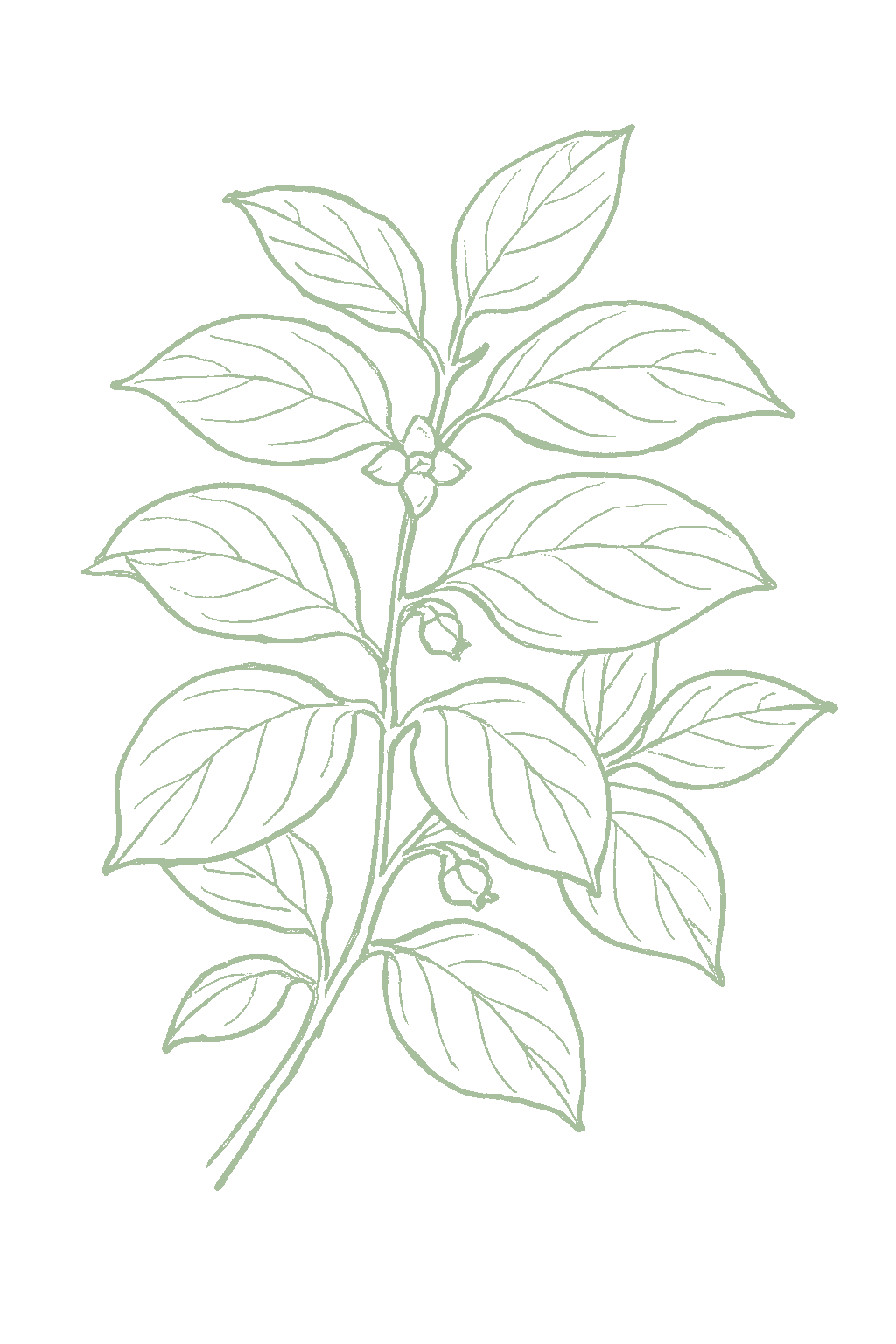
Bloom
Small, easy-to-miss cream or yellow flowers. Asian persimmons fruit on their own, often making seedless fruit with no pollen. American persimmons usually need a separate male tree nearby unless it is a self-fruitful kind. Because persimmon blooms late, frost is rarely a problem.Small, inconspicuous cream-to-yellow flowers. Asian persimmons are self-fruitful and set fruit alone, often parthenocarpically (seedless); American persimmons are usually dioecious, so a female needs a male nearby unless it is a self-fruitful selection. Late bloom means frost is rarely a threat.
There is little to do. If you have an American persimmon that is not fruiting, make sure a male tree is nearby. Otherwise let the self-fruitful tree set fruit on its own; bees visiting the flowers help a little.Little intervention is needed. Ensure a pollinizer is present for dioecious American females if fruit set is poor; otherwise let the self-fruitful tree set its own crop. Support bloom-time pollinator activity as a modest aid.
FROM PLANT · Persimmon blooms late, in May or June, so it usually dodges the spring frosts that wreck earlier fruit trees. That makes it more dependable in frosty areas.Persimmon blooms late (May to June), so it largely escapes the spring frosts that ruin earlier-blooming fruit, a major reliability advantage in frost-prone areas.
FROM PLANT · Know your type. Asian persimmons fruit on their own, often with no seeds. American persimmons usually need a separate male tree nearby, unless it is a self-fruitful kind like Meader.Know your type: Asian persimmons are self-fruitful and set alone (often seedless), while American persimmons are usually dioecious and a female needs a male nearby, unless it is a self-fruitful cultivar like Meader.
07
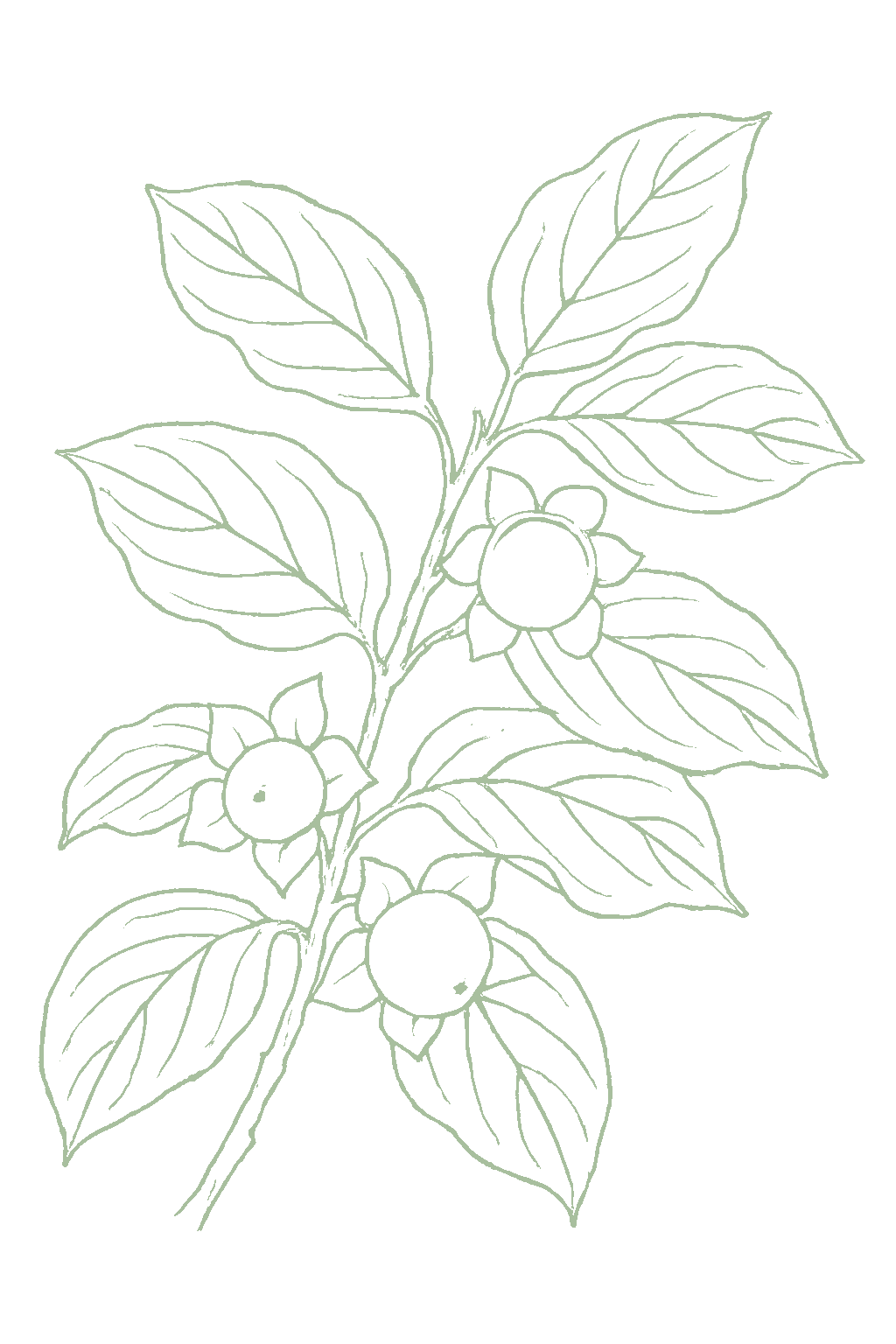
Fruit set and drop
Small green fruit forming, then a natural drop of some of it in early summer, which is normal. If a lot drops, the tree may be too dry or over-fed with nitrogen. Persimmon usually does not need you to thin the fruit by hand.Small green fruit developing, followed by a natural early-summer drop of a share of it, which is normal. Excessive drop can signal water stress or over-fertilization (especially too much nitrogen). Persimmon rarely needs hand thinning.
Keep the water steady to reduce fruit drop and do not over-feed with nitrogen. If a young tree is loaded and its branches might break, thin a little or prop the limbs; otherwise leave the tree to sort itself out.Keep moisture steady to limit excess drop and hold off on heavy nitrogen. On a young tree carrying a heavy set on brittle wood, light thinning or limb support prevents breakage; otherwise let the tree self-regulate.
FROM PLANT · Persimmon naturally drops some small fruit in early summer, which is normal. Heavier drop usually means the tree is too dry or over-fed, so keep the water steady and go light on fertilizer.A natural early-summer fruit drop is normal; heavier drop usually means water stress or excess nitrogen, so keep moisture steady and feed lightly.
08
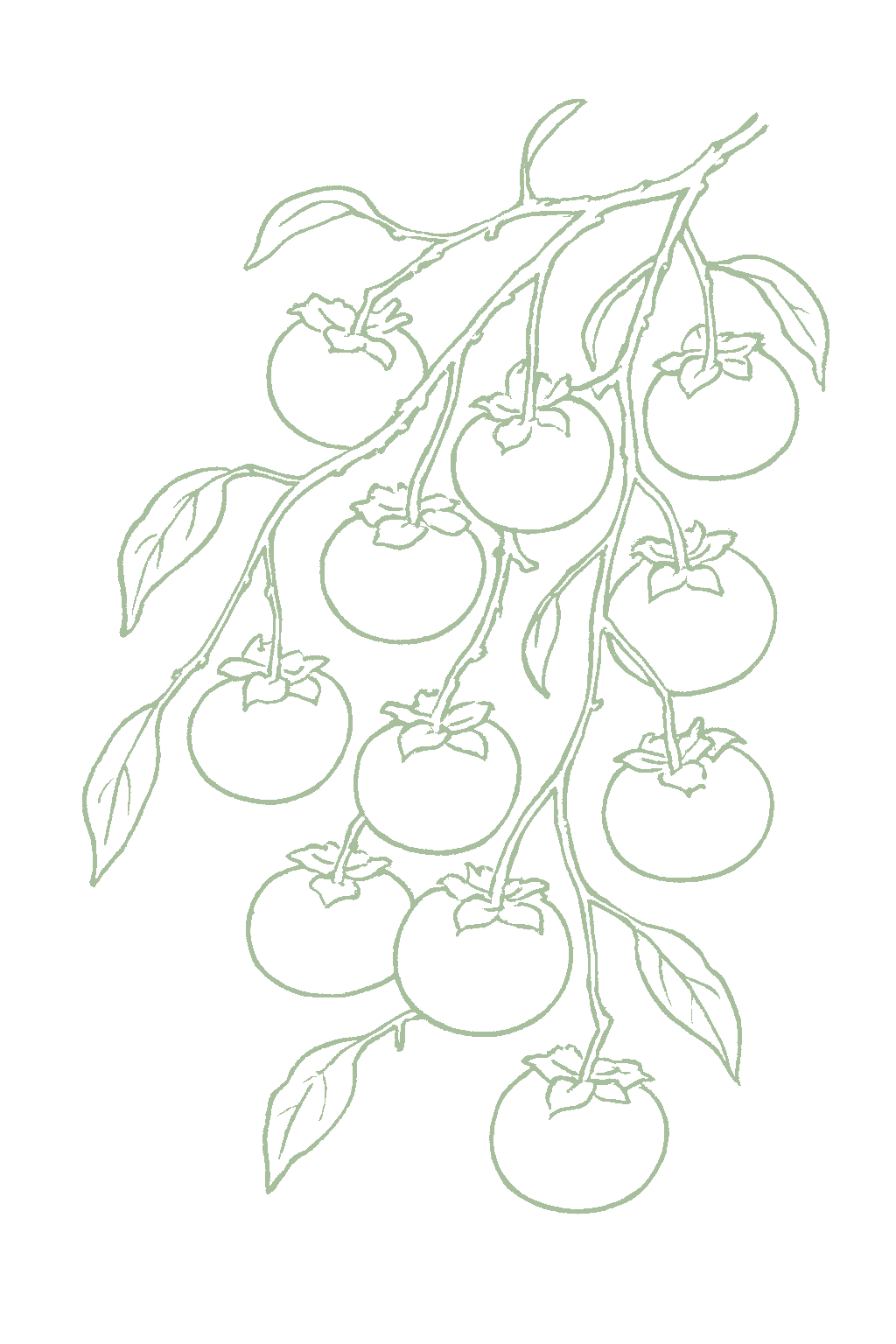
Harvest
The fruit turns fully orange. Firm types (Fuyu) are picked while still firm and eaten crisp; astringent types (Hachiya, most American) are picked when fully colored and then left to soften completely before eating. The fruit hangs on well and comes off with the leafy cap attached.Full orange color across the fruit. Non-astringent types (Fuyu) are picked firm and eaten crisp; astringent types (Hachiya, most American) are picked at full color and ripened to jelly-soft before eating. Fruit holds well on the tree and clips or twists free with the calyx attached.
Clip or gently twist off ripe fruit, keeping the leafy cap on, instead of yanking it. Pick firm types to eat crisp, and pick astringent types when fully orange, then let them soften on the counter. The fruit holds on the tree into cool weather, so there is no rush.Clip or twist ripe fruit with the calyx intact rather than pulling, to avoid tearing. Harvest firm non-astringent fruit for crisp eating; pick astringent fruit at full color and counter-ripen. Fruit can be left hanging into cool fall weather, so harvest is unhurried.
FROM PLANT · Pick by type: harvest firm types like Fuyu while still firm and eat them crisp. Pick astringent types like Hachiya when fully orange, then let them soften all the way before eating.Match harvest to type: pick non-astringent Fuyu firm for crisp eating, and pick astringent Hachiya and American types at full color, then ripen to jelly-soft before eating.
FROM PLANT · Clip or gently twist the fruit off with the leafy cap on instead of yanking it. Persimmon holds on the tree well, so you can pick it over cool fall weeks without rushing.Clip or twist fruit off with the calyx attached rather than pulling, and take advantage of persimmon holding well on the tree to harvest at leisure into cool fall weather.
The specs

Care guide

The numbers that matter, at a glance.

Sunlight
full sun · 6-8 hrs/day
Water
moderate
Spacing
180-240 inches
Soil
loam
Soil pH
6 to 6.5
Container OK?
No
Soil chemistry

Soil pH for persimmon

Preferred
6 to 6.5
Tolerated
6 to 7

Persimmon does best in a slightly acidic soil, around pH 6.0 to 6.5, and is fine up to about 7.0 (pH is just a measure of how acidic or alkaline the soil is). Test your soil before planting the permanent tree. If it is too acidic, garden lime raises the pH; if it is too alkaline, elemental sulfur lowers it. Mix any amendment in before planting, since pH changes slowly and is far easier to correct before the tree is in the ground.Persimmon prefers a slightly acidic pH 6.0 to 6.5 and tolerates up to about 7.0. Test before planting and adjust gradually: lime raises a too-acidic pH, elemental sulfur lowers one that is too alkaline. Work amendments in ahead of planting the permanent tree, since pH shifts slowly and is easiest to correct before establishment.

Verified · 2 sources View
Steady hand on the hose

Watering

When & how much
Frequency
Water deeply now and then rather than a little every day. A young tree needs a deep soak about once or twice a week for its first couple of years. An older tree handles dry spells well and is happy with roughly a weekly deep soak in summer, less when it is cool, and almost nothing in winter. Do not keep the soil soggy, since that causes root rot.Water deeply and infrequently. A young tree wants a deep soak about once or twice a week through its first two seasons; an established tree is fairly drought-tolerant and does well on roughly weekly deep watering in summer heat, less in cool weather and little through winter dormancy. Persimmon prefers infrequent, thorough irrigation over frequent shallow watering, and standing-wet soil invites root rot.
Amount
Each time you water, give a deep soak that reaches down to the roots, not just a splash on top. A young tree wants about 5 gallons per soak; an older, fruiting tree wants about an inch of water a week through the growing season, and more in a heat wave. Deep soaks build deep roots that handle dry spells.Soak deeply enough to wet the full root zone rather than just the surface: on the order of 5 gallons per watering for a young tree, and roughly the equivalent of an inch of water per week for a bearing tree through the growing season, more in extreme heat. Deep, thorough soaks drive the deep rooting that carries an established persimmon through dry stretches.
Method
Water the ground around the roots with a drip line or soaker hose, out to the edge of the branches, and keep the base of the trunk from sitting wet. Persimmon handles dry better than soggy, so let the soil dry a bit between waterings. In humid areas, avoid spraying water over the leaves, which can bring on leaf diseases.Water at the root zone with drip or a soaker hose out toward the drip line, keeping the trunk base from staying wet. Persimmon tolerates drought better than waterlogging, so the discipline is deep-then-dry, never continuously saturated. Overhead watering that wets the canopy in humid regions can encourage anthracnose and leaf spot.
Signs of trouble
Too much water
Yellow leaves, wilting even when the soil is wet, and a tree slowly going downhill mean too much water and the risk of root rot, which persimmon catches easily. Soil that never dries out is your signal to back off. Overwatering hurts persimmon more than underwatering does.Yellowing leaves, wilting that persists in wet soil, and general decline point to waterlogging and possible root or crown rot, to which persimmon (especially Asian types) is prone. Soil that never dries between waterings is the warning; this is far more dangerous to persimmon than underwatering.
Too little water
Wilting, dull or curling leaves, slower growth, and, the clearest sign, fruit dropping early or staying small when the tree gets too dry while the fruit is filling out. An older persimmon can take some dryness, but the crop suffers if it goes too dry for too long.Wilting, dull or curling leaves, slowed growth, and, most tellingly, premature fruit drop or small, poorly sized fruit when a tree runs dry during fruit development. An established persimmon endures moderate drought but sizes its crop poorly under sustained water stress.
Feeding rhythm

Feeding

Frequency
1-3x per year
Type
balanced granular (e.g. 10-10-10)
When to start
late dormancy, split with early and late summer

Persimmon barely needs feeding, and too much fertilizer, especially nitrogen, makes the fruit drop off. Go light. Scatter it evenly on the soil around the tree out to where the branches reach, keep it off the trunk, and water it in. On good soil an older tree may need nothing at all, so only feed if the tree looks weak or the leaves are pale.Persimmon needs little feeding and is easily over-fed: excess nitrogen causes premature fruit drop. A light program suits it, split across the season on sandy soils (the bulk in late dormancy, a lighter touch in early and late summer), broadcast evenly around the root zone to the drip line and kept off the trunk. On decent soil an established tree may need no fertilizer at all; feed only if growth is weak or leaves are pale.

N · P · K = 10-10-10

A balanced fertilizer like 10-10-10 (the three numbers are nitrogen, phosphorus, and potassium) is all persimmon needs, and often it needs none. Do not overdo it, because too much, especially the first number, nitrogen, makes the fruit fall off.A balanced ratio such as 10-10-10 is plenty for persimmon; the tree is a light feeder and over-fertilizing, particularly with nitrogen, drops fruit rather than improving it. Err toward less.

Try 10-10-10 balanced fertilizer
Who grows well together

Companion planting

Most Asian persimmons are self-fruitful, so one tree fruits on its own and you do not need a partner tree. American persimmons are different: they usually have male and female trees, so a female needs a male American persimmon nearby to fruit, unless you plant a self-fruitful kind like Meader. For a tree, the pairings that matter are not vegetable-garden companions but what grows around the roots: keep grass and weeds pulled back from under the branches, since lawn competes with a young tree, and a mulched, weed-free circle helps it settle in. Persimmon is a low-pest, easygoing tree, so there is little else to fuss over. Asian persimmon (D. kaki) is self-fruitful, so a single tree crops without a pollinizer; American persimmon (D. virginiana) is typically dioecious and a female needs a male within roughly 50 to 200 feet, the exception being self-fruitful selections like Meader. The interactions that matter for a tree concern the root zone, not classic vegetable companions: keep turf and weeds cleared back from under the canopy, since grass competes hard with a young tree, and a mulched, competition-free root area speeds establishment. Persimmon is notably low-pest and low-maintenance, so companion planting is a minor consideration here.

Other
Flowering herbs and pollinator plants
A skirt of flowering herbs and pollinator plants around a persimmon supports orchard-floor health. Because persimmon is self-fruitful and its Asian cultivars set fruit parthenocarpically, the pollinator draw is a bonus rather than a requirement, but the same flowers recruit the ladybugs, lacewings, and parasitic wasps that keep scale, mealybug, and persimmon psyllid at tolerable levels, which is exactly the natural-enemy approach UC IPM recommends for this low-spray tree. Keep the plantings out toward the drip line rather than crowding the trunk. Traditional
Keep apart from
Lawn and weeds crowding the young trunk Grass and weeds pressed up against a young persimmon are the pairing to avoid. Turf competes hard with a newly planted tree for water and nitrogen and measurably slows establishment, and growth against the trunk also traps moisture and invites string-trimmer wounds. Keep a mulched, weed-free circle a few feet out from the trunk through the establishment years, keeping the mulch itself off the bark. Research-backed
Provenance tagged inline · see methodology for the labeling system Key
Harvest signals

When to pick

A persimmon is ready when the fruit turns fully deep orange. For firm types like Fuyu, orange plus a firm feel means you can pick and eat it crisp. For astringent types like Hachiya and most American persimmons, orange means ready to pick but not yet to eat: let them sit until completely soft and jelly-like, when the pucker is gone. Clip or gently twist the fruit off with the leafy cap on instead of pulling. The fruit hangs on well into cool fall weather, so you do not have to rush.Persimmon is ready when the fruit reaches full, deep orange color. For non-astringent types (Fuyu), that plus a firm feel means ready to pick and eat crisp. For astringent types (Hachiya and most American persimmons), full color means ready to harvest, but not yet to eat: they must then ripen to a jelly-soft, nearly translucent stage before the astringency clears. Clip or twist fruit free with the calyx (the leafy cap) attached rather than pulling. The fruit holds on the tree well into cool fall weather, so harvest can be unhurried.

Verified · 2 sources View
Yield

What to expect

A grown persimmon can give a lot of fruit, often 50 to 100 pounds or more for an Asian tree and even more for a big American tree in a good year. Once it settles in, persimmon bears well and steadily, and you rarely need to thin the fruit the way you do with peaches.A mature standard persimmon commonly yields on the order of 100 to 300 pounds in a good year for a large American tree, and roughly 50 to 100 pounds or more for a well-grown Asian tree, depending on variety, age, and season. Persimmon tends to bear heavily and reliably once established, and rarely needs the thinning stone fruit demands.

A persimmon hits full production around years five to seven and keeps bearing for decades. American persimmons are especially long-lived; Asian ones can be shorter-lived in humid areas where trunk disease is a problem.Trees reach full bearing around years five to seven and stay productive for decades, with American persimmon especially long-lived. Asian persimmon in disease-prone humid regions may be shorter-lived where trunk canker is a factor. Do not expect fruit the first year, or really the first two or three. Pick off any early fruit so the young tree builds roots and branches. Your first real harvest usually comes around years three to five, with full crops by years five to seven.Expect no crop in the planting year and little to none for the first two to three years. Remove any early fruit so the tree builds roots and framework; the first meaningful harvest typically comes around years three to five, with full bearing by years five to seven.

What changes yield
type (Asian vs American) and cultivartree age and establishmentadequate winter chill for the cultivarsteady moisture during fruit developmentavoiding excess nitrogen (which drops fruit)summer heat and sunburn in desert zonesdisease pressure (anthracnose, trunk canker) in humid regions
Verified · 2 sources View
Off the vine

Storing your harvest

Room temp
Firm-eaten types like Fuyu keep on the counter for a week or more and just slowly soften. Astringent types like Hachiya need to sit out until they turn completely soft and jelly-like before you eat them, or they taste harshly puckery. Persimmons keep ripening after picking, so leaving astringent ones on the counter to soften is exactly right.Non-astringent types (Fuyu) are eaten firm and hold at room temperature for a week or more, softening slowly. Astringent types (Hachiya) must be held at room temperature until they ripen to a jelly-soft, fully translucent stage before eating; rushing them leaves an intensely puckery, tannic mouthfeel. Persimmons continue to ripen after picking, so counter-ripening astringent fruit is normal practice.
Fridge
Firm Fuyu-type persimmons keep in the fridge for several weeks, better than most fruit. Put soft, ripe Hachiya-type fruit in the fridge only once it is fully soft, and eat it within a few days.Refrigerate firm non-astringent persimmons to hold them for several weeks; they keep notably better than most tree fruit. Refrigerate soft-ripe astringent fruit only once fully ripe and use within a few days. Chilling can be used to speed some astringent types toward ripeness, but eating quality is best judged by full softness.
Freezer
Persimmons freeze nicely as pulp. Scoop out the soft ripe flesh, mix in a little lemon juice so it does not brown, and freeze it in portions. It keeps for months and is great for baking. You can also freeze whole astringent persimmons; thawing softens them and takes away the pucker.Persimmons freeze well as pulp. Scoop the soft, ripe flesh of astringent types, or puree non-astringent flesh, add a little lemon juice to limit browning, and freeze in portions. Frozen pulp keeps for several months and is ideal for baking, cookies, and puddings. Whole astringent fruit can also be frozen and thawed, which softens and de-astringes them.
Verified · 2 sources View
When something goes wrong

Common problems

The tree is healthy but gives no fruitTree grows well but sets no fruit
01 of 03
What happened A healthy tree that never fruits is usually an American persimmon female with no male tree nearby, because American persimmons usually need separate male and female trees. It might also just be too young (persimmon takes three to five years), or a male seedling that will never fruit. The fix depends on the type: for a single tree, plant a self-fruitful Asian variety like Fuyu, or a self-fruitful American kind like Meader; if you have an American female, add a male American persimmon nearby.A vigorous tree that never fruits is most often an American persimmon female with no male pollinizer nearby, since American persimmons are typically dioecious. It can also simply be a young tree not yet of bearing age (three to five years), or occasionally an all-male seedling that will never fruit. The fix is type-aware: for a lone tree, choose a self-fruitful Asian variety (Fuyu, Hachiya) or a self-fruitful American selection (Meader); for existing American females, add a male American persimmon nearby. Next season Find out what type and sex your tree is. A self-fruitful Asian variety fruits on its own; an American female needs a male tree nearby.Identify your tree's type and sex. Plant a self-fruitful Asian cultivar for guaranteed fruit on one tree, or ensure a male is present for a dioecious American female.
The fruit is harshly puckery and dries out my mouthThe fruit is harshly astringent and puckers the mouth
02 of 03
What happened Harsh pucker almost always means you ate an astringent type (Hachiya, or most American persimmons) before it was fully ripe. Astringent kinds are only good once they turn completely soft and jelly-like; eaten firm, they are intensely puckery. It is not a bad fruit, just eaten too early. Firm types like Fuyu can be eaten crisp with no waiting.Intense astringency almost always means an astringent-type persimmon (Hachiya, most American types) was eaten before it was fully ripe. Astringent types are only edible once ripened to a jelly-soft, translucent stage, when the tannins have converted; picked or eaten firm, they are mouth-puckeringly tannic. This is not a defect but a type mismatch in handling. Non-astringent types (Fuyu) can be eaten firm and crisp with no such stage. Next season Let astringent types get completely soft before eating (freezing them or a warm spot helps), or grow a non-astringent Fuyu type you can eat crisp.Ripen astringent types to full jelly-softness before eating (freezing or a warm spot speeds it), or plant a non-astringent Fuyu type you can eat firm.
Lots of small fruit falls off before it ripensYoung fruit drops heavily before ripening
03 of 03
What happened Persimmon naturally drops some small fruit in early summer, but heavy drop usually comes from uneven or too-little watering while the fruit is growing, or from too much fertilizer, especially nitrogen, which makes persimmon drop fruit instead of growing more. Young trees also just hold little fruit. The fix is steady watering while the fruit fills out and going light on fertilizer.Some early-summer fruit drop is a normal self-regulation, but heavy drop usually traces to water stress (erratic or insufficient moisture during fruit development) or over-fertilization, especially excess nitrogen, which persimmon responds to by shedding fruit rather than growing more. Young trees also naturally hold little fruit. The corrective action is steady moisture through fruit fill and a light hand with fertilizer. Next season Keep the water steady while the fruit is growing and do not over-feed with nitrogen. On a young tree, prop up or lightly thin a heavy load so branches do not break.Keep moisture even through fruit development and avoid heavy nitrogen; on a young brittle-wooded tree, support or lightly thin a heavy set to prevent limb breakage.
The usual suspects

Pests & diseases

Pests
Scale insects
P · 01
Symptoms Little bumps stuck to the bark, twigs, and leaf undersides that do not move. White peach scale looks like snow-white crust on the trunk and branches; other scales are small brown domes. They leave a sticky coating (honeydew) that turns black with sooty mold and attracts ants. Bad cases slowly weaken the tree.Small, immobile bumps on bark, twigs, and the underside of leaves; white peach scale shows as snow-white encrustations on the trunk and limbs, while soft scales are brown and rounded. Heavy infestations produce sticky honeydew that blackens with sooty mold and draws ants. Vigor and fruit quality decline where scale builds up unchecked. Cause Tiny sap-sucking insects that hide under a waxy shell, mainly white peach scale and soft scales. They feed on the tree's sap and drip sticky honeydew that grows black mold. They get worse when sprays kill off the helpful insects that normally eat them.Several scale species, notably white peach scale and soft scales (Parthenolecanium spp.), which insert their mouthparts and feed on sap under a protective waxy shell. Their honeydew supports sooty mold. Populations flare where natural enemies have been knocked back by broad-spectrum sprays. Organic treatment Let the helpful bugs do the work by avoiding broad sprays, since ladybugs and tiny wasps usually keep scale in check on persimmon. Cut out and throw away badly crusted branches. A spray of horticultural oil while the tree is leafless in winter smothers the scale on the bark and is the simplest hands-on control.Preserve natural enemies (ladybugs, parasitic wasps) by not spraying broadly, since they usually hold scale to tolerable levels on persimmon. Prune out and destroy heavily encrusted wood. A dormant-season horticultural oil application smothers overwintering scale on the bark and is the main direct control for a backyard tree. Prevention Keep the tree healthy, skip the broad bug sprays that kill the good insects, and check the trunk and branches now and then for the first white crusty patches so you can put on a winter oil spray before it spreads.Keep the tree vigorous, avoid broad-spectrum insecticides that disrupt biological control, and monitor the trunk and scaffolds for early white encrustations so a dormant oil can be timed before populations explode.
Mealybugs
P · 02
Symptoms Small soft insects covered in white, cottony fluff, tucked into leaf joints, under the leafy cap of the fruit, and along stems. They leave the same sticky honeydew and black mold as scale, and where they hide under the fruit's cap they can spoil its look.Soft, oval insects coated in white, cottony wax clustered in leaf axils, under the calyx of the fruit, and along shoots. Like scale, they excrete honeydew that fosters sooty mold and ants, and feeding under the calyx can contaminate and blemish fruit. Cause Sap-sucking insects called mealybugs that hide in sheltered spots, including under the leafy cap on the fruit. Ants often protect them because they want the sweet honeydew, which lets the mealybugs build up.Mealybugs (several species) that suck phloem sap and shelter in protected crevices, including beneath the fruit calyx. Ant-tended colonies persist because ants protect them from natural enemies for the honeydew. Organic treatment Let natural predators handle most mealybugs, and avoid broad sprays that kill those helpers. Stop ants from climbing the trunk with a sticky band so the predators can reach the mealybugs. Dab visible clusters with horticultural oil or insecticidal soap.Rely first on natural enemies, which generally keep mealybugs below damaging levels on landscape fruit trees; avoid the broad-spectrum sprays that disrupt them. Control honeydew-farming ants (sticky trunk bands) so predators can work. Spot-treat visible colonies with a horticultural oil or insecticidal soap. Prevention Keep the helpful insects around by not spraying broadly, keep ants off the tree, and check under the cap of the growing fruit where mealybugs like to hide, picking off any infested ones early.Maintain biological control by minimizing broad-spectrum sprays, manage ants, and inspect the calyx end of developing fruit where mealybugs hide, removing infested fruit early.
Persimmon psyllid
P · 03
Symptoms In spring the new leaves curl and roll up around tiny insects feeding inside. You may see small crawlers and white waxy threads inside the rolled leaves. On an older tree the harm is mostly cosmetic, but it can slow down a young one.New leaves curl, roll, and cup around the feeding of tiny nymphs in spring, often distorting the flush of young growth. Small crawlers and their waxy filaments may be visible inside the rolled leaves. Damage is largely cosmetic on an established tree but can stunt young shoots. Cause A small sap-feeding insect called the persimmon psyllid. Its young feed on the new spring leaves and make them curl. It is a minor pest that mostly just looks bad.The persimmon psyllid, a small sap-feeding insect whose nymphs feed on expanding leaves in spring and induce the characteristic leaf roll. It is a minor, mostly cosmetic pest of both native and Oriental persimmon. Organic treatment Usually nothing needs to be done, since the tree shrugs it off. On a small tree you can clip off the worst curled tips in spring. Avoid broad sprays so the helpful insects stay around.Usually no treatment is warranted; natural enemies and the tree's vigor absorb the damage. On a small tree, prune off and destroy the worst rolled tips in spring. Preserve beneficial insects by avoiding broad sprays. Prevention There is not much to do. A healthy tree with its natural predators intact keeps this pest to a harmless nuisance.Little is required. Keeping the tree healthy and preserving natural enemies keeps the psyllid a cosmetic nuisance rather than a problem.
Persimmon borer
P · 04
Symptoms Shoots that wilt or die, and near the bottom of the trunk a sticky ooze mixed with what looks like sawdust, where the larvae are tunneling under the bark. A young tree can be ringed and killed, so this is the one persimmon pest to take seriously.Wilting or dying shoots and, on the trunk, gummy ooze mixed with sawdust-like frass near the base where larvae tunnel the inner bark. Young trees can be girdled and killed; it is the one persimmon pest extension warns can be serious, particularly in the Southeast. Cause The larvae (grub stage) of borer beetles and moths that tunnel into the lower trunk. Wounded or stressed trees are hit hardest, but a healthy tree can be attacked too.Larvae of the persimmon (and flatheaded) borers that bore into the lower trunk and inner bark. Trees stressed by wounds or drought are attacked first, but healthy bark can also be entered; it affects both native and Oriental persimmon. Organic treatment Once the larvae are inside, no spray reaches them. Scrape soil away from the base, find the holes marked by gum and sawdust, and kill the grubs with a stiff wire. Keep mowers and trimmers away from the trunk so you are not giving the borers wounds to enter.No spray reaches larvae already inside the trunk. Expose the crown, locate entry holes by the gum and frass, and kill larvae by hand with a wire. Keep the trunk base free of mechanical wounds and remove badly infested young wood. Prevention Keep mowers and string trimmers off the trunk, keep the tree healthy and watered, and check the base of the trunk each late summer for fresh ooze and sawdust so you catch borers early.Protect the lower trunk from injury, keep the tree vigorous and well watered, and inspect the trunk base each late summer for fresh gum and frass so an infestation is caught in its first year.
Diseases
Anthracnose
D · 01
Symptoms Dark, sunken spots on the fruit and spots or dieback on leaves and new shoots, worst in warm, rainy weather. Bad cases rot the fruit and thin out the leaves.Dark, sunken lesions on fruit, and spots and dieback on leaves and young shoots, most damaging in warm, wet weather and humid regions. Infected fruit can rot before or after harvest, and severe leaf infection thins the canopy. Cause A fungus (anthracnose) that survives winter in dead wood and old fruit and spreads in warm, wet weather. It is a bigger problem in humid, rainy areas than in dry ones.Anthracnose fungi (Colletotrichum and related genera) that overwinter in dead wood and mummified fruit and spread by rain-splash in warm, humid conditions. Pressure is highest in the wet Southeast and lowest in dry-summer climates. Organic treatment Cleanup is the main fix: cut out dead branches, pick off and throw away any shriveled old fruit, and prune so the tree is open and dries fast after rain. Remove spotted fruit as you see it. A home tree rarely needs spraying if you keep it clean.Sanitation is the core control: prune out and destroy dead and cankered wood and remove mummified fruit, and keep the canopy open so it dries quickly after rain. Remove and dispose of infected fruit promptly. Fungicides are rarely needed on a backyard tree if sanitation is kept up. Prevention Keep the tree open with light pruning, clean up fallen and dried-up fruit every year, and plant it where air moves freely. In rainy areas, pick a variety known to hold up better.Choose an open canopy through pruning, clear fallen and mummified fruit each season, and site the tree with good air movement. In high-pressure humid regions, favor cultivars with better tolerance.
Root and crown rot
D · 02
Symptoms A tree that slowly goes downhill, with thin yellow leaves and dying branches, usually in wet or heavy soil. The bark and roots at the base turn dark and rotten. Asian persimmon is especially prone, and a badly affected tree can die within a year or two.General decline, sparse yellowing foliage, and dieback on a tree in heavy or poorly drained soil, with dark, decayed bark and roots at and below the soil line. Asian persimmon is especially susceptible; the tree may collapse over a season or two once the crown is girdled. Cause Water-mold fungi in the soil (Phytophthora) that rot the roots and crown when the ground stays wet. Asian persimmon is easily hit, which is why it is often grafted onto the tougher native persimmon roots.Soilborne Phytophthora (and related) fungi that attack roots and the crown in waterlogged soil. Oriental persimmon is notably susceptible to root rot, which is a chief reason it is often grafted onto the more tolerant native (D. virginiana) rootstock. Organic treatment Once the base is rotting there is no fixing it, so this one is all about prevention. Never plant where water stands, plant on a raised mound in heavy soil, and pick a tree grafted onto native persimmon roots if your drainage is iffy. Do not overwater an older tree.There is no cure once the crown is rotting. Management is prevention through drainage: never plant in standing-water sites, plant on a mound in heavy soil, and choose a tree on tolerant native rootstock where drainage is marginal. Avoid overwatering an established tree. Prevention Plant only where water drains well, or on a raised mound, choose a tree on native persimmon rootstock if your soil is heavy, and water deeply now and then instead of keeping the soil soggy.Plant only on well-drained ground or a raised berm, select tolerant (native) rootstock in marginal soils, and water deeply but infrequently rather than keeping the root zone saturated.
Leaf spot and twig dieback
D · 03
Symptoms Round or angular spots on the leaves that can turn them yellow and drop in a wet year, plus a little dieback of small twigs. On a healthy persimmon this is usually minor and just cosmetic.Circular to angular leaf spots that may yellow and drop leaves in a wet season, and dieback of small twigs. Usually a minor, cosmetic issue on an otherwise healthy persimmon, which extension sources note has few serious disease problems. Cause Common leaf-spot fungi that show up when leaves stay wet a long time. Persimmon has few real disease problems, so this is usually just a minor, weather-related annoyance.Several leaf-spot fungi favored by prolonged leaf wetness. Persimmon is generally regarded as having no serious insect or disease problems, so leaf spot is typically a low-impact, weather-driven nuisance. Organic treatment Rake up and remove fallen spotted leaves, keep the tree open, and keep it healthy. A home tree almost never needs a spray for this.Rake and remove fallen infected leaves to reduce carryover, keep the canopy open, and keep the tree vigorous; fungicides are seldom justified on a home tree. Prevention Good airflow, light pruning to keep the tree open, and cleaning up fallen leaves in autumn keep this to a harmless level.Good air movement, an open canopy, and fall leaf cleanup keep leaf spot to a cosmetic level.
Verified · 6 sources View
Seasoned
Where to plant next year

Crop rotation

Pick the spot for sun and good drainage, not for what was there before. Persimmon's main weakness is root rot in wet soil, so a well-drained, sunny place is what counts.Choose the planting site for sun and drainage rather than for what grew before. Persimmon's one soil vulnerability is root and crown rot on wet ground, so a fresh, well-drained, full-sun position is what matters, not a rotation interval.

Family
Ebenaceae (Diospyros)
Avoid following
You do not rotate a persimmon the way you rotate vegetables, because it stays in one place for many years. Persimmon does not have the replant problems that stone fruits do, so the main thing to avoid is a wet, poorly drained spot, or a place where another tree died of root rot.Annual crop rotation does not apply to persimmon: the tree holds its site for decades. Persimmon has no notable replant-disease reputation, unlike stone fruit, so the main site concern is simply drainage. Avoid planting where water stands or where a previous tree died of root or crown rot.
Plant after
any well-drained site in full sun with no standing-water history
Verified · 2 sources View
Ask the gardener

Common questions

Got a question we missed?

We're building this guide with real growers. Got a question we missed? Ask here. We read every one and add the best answers right to this page.

Grown this before?

Share a tip

Learned something the hard way? Pass it on. Real growers' tips make this guide better for the next person, and we credit you by name when yours goes live.

Seasoned
Spot something wrong?

Report a problem

If you've grown this crop and you see a date, a temperature, a companion claim, or a recommendation that doesn't match your experience, tell us. Real growers' corrections make this guide better for the next person.

How we built this guide

Methodology & sources

Every date, temperature, spacing, and recommendation on this page is sourced from university cooperative extension publications, peer-reviewed agricultural research, NOAA climate data, and direct extension calendars. Where claims are softer (traditional gardening wisdom not formally documented), we say so.

Research-backed Documented in cooperative extension publications or peer-reviewed research
Well-grounded A known agronomic principle, but not formally tested for this specific pair
Traditional Time-tested gardening wisdom, limited formal research support
Last reviewed
June 30, 2026
Data version
crops_data_final · v1.0 · schema 2.9
Sources cited on this page
16 publications
Verified entries
Companion-planting claims tagged inline · zone dates verified against 5+ extensions
See all sources cited on this page
  • University of Minnesota Extension umn_ext
  • University of Maryland Extension umd_ext
  • Cornell Cooperative Extension cornell_ext
  • Iowa State University Extension iastate_ext
  • Michigan State University Extension msu_ext
  • NC State Extension ncsu_ext
  • Penn State Extension psu_ext
  • U. of Illinois Urbana-Champaign Extension uiuc_ext
  • UC Davis Postharvest Center ucd_postharvest
  • Texas A&M AgriLife Extension tamu_agrilife
  • Virginia Cooperative Extension 426-331 vce_426_331
  • Piedmont Master Gardeners piedmont_mg
  • UGA Vegetable Garden Calendar uga_calendar
  • Clemson Home & Garden Information Center clemson_hgic
  • UC IPM Statewide IPM Program uc_ipm
  • NOAA 1991-2020 Climate Normals noaa_normals

Growing notes, weekly.

Zone-aware seasonal nudges, what's worth planting now, and the occasional recipe from the harvest. No spam, ever.

Vol. 004 · Persimmon · plant.lifestyle