Pick your zone and the dates re-calibrate.
The Guide Fruit trees Vol. 004

Persimmon

in Zone 9, this week

A persimmon is a good-looking fruit tree that drops its leaves each winter and gives you one of the easiest crops you can grow, with brilliant fall color and bright orange fruit that hangs on after the leaves fall. There are two main kinds. The Asian persimmon (Diospyros kaki) is the popular one for backyards: it fruits on its own, needs little winter cold, and handles down to about zone 7, with firm types eaten crisp like an apple (Fuyu) and soft types ripened until sweet and jelly-like (Hachiya). The American persimmon (Diospyros virginiana) is much hardier, down to about zone 4, but usually needs separate male and female trees, unless you plant a self-fruitful kind like Meader. Persimmon blooms late, in May or June, so it usually escapes the spring frosts that hurt earlier fruit trees, and it hardly ever has pest or disease trouble. It just needs full sun, well-drained soil, a little pruning, and a few years of patience. Persimmon (Diospyros) is a handsome, low-maintenance deciduous fruit tree that yields some of the easiest home fruit there is, plus fiery orange-to-scarlet fall color and bright fruit that clings decoratively after the leaves drop. It comes in two very different forms. The Asian or Oriental persimmon (D. kaki) is the dooryard favorite: self-fruitful, low-chill, hardy to about USDA zone 7, with large fruit in non-astringent types eaten crisp like an apple (Fuyu) or astringent types ripened to a sweet, jelly-soft pulp (Hachiya). The American persimmon (D. virginiana) is far more cold-hardy, to roughly zone 4, but is usually dioecious, so a female needs a male tree nearby unless you plant a self-fruitful selection like Meader. Persimmon blooms late, in May or June, so it largely dodges the spring frosts that plague earlier fruit, and it is famously untroubled by pests and diseases. It asks little: full sun, well-drained soil, light pruning, and patience for the first three to five years.

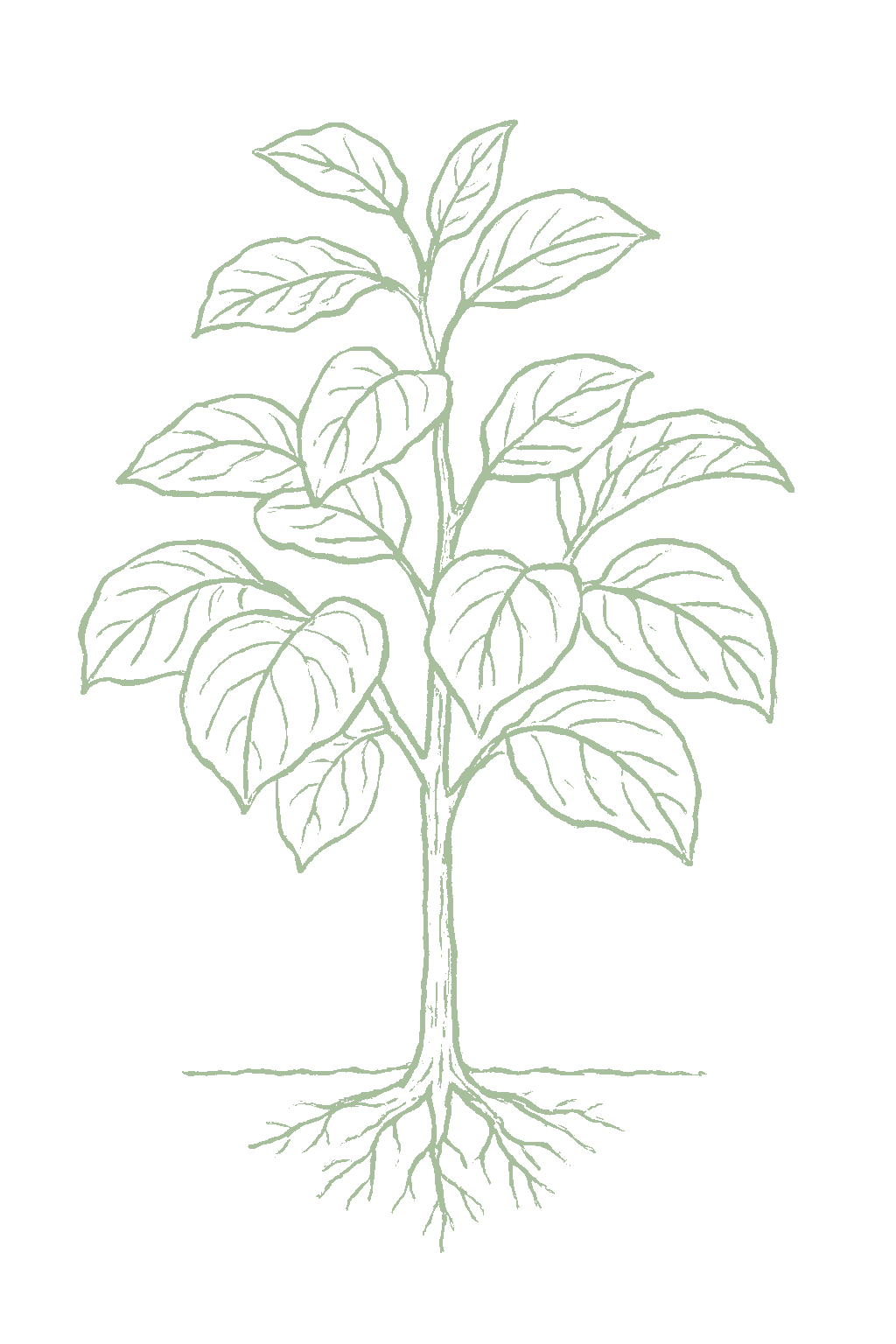
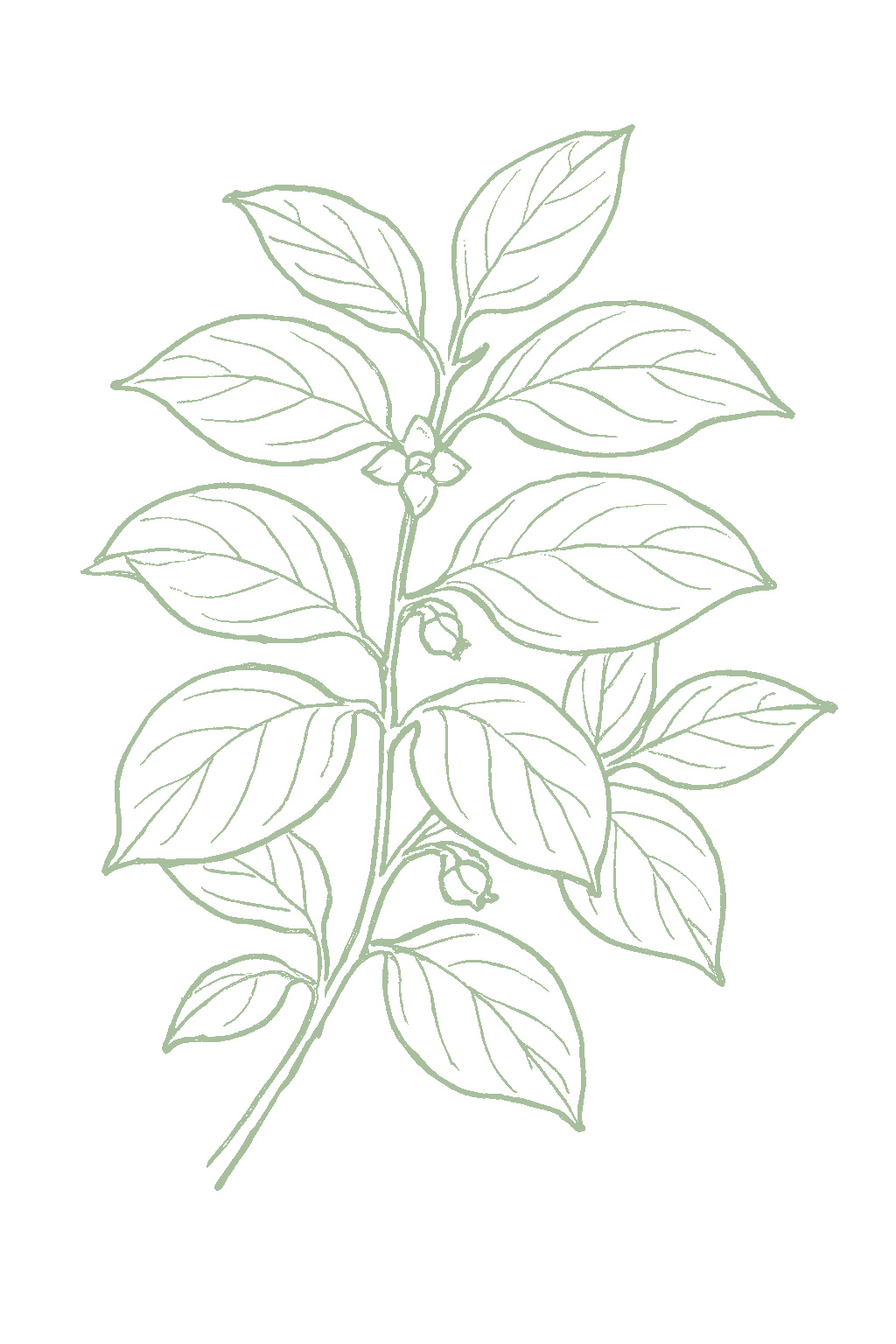
Persimmon mature plant
Fig. 01 · Persimmon, mature Zone 9
First fruit
3-5 yrs
to first harvest
Sunlight
Full sun
6-8 hrs daily
Water
Moderate
Spacing
15 to 18 ft
between trees
Soil pH
6-6.5
slightly acidic
Hardiness & fruiting range

Will it actually fruit here?

Hardiness tells you the tree will survive your winters. It does not tell you whether you will get fruit. Each zone carries its own verdict. Yours is marked.

3
survives,
rarely fruits
4
survives,
rarely fruits
5
reliable
6
reliable
7
reliable
8
reliable
Your zone
9
reliable
10
reliable
11
survives,
low chill
Fruits reliably
Fruits reliably Survives only Too warm
← colder winterswarmer, less chill →
✓ Zone 9: The lower valley fruits Asian persimmon reliably, with an early bloom and a long harvest into early winter. There is plenty of winter cold for any variety.The lower valley fruits Asian persimmon reliably with an early bloom and a long harvest from fall into early winter. Chill is ample for the full cultivar range.
The growing year

Your persimmon year, month by month

California: Interior, Zone 9. Winters bank about 300 to 950 chill hours; these varieties need about 100 to 700 chill hours. The lower valley fruits Asian persimmon reliably, with an early bloom and a long harvest into early winter. There is plenty of winter cold for any variety.The lower valley fruits Asian persimmon reliably with an early bloom and a long harvest from fall into early winter. Chill is ample for the full cultivar range.

A fruit tree runs on the same rhythm every year: rest, prune, bloom, grow, harvest, then settle in again.

Jan
Feb
Mar
Apr
May
Jun
Jul
Aug
Sep
Oct
Nov
Dec
▲ We are here
Tree’s year
rest
prune
bloom
growing
harvest
care
Plant new tree
plant
plant
Dormant rest Prune Bloom Growing fruit Harvest Post-harvest care
Plant bare-root
Dec - Jan
Bloom
Apr 5 - Apr 30
Harvest
Sep 25 - Nov 25
Chill hours

Will your winter be cold enough?

Persimmon needs only a little winter cold (called chill hours) to bloom properly, which is why it grows in mild-winter places where peaches struggle. Asian persimmon needs only about 100 to 200 hours of cold below 45°F, and some kinds less. That low need, plus its late bloom, makes persimmon one of the most adaptable fruit trees. Only the warmest, nearly frost-free tropics (south Florida, lowland Hawaii) are too warm for the usual varieties to fruit.Persimmon has a low chilling requirement, which is a big reason it succeeds across mild-winter regions where high-chill stone fruit fails. Asian persimmon needs only about 100 to 200 hours below 45°F, and some cultivars less; American persimmon needs somewhat more but is still modest. This low chill, combined with late bloom, makes persimmon one of the most broadly adaptable temperate-to-subtropical fruits. Only the near-chill-free deep tropics (south Florida, lowland Hawaii) fall short for standard cultivars.

Your winter ~300 – 950 hrs
0 250 500 750 1000
✓Dependable here
Fuyu (Jiro)200Izu100Hachiya200Great Wall200Meader400Prok400
!Borderline in a warm winter
None. Every variety in this roster gets enough chill here.
Bloom timing & cross-pollination

One tree is usually enough

Most persimmons are self-fruitful: a single tree sets a full crop with its own pollen, so you don’t need a second variety to get fruit. Bees still move the pollen from blossom to blossom, so strong pollinator activity through bloom is what drives a heavy set.

Bar length shows how long each variety blooms, roughly 8 to 14 days. Bars that overlap bloom at the same time.

▲ Tap a variety to see its bloom timing

Very early Early Mid Late Very late
The pollination rule

Pollination is the biggest difference between the two persimmon types, and it decides whether you need one tree or two. Asian persimmon (Diospyros kaki), including Fuyu and Hachiya, fruits on its own: a single tree makes a full crop by itself, and the main kinds make seedless fruit with no pollen at all. American persimmon (Diospyros virginiana) is the opposite: it usually has separate male and female trees, so a female needs a male American persimmon nearby to fruit. The exceptions are self-fruitful American kinds like Meader, which make seedless fruit with no male. The two species do not pollinate each other. For most gardeners the easy choice is one self-fruitful Asian tree; go with American (a female plus a male, or a self-fruitful kind like Meader) where winters are too cold for the Asian type.Pollination is the headline difference between the two persimmon types, and it decides whether you need one tree or two. Asian persimmon (D. kaki), including non-astringent Fuyu and astringent Hachiya, is self-fruitful: a single tree sets a full crop alone, and its main cultivars are parthenocarpic, forming seedless fruit with no pollen at all. American persimmon (D. virginiana) is the opposite: it is typically dioecious, carrying male and female flowers on separate trees, so a female needs a male American persimmon within roughly 50 to 200 feet to fruit. The exceptions are self-fruitful American cultivars such as Meader, bred to set seedless fruit with no male present. The two species do not cross-pollinate each other, and even among self-fruitful types, planting a pollinizer often gives heavier, seedier crops. For most home gardeners the simple path is one self-fruitful Asian tree; choose the American route (a hardy female plus a male, or a self-fruitful selection like Meader) where winters are too cold for Asian persimmon.

Pick your variety

Recommended varieties

Pick first by type and your climate. In zone 7 and warmer, an Asian persimmon is usually best: a self-fruitful, non-astringent Fuyu to eat crisp, or an astringent Hachiya to eat soft. In colder areas (zones 4 to 6), choose an American persimmon: a self-fruitful Meader for a single tree, or a hardy kind like Prok with a male tree nearby. Persimmon needs little winter cold, so most types suit most winters. Buy a named, grafted tree rather than a seedling so you know the fruit and, for American types, the sex.Choose first by type and climate. In zones 7 and warmer, an Asian persimmon (D. kaki) is the usual pick: a self-fruitful, non-astringent Fuyu for firm crisp eating, or an astringent Hachiya for soft-ripe fruit and baking. In colder zones (4 to 6), choose an American persimmon (D. virginiana): a self-fruitful Meader for a single tree, or a hardy female such as Prok with a male pollinizer. Match the cultivar's modest chill requirement to your winters, and favor named grafted cultivars over seedlings for known fruit quality and sex.

Fuyu (Jiro)
fresh eating (firm)
Izu
fresh eating (firm)
Hachiya
fresh eating (soft-ripe), baking, drying
Great Wall
fresh eating (soft-ripe), drying
Meader
fresh eating (soft-ripe)
Prok
fresh eating (soft-ripe)
Rootstock & size

How big will it get?

Asian persimmon is commonly grafted onto native D. virginiana for cold and wet-soil tolerance; choose rootstock for your soil and climate, not for tree size.

Recommended
Diospyros virginiana (American persimmon)standard
Mature height
20 to 30 ft
Bears
year 3–5
Container
in-ground
Diospyros lotus (date-plum)standard
Mature height
20 to 30 ft
Bears
year 3–5
Container
in-ground
Diospyros kaki (seedling)standard
Mature height
20 to 30 ft
Bears
year 3–5
Container
in-ground
Ask the nursery

Ask for your Asian variety grafted on native D. virginiana for cold-hardiness and wet-soil tolerance.

From seed to fruit

The growing journey

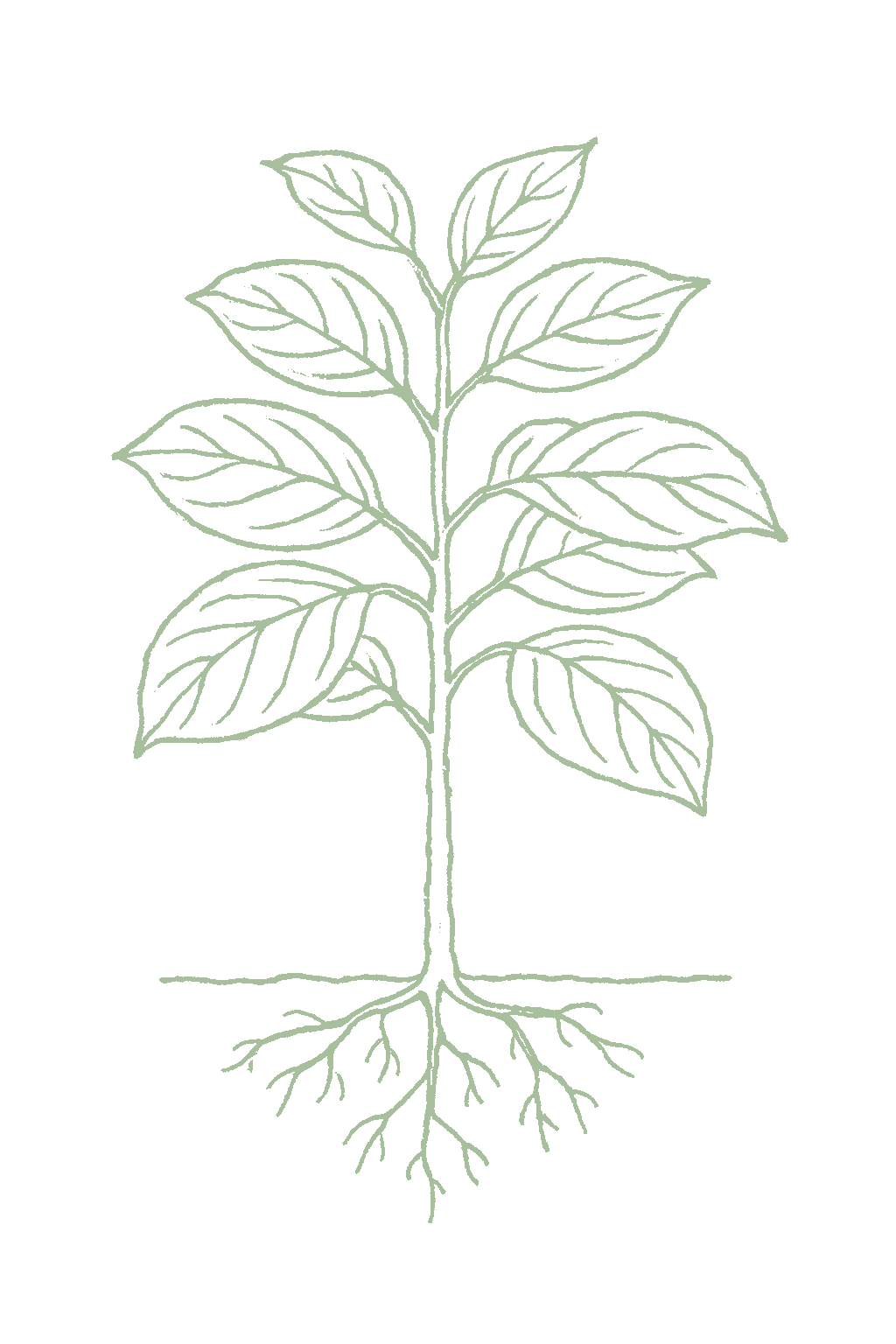
Stage 01 · Planting (bare-root or grafted, dormant)
01
Planting (bare-root or grafted, dormant)
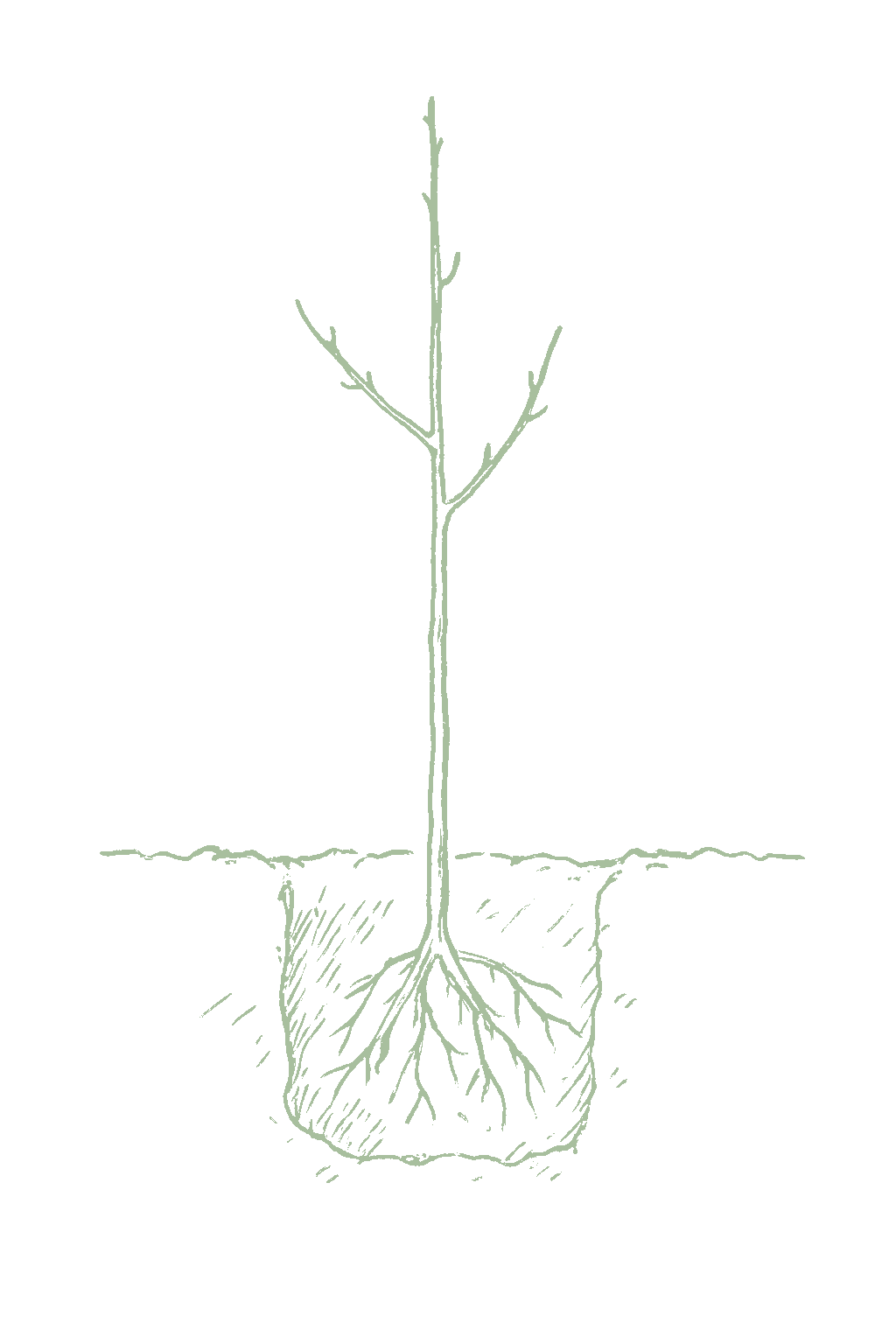
A leafless young tree with firm buds and healthy roots. On a grafted tree, find the graft joint low on the trunk and keep it above the soil when you plant.A dormant tree with firm buds and healthy roots; on a grafted tree, the graft union (the swollen joint where the fruiting variety meets the rootstock) should sit above the final soil line.
Handle the roots gently, since persimmon does not like being disturbed. Dig a wide hole, set the tree at the depth it grew before with the graft joint above the soil, fill with the soil you dug out, and water well. No fertilizer in the hole. On heavy soil, plant on a mound.Handle the taproot gently (persimmon resents root disturbance), dig a hole wide enough to spread the roots, set the tree at nursery depth with the graft union above grade, backfill with native soil, and water in well. Do not fertilize in the hole. On heavy soil, plant on a raised mound.
FROM PLANT · Handle the roots gently and plant right away. Persimmon does not like having its roots disturbed, so getting it in the ground quickly helps it settle.Handle the taproot gently and plant promptly: persimmon resents root disturbance, so a bare-root tree established quickly outperforms one left to dry or sit.
FROM PLANT · Plant where the tree gets full sun and the soil drains well, or on a raised mound. Persimmon roots rot in soggy soil, especially the Asian kinds.Plant in full sun on a well-drained site or a raised mound; persimmon, especially Asian types, is prone to root and crown rot on wet ground.
02
Year-one establishment
Healthy new shoots and a tree settling in. Persimmon takes its time. Do not expect fruit yet, and pick off any that forms so the tree builds roots and branches.Steady new shoot growth and a strengthening root system. Persimmon establishes slowly; do not expect fruit, and remove any that sets so energy goes to roots and framework.
Water deeply and often this first season, keep a mulched, weed-free circle around the trunk with the mulch off the bark, and keep mowers and trimmers away from the trunk so borers have no wounds to enter.Water deeply and regularly through the first season (persimmon's most water-sensitive period), keep a weed-free mulched circle around the trunk without piling mulch on the bark, and protect the trunk from string-trimmer wounds that invite borers.
FROM PLANT · Water deeply and often the first couple of years, but let the soil dry a bit between waterings. Persimmon needs steady water to establish but rots in soggy soil.The first two seasons are the most water-sensitive; water deeply and regularly, but let the soil dry between soaks, since persimmon hates waterlogging.
FROM PLANT · Keep mowers and trimmers away from the bottom of the trunk. The wounds they leave let in borers, the one persimmon pest that can kill a young tree.Keep mowers and string trimmers off the trunk base: the wounds they leave are the entry point for persimmon borer, the one pest that can kill a young tree.
03
Training (years one to three)
Persimmon is usually trained to a modified central-leader or open, vase-like shape with evenly spaced main branches. The wood is a bit brittle, so building strong branches early matters once the tree carries heavy fruit.Persimmon is commonly trained to a modified central leader or open-center framework with well-spaced scaffolds. Its wood is somewhat brittle, so building a strong branch structure early pays off when heavy fruit loads arrive.
Each winter, prune lightly to keep a few well-spaced main branches and remove ones that cross or are weak. Persimmon needs much less pruning than peaches; you are just building a strong, open shape.Prune lightly in dormancy to select well-spaced scaffolds and remove crossing or weak wood. Persimmon needs far less pruning than stone fruit; the goal is a sound framework and good light penetration, not heavy annual renewal.
FROM PLANT · Build strong branches early. Persimmon wood is a bit brittle and heavy fruit can snap weak limbs, so keep the main branches well spaced and spread out.Build a strong framework early: persimmon wood is brittle and heavy fruit loads can break poorly structured limbs, so favor well-spaced, wide-angled scaffolds.
04
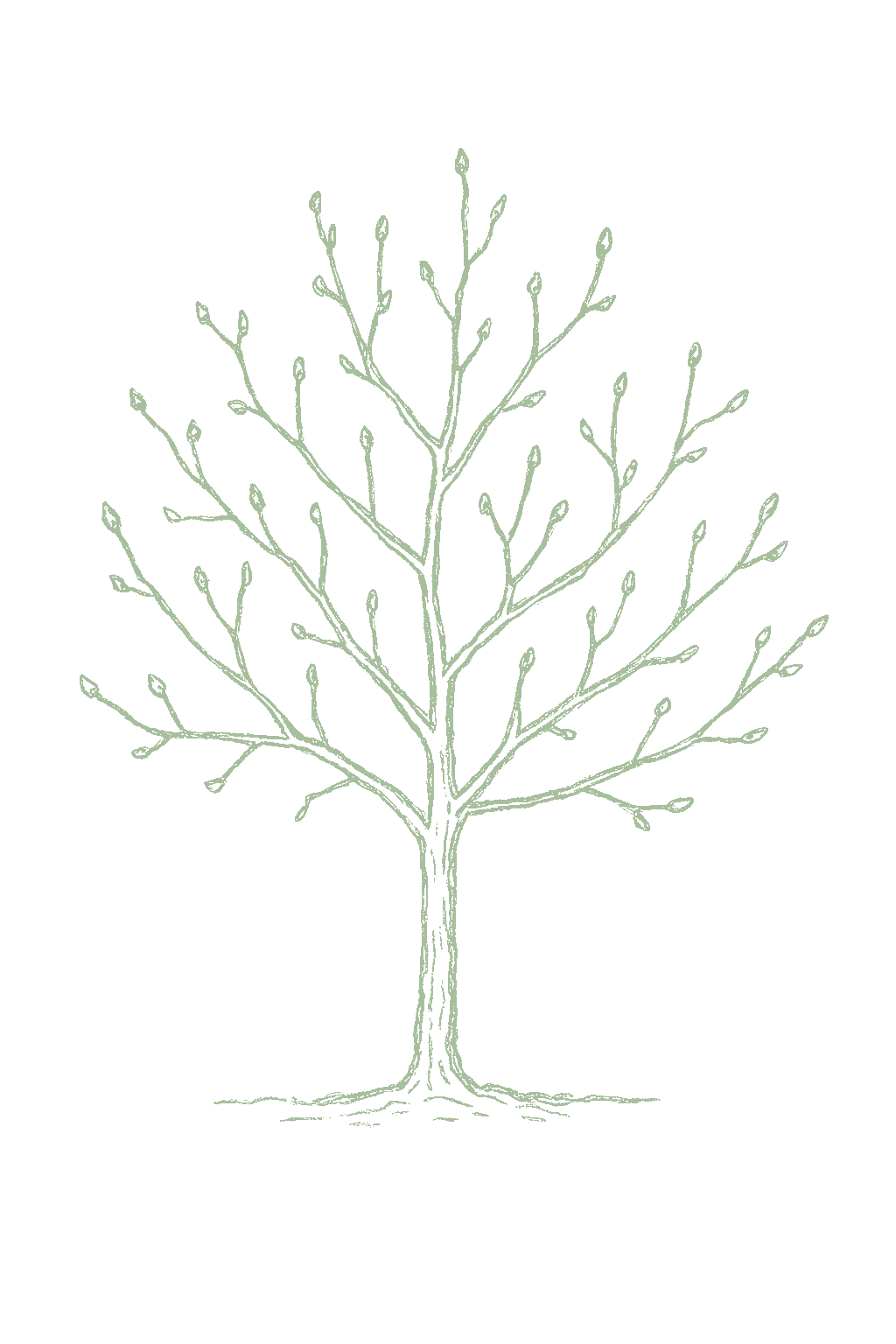
Winter dormancy
A bare, resting tree, often still holding bright orange fruit after the leaves have fallen, which looks striking. Persimmon needs only a little winter cold (about 100 to 200 hours for Asian types) to wake up properly in spring.A leafless tree at rest, often still holding bright orange fruit that clings decoratively after the leaves drop. Persimmon needs only a modest amount of winter chill (roughly 100 to 200 hours for Asian types) to break dormancy evenly.
Not much to do beyond cleanup: clear fallen and dried-up fruit and cut out any dead branches while you can see the shape. An established tree needs very little water now.Little is required beyond winter sanitation: clear fallen and mummified fruit and prune out any dead or cankered wood while the structure is visible. Established trees need minimal water now.
FROM PLANT · Persimmon needs only a little winter cold (about 100 to 200 hours for Asian types), so it fruits in mild-winter areas where peaches struggle.Persimmon needs only modest winter chill (roughly 100 to 200 hours for Asian types), so it fruits across mild-winter zones where high-chill stone fruit fails.
FROM PLANT · Clear away fallen and dried-up fruit during winter. It carries anthracnose disease into the next year.Clear fallen and mummified fruit over winter; it is the main overwintering source of anthracnose for the coming season.
05
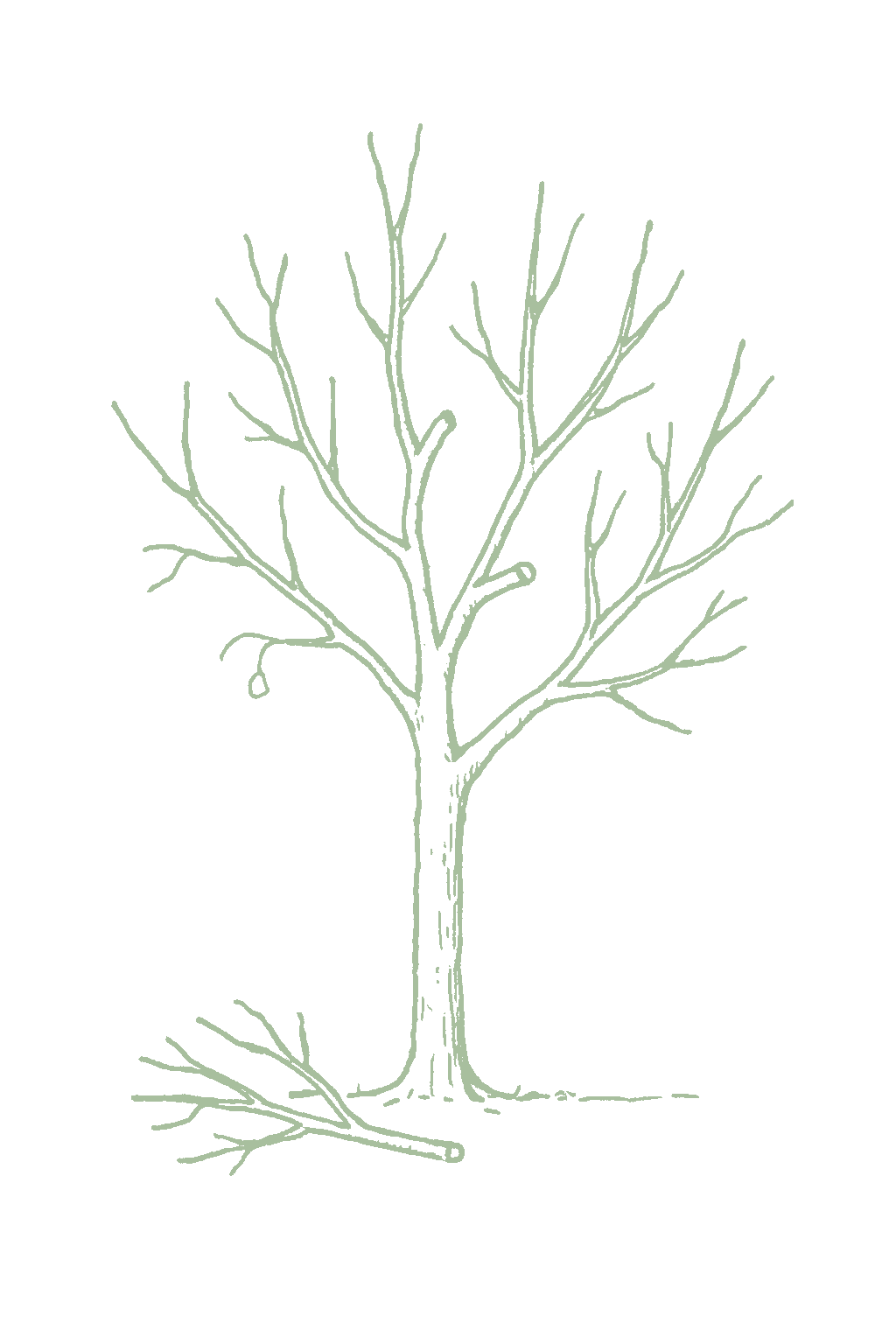
Dormant pruning
Bare branches, so you can see the whole shape. Persimmon fruits on new shoots and its wood breaks easily, so you only need light pruning to keep the shape and open the middle, not the hard cutting peaches get.Bare branches that show the framework clearly. Persimmon fruits on new growth from the previous season's wood, and its wood is brittle, so the aim is light structural pruning and thinning, not the hard renewal cuts stone fruit needs.
Prune lightly in late winter: take out dead, crossing, and weak branches, thin to let light in, and shorten any long, heavy limbs so they do not snap under fruit. Make clean cuts so borers and disease have fewer wounds to enter.Prune lightly in late dormancy: remove dead, crossing, and weak wood, thin to let light in, and shorten overly long or heavy limbs to reduce breakage under a fruit load. Make clean cuts to limit the wounds that draw borers and canker.
FROM PLANT · Prune persimmon much more lightly than peaches: take out dead and crossing branches and thin to let light in, but skip the heavy cutting stone fruit gets.Prune persimmon far more lightly than stone fruit: remove dead and crossing wood and thin for light, but avoid the hard renewal cuts peaches need.
FROM PLANT · Shorten any long, heavy branches so they do not break under the fruit, and make clean cuts so borers and disease have fewer wounds to get in.Shorten long, heavy limbs to reduce breakage under fruit, and make clean cuts to limit the wounds that draw borers and canker.
06
Bloom
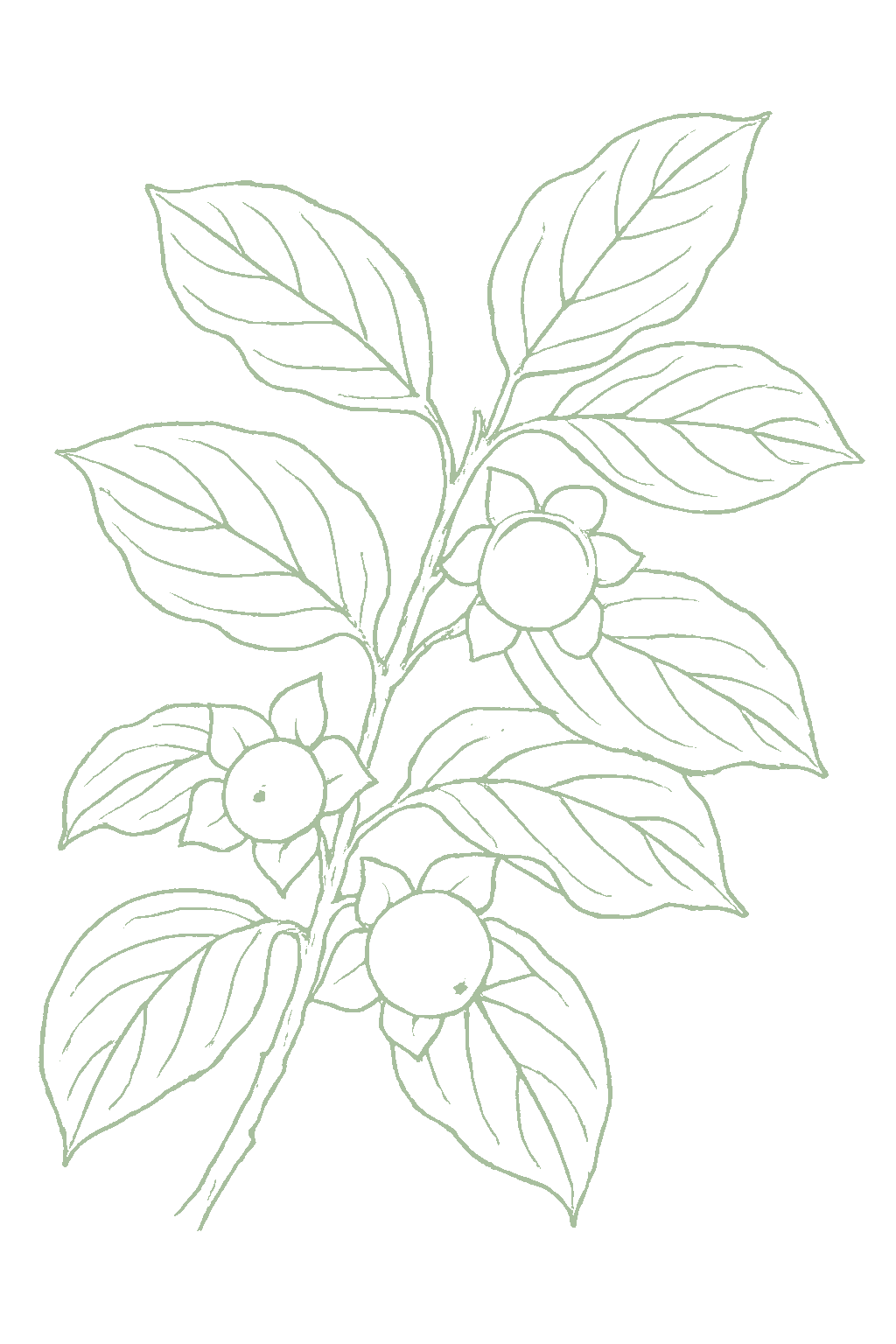
Small, easy-to-miss cream or yellow flowers. Asian persimmons fruit on their own, often making seedless fruit with no pollen. American persimmons usually need a separate male tree nearby unless it is a self-fruitful kind. Because persimmon blooms late, frost is rarely a problem.Small, inconspicuous cream-to-yellow flowers. Asian persimmons are self-fruitful and set fruit alone, often parthenocarpically (seedless); American persimmons are usually dioecious, so a female needs a male nearby unless it is a self-fruitful selection. Late bloom means frost is rarely a threat.
There is little to do. If you have an American persimmon that is not fruiting, make sure a male tree is nearby. Otherwise let the self-fruitful tree set fruit on its own; bees visiting the flowers help a little.Little intervention is needed. Ensure a pollinizer is present for dioecious American females if fruit set is poor; otherwise let the self-fruitful tree set its own crop. Support bloom-time pollinator activity as a modest aid.
FROM PLANT · Persimmon blooms late, in May or June, so it usually dodges the spring frosts that wreck earlier fruit trees. That makes it more dependable in frosty areas.Persimmon blooms late (May to June), so it largely escapes the spring frosts that ruin earlier-blooming fruit, a major reliability advantage in frost-prone areas.
FROM PLANT · Know your type. Asian persimmons fruit on their own, often with no seeds. American persimmons usually need a separate male tree nearby, unless it is a self-fruitful kind like Meader.Know your type: Asian persimmons are self-fruitful and set alone (often seedless), while American persimmons are usually dioecious and a female needs a male nearby, unless it is a self-fruitful cultivar like Meader.
07
Fruit set and drop
Small green fruit forming, then a natural drop of some of it in early summer, which is normal. If a lot drops, the tree may be too dry or over-fed with nitrogen. Persimmon usually does not need you to thin the fruit by hand.Small green fruit developing, followed by a natural early-summer drop of a share of it, which is normal. Excessive drop can signal water stress or over-fertilization (especially too much nitrogen). Persimmon rarely needs hand thinning.
Keep the water steady to reduce fruit drop and do not over-feed with nitrogen. If a young tree is loaded and its branches might break, thin a little or prop the limbs; otherwise leave the tree to sort itself out.Keep moisture steady to limit excess drop and hold off on heavy nitrogen. On a young tree carrying a heavy set on brittle wood, light thinning or limb support prevents breakage; otherwise let the tree self-regulate.
FROM PLANT · Persimmon naturally drops some small fruit in early summer, which is normal. Heavier drop usually means the tree is too dry or over-fed, so keep the water steady and go light on fertilizer.A natural early-summer fruit drop is normal; heavier drop usually means water stress or excess nitrogen, so keep moisture steady and feed lightly.
08
Harvest
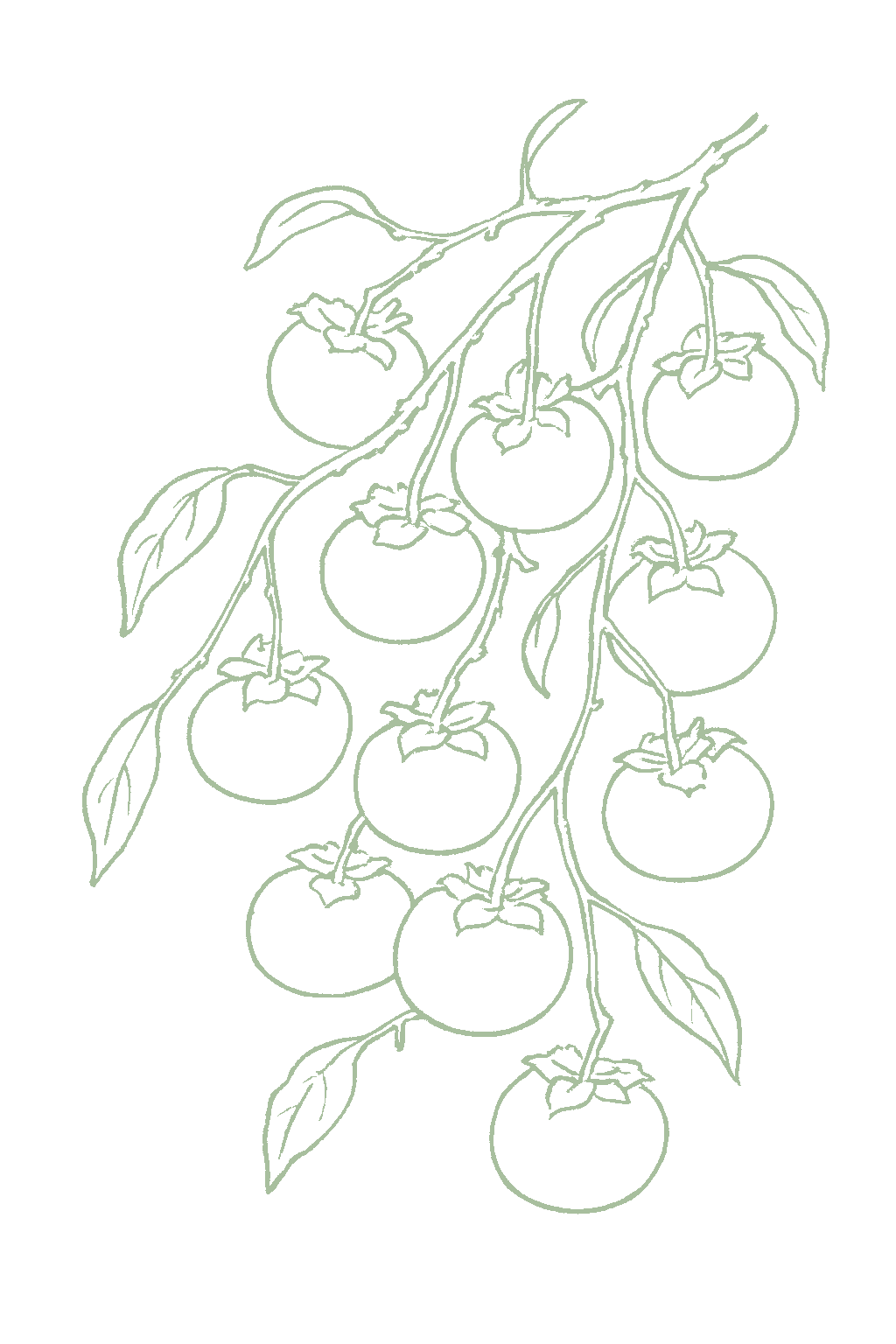
The fruit turns fully orange. Firm types (Fuyu) are picked while still firm and eaten crisp; astringent types (Hachiya, most American) are picked when fully colored and then left to soften completely before eating. The fruit hangs on well and comes off with the leafy cap attached.Full orange color across the fruit. Non-astringent types (Fuyu) are picked firm and eaten crisp; astringent types (Hachiya, most American) are picked at full color and ripened to jelly-soft before eating. Fruit holds well on the tree and clips or twists free with the calyx attached.
Clip or gently twist off ripe fruit, keeping the leafy cap on, instead of yanking it. Pick firm types to eat crisp, and pick astringent types when fully orange, then let them soften on the counter. The fruit holds on the tree into cool weather, so there is no rush.Clip or twist ripe fruit with the calyx intact rather than pulling, to avoid tearing. Harvest firm non-astringent fruit for crisp eating; pick astringent fruit at full color and counter-ripen. Fruit can be left hanging into cool fall weather, so harvest is unhurried.
FROM PLANT · Pick by type: harvest firm types like Fuyu while still firm and eat them crisp. Pick astringent types like Hachiya when fully orange, then let them soften all the way before eating.Match harvest to type: pick non-astringent Fuyu firm for crisp eating, and pick astringent Hachiya and American types at full color, then ripen to jelly-soft before eating.
FROM PLANT · Clip or gently twist the fruit off with the leafy cap on instead of yanking it. Persimmon holds on the tree well, so you can pick it over cool fall weeks without rushing.Clip or twist fruit off with the calyx attached rather than pulling, and take advantage of persimmon holding well on the tree to harvest at leisure into cool fall weather.
The specs

Care guide

The numbers that matter, at a glance.

Sunlight
full sun · 6-8 hrs/day
Water
moderate
Spacing
15 to 18 feet
Soil
loam
Soil pH
6 to 6.5
Container OK?
No
In a pot

Not suited to a pot

Persimmon really wants to grow in the ground, where it becomes a good-sized tree. A pot is a workaround only for a naturally dwarf variety or where you have no space for a full tree. It can be done, but expect more hands-on watering and smaller crops. Use the biggest well-draining pot you can, and give it winter protection in cold areas.Persimmon is fundamentally a ground tree that reaches 15 to 30 feet, so a container is a compromise reserved for genetic-dwarf selections or space-limited gardens. It is workable but demands closer watering, feeding, and winter protection than an in-ground tree, and crops are lighter. Use the largest practical pot with excellent drainage, since the species will not tolerate a mix held wet against the roots.

Mature size
20 to 30 feet tall, 15 to 25 feet wide
Soil chemistry

Soil pH for persimmon

Preferred
6 to 6.5
Tolerated
6 to 7

Persimmon does best in a slightly acidic soil, around pH 6.0 to 6.5, and is fine up to about 7.0 (pH is just a measure of how acidic or alkaline the soil is). Test your soil before planting the permanent tree. If it is too acidic, garden lime raises the pH; if it is too alkaline, elemental sulfur lowers it. Mix any amendment in before planting, since pH changes slowly and is far easier to correct before the tree is in the ground.Persimmon prefers a slightly acidic pH 6.0 to 6.5 and tolerates up to about 7.0. Test before planting and adjust gradually: lime raises a too-acidic pH, elemental sulfur lowers one that is too alkaline. Work amendments in ahead of planting the permanent tree, since pH shifts slowly and is easiest to correct before establishment.

Verified · 2 sources View
Steady hand on the hose

Watering

When & how much
Frequency
Water deeply now and then rather than a little every day. A young tree needs a deep soak about once or twice a week for its first couple of years. An older tree handles dry spells well and is happy with roughly a weekly deep soak in summer, less when it is cool, and almost nothing in winter. Do not keep the soil soggy, since that causes root rot.Water deeply and infrequently. A young tree wants a deep soak about once or twice a week through its first two seasons; an established tree is fairly drought-tolerant and does well on roughly weekly deep watering in summer heat, less in cool weather and little through winter dormancy. Persimmon prefers infrequent, thorough irrigation over frequent shallow watering, and standing-wet soil invites root rot.
Amount
Each time you water, give a deep soak that reaches down to the roots, not just a splash on top. A young tree wants about 5 gallons per soak; an older, fruiting tree wants about an inch of water a week through the growing season, and more in a heat wave. Deep soaks build deep roots that handle dry spells.Soak deeply enough to wet the full root zone rather than just the surface: on the order of 5 gallons per watering for a young tree, and roughly the equivalent of an inch of water per week for a bearing tree through the growing season, more in extreme heat. Deep, thorough soaks drive the deep rooting that carries an established persimmon through dry stretches.
Method
Water the ground around the roots with a drip line or soaker hose, out to the edge of the branches, and keep the base of the trunk from sitting wet. Persimmon handles dry better than soggy, so let the soil dry a bit between waterings. In humid areas, avoid spraying water over the leaves, which can bring on leaf diseases.Water at the root zone with drip or a soaker hose out toward the drip line, keeping the trunk base from staying wet. Persimmon tolerates drought better than waterlogging, so the discipline is deep-then-dry, never continuously saturated. Overhead watering that wets the canopy in humid regions can encourage anthracnose and leaf spot.
Signs of trouble
Too much water
Yellow leaves, wilting even when the soil is wet, and a tree slowly going downhill mean too much water and the risk of root rot, which persimmon catches easily. Soil that never dries out is your signal to back off. Overwatering hurts persimmon more than underwatering does.Yellowing leaves, wilting that persists in wet soil, and general decline point to waterlogging and possible root or crown rot, to which persimmon (especially Asian types) is prone. Soil that never dries between waterings is the warning; this is far more dangerous to persimmon than underwatering.
Too little water
Wilting, dull or curling leaves, slower growth, and, the clearest sign, fruit dropping early or staying small when the tree gets too dry while the fruit is filling out. An older persimmon can take some dryness, but the crop suffers if it goes too dry for too long.Wilting, dull or curling leaves, slowed growth, and, most tellingly, premature fruit drop or small, poorly sized fruit when a tree runs dry during fruit development. An established persimmon endures moderate drought but sizes its crop poorly under sustained water stress.
Feeding rhythm

Feeding

Frequency
1-3x per year
Type
balanced granular (e.g. 10-10-10)
When to start
late dormancy, split with early and late summer

Persimmon barely needs feeding, and too much fertilizer, especially nitrogen, makes the fruit drop off. Go light. Scatter it evenly on the soil around the tree out to where the branches reach, keep it off the trunk, and water it in. On good soil an older tree may need nothing at all, so only feed if the tree looks weak or the leaves are pale.Persimmon needs little feeding and is easily over-fed: excess nitrogen causes premature fruit drop. A light program suits it, split across the season on sandy soils (the bulk in late dormancy, a lighter touch in early and late summer), broadcast evenly around the root zone to the drip line and kept off the trunk. On decent soil an established tree may need no fertilizer at all; feed only if growth is weak or leaves are pale.

N · P · K = 10-10-10

A balanced fertilizer like 10-10-10 (the three numbers are nitrogen, phosphorus, and potassium) is all persimmon needs, and often it needs none. Do not overdo it, because too much, especially the first number, nitrogen, makes the fruit fall off.A balanced ratio such as 10-10-10 is plenty for persimmon; the tree is a light feeder and over-fertilizing, particularly with nitrogen, drops fruit rather than improving it. Err toward less.

Try 10-10-10 balanced fertilizer
Who grows well together

Companion planting

Most Asian persimmons are self-fruitful, so one tree fruits on its own and you do not need a partner tree. American persimmons are different: they usually have male and female trees, so a female needs a male American persimmon nearby to fruit, unless you plant a self-fruitful kind like Meader. For a tree, the pairings that matter are not vegetable-garden companions but what grows around the roots: keep grass and weeds pulled back from under the branches, since lawn competes with a young tree, and a mulched, weed-free circle helps it settle in. Persimmon is a low-pest, easygoing tree, so there is little else to fuss over. Asian persimmon (D. kaki) is self-fruitful, so a single tree crops without a pollinizer; American persimmon (D. virginiana) is typically dioecious and a female needs a male within roughly 50 to 200 feet, the exception being self-fruitful selections like Meader. The interactions that matter for a tree concern the root zone, not classic vegetable companions: keep turf and weeds cleared back from under the canopy, since grass competes hard with a young tree, and a mulched, competition-free root area speeds establishment. Persimmon is notably low-pest and low-maintenance, so companion planting is a minor consideration here.

Other
Flowering herbs and pollinator plants
A skirt of flowering herbs and pollinator plants around a persimmon supports orchard-floor health. Because persimmon is self-fruitful and its Asian cultivars set fruit parthenocarpically, the pollinator draw is a bonus rather than a requirement, but the same flowers recruit the ladybugs, lacewings, and parasitic wasps that keep scale, mealybug, and persimmon psyllid at tolerable levels, which is exactly the natural-enemy approach UC IPM recommends for this low-spray tree. Keep the plantings out toward the drip line rather than crowding the trunk. Traditional
Keep apart from
Lawn and weeds crowding the young trunk Grass and weeds pressed up against a young persimmon are the pairing to avoid. Turf competes hard with a newly planted tree for water and nitrogen and measurably slows establishment, and growth against the trunk also traps moisture and invites string-trimmer wounds. Keep a mulched, weed-free circle a few feet out from the trunk through the establishment years, keeping the mulch itself off the bark. Research-backed
Provenance tagged inline · see methodology for the labeling system Key
Harvest signals

When to pick

A persimmon is ready when the fruit turns fully deep orange. For firm types like Fuyu, orange plus a firm feel means you can pick and eat it crisp. For astringent types like Hachiya and most American persimmons, orange means ready to pick but not yet to eat: let them sit until completely soft and jelly-like, when the pucker is gone. Clip or gently twist the fruit off with the leafy cap on instead of pulling. The fruit hangs on well into cool fall weather, so you do not have to rush.Persimmon is ready when the fruit reaches full, deep orange color. For non-astringent types (Fuyu), that plus a firm feel means ready to pick and eat crisp. For astringent types (Hachiya and most American persimmons), full color means ready to harvest, but not yet to eat: they must then ripen to a jelly-soft, nearly translucent stage before the astringency clears. Clip or twist fruit free with the calyx (the leafy cap) attached rather than pulling. The fruit holds on the tree well into cool fall weather, so harvest can be unhurried.

Verified · 2 sources View
Yield

What to expect

A grown persimmon can give a lot of fruit, often 50 to 100 pounds or more for an Asian tree and even more for a big American tree in a good year. Once it settles in, persimmon bears well and steadily, and you rarely need to thin the fruit the way you do with peaches.A mature standard persimmon commonly yields on the order of 100 to 300 pounds in a good year for a large American tree, and roughly 50 to 100 pounds or more for a well-grown Asian tree, depending on variety, age, and season. Persimmon tends to bear heavily and reliably once established, and rarely needs the thinning stone fruit demands.

A persimmon hits full production around years five to seven and keeps bearing for decades. American persimmons are especially long-lived; Asian ones can be shorter-lived in humid areas where trunk disease is a problem.Trees reach full bearing around years five to seven and stay productive for decades, with American persimmon especially long-lived. Asian persimmon in disease-prone humid regions may be shorter-lived where trunk canker is a factor. Do not expect fruit the first year, or really the first two or three. Pick off any early fruit so the young tree builds roots and branches. Your first real harvest usually comes around years three to five, with full crops by years five to seven.Expect no crop in the planting year and little to none for the first two to three years. Remove any early fruit so the tree builds roots and framework; the first meaningful harvest typically comes around years three to five, with full bearing by years five to seven.

What changes yield
type (Asian vs American) and cultivartree age and establishmentadequate winter chill for the cultivarsteady moisture during fruit developmentavoiding excess nitrogen (which drops fruit)summer heat and sunburn in desert zonesdisease pressure (anthracnose, trunk canker) in humid regions
Verified · 2 sources View
Off the vine

Storing your harvest

Room temp
Firm-eaten types like Fuyu keep on the counter for a week or more and just slowly soften. Astringent types like Hachiya need to sit out until they turn completely soft and jelly-like before you eat them, or they taste harshly puckery. Persimmons keep ripening after picking, so leaving astringent ones on the counter to soften is exactly right.Non-astringent types (Fuyu) are eaten firm and hold at room temperature for a week or more, softening slowly. Astringent types (Hachiya) must be held at room temperature until they ripen to a jelly-soft, fully translucent stage before eating; rushing them leaves an intensely puckery, tannic mouthfeel. Persimmons continue to ripen after picking, so counter-ripening astringent fruit is normal practice.
Fridge
Firm Fuyu-type persimmons keep in the fridge for several weeks, better than most fruit. Put soft, ripe Hachiya-type fruit in the fridge only once it is fully soft, and eat it within a few days.Refrigerate firm non-astringent persimmons to hold them for several weeks; they keep notably better than most tree fruit. Refrigerate soft-ripe astringent fruit only once fully ripe and use within a few days. Chilling can be used to speed some astringent types toward ripeness, but eating quality is best judged by full softness.
Freezer
Persimmons freeze nicely as pulp. Scoop out the soft ripe flesh, mix in a little lemon juice so it does not brown, and freeze it in portions. It keeps for months and is great for baking. You can also freeze whole astringent persimmons; thawing softens them and takes away the pucker.Persimmons freeze well as pulp. Scoop the soft, ripe flesh of astringent types, or puree non-astringent flesh, add a little lemon juice to limit browning, and freeze in portions. Frozen pulp keeps for several months and is ideal for baking, cookies, and puddings. Whole astringent fruit can also be frozen and thawed, which softens and de-astringes them.
Verified · 2 sources View
When something goes wrong

Common problems

The tree is healthy but gives no fruitTree grows well but sets no fruit
01 of 03
What happened A healthy tree that never fruits is usually an American persimmon female with no male tree nearby, because American persimmons usually need separate male and female trees. It might also just be too young (persimmon takes three to five years), or a male seedling that will never fruit. The fix depends on the type: for a single tree, plant a self-fruitful Asian variety like Fuyu, or a self-fruitful American kind like Meader; if you have an American female, add a male American persimmon nearby.A vigorous tree that never fruits is most often an American persimmon female with no male pollinizer nearby, since American persimmons are typically dioecious. It can also simply be a young tree not yet of bearing age (three to five years), or occasionally an all-male seedling that will never fruit. The fix is type-aware: for a lone tree, choose a self-fruitful Asian variety (Fuyu, Hachiya) or a self-fruitful American selection (Meader); for existing American females, add a male American persimmon nearby. Next season Find out what type and sex your tree is. A self-fruitful Asian variety fruits on its own; an American female needs a male tree nearby.Identify your tree's type and sex. Plant a self-fruitful Asian cultivar for guaranteed fruit on one tree, or ensure a male is present for a dioecious American female.
The fruit is harshly puckery and dries out my mouthThe fruit is harshly astringent and puckers the mouth
02 of 03
What happened Harsh pucker almost always means you ate an astringent type (Hachiya, or most American persimmons) before it was fully ripe. Astringent kinds are only good once they turn completely soft and jelly-like; eaten firm, they are intensely puckery. It is not a bad fruit, just eaten too early. Firm types like Fuyu can be eaten crisp with no waiting.Intense astringency almost always means an astringent-type persimmon (Hachiya, most American types) was eaten before it was fully ripe. Astringent types are only edible once ripened to a jelly-soft, translucent stage, when the tannins have converted; picked or eaten firm, they are mouth-puckeringly tannic. This is not a defect but a type mismatch in handling. Non-astringent types (Fuyu) can be eaten firm and crisp with no such stage. Next season Let astringent types get completely soft before eating (freezing them or a warm spot helps), or grow a non-astringent Fuyu type you can eat crisp.Ripen astringent types to full jelly-softness before eating (freezing or a warm spot speeds it), or plant a non-astringent Fuyu type you can eat firm.
Lots of small fruit falls off before it ripensYoung fruit drops heavily before ripening
03 of 03
What happened Persimmon naturally drops some small fruit in early summer, but heavy drop usually comes from uneven or too-little watering while the fruit is growing, or from too much fertilizer, especially nitrogen, which makes persimmon drop fruit instead of growing more. Young trees also just hold little fruit. The fix is steady watering while the fruit fills out and going light on fertilizer.Some early-summer fruit drop is a normal self-regulation, but heavy drop usually traces to water stress (erratic or insufficient moisture during fruit development) or over-fertilization, especially excess nitrogen, which persimmon responds to by shedding fruit rather than growing more. Young trees also naturally hold little fruit. The corrective action is steady moisture through fruit fill and a light hand with fertilizer. Next season Keep the water steady while the fruit is growing and do not over-feed with nitrogen. On a young tree, prop up or lightly thin a heavy load so branches do not break.Keep moisture even through fruit development and avoid heavy nitrogen; on a young brittle-wooded tree, support or lightly thin a heavy set to prevent limb breakage.
The usual suspects

Pests & diseases

Pests
Scale insects
P · 01
Symptoms Little bumps stuck to the bark and twigs that never move. White peach scale looks like patches of snow-white crust on the trunk and branches; it scrapes off easily, and it stands out most in warm weather when the tiny winged males come out. If the bumps are one of the soft scales instead, you will also find a sticky coating (honeydew) on the leaves and branches below them that turns black with mold and brings ants. White peach scale makes no honeydew, so a crusty trunk with no stickiness is the usual persimmon picture.Small, immobile bumps fixed to bark and twigs. White peach scale, the species Florida names, shows as snow-white patches on the trunk and limbs that scrape off easily and are most visible when the males emerge in warm weather. Where the scale is a soft species, such as the tuliptree scale Georgia expects, the colony also drips sticky honeydew that grows black sooty mold and draws ants; white peach scale and the other armored scales produce no honeydew at all. Cause Tiny sap-sucking insects that live under a hard or waxy covering. On persimmon the main one is white peach scale, and soft scales such as tuliptree scale turn up too. Only the soft kinds drip the sticky honeydew that grows black mold. Scale gets out of hand when a spray aimed at some other pest kills off the helpful insects that normally eat it.Several scale species feeding on sap under a protective covering: white peach scale (Pseudaulacaspis pentagona), the armored species Florida names for persimmon, and the soft scales, with tuliptree scale the one Georgia expects. Only the soft scales excrete honeydew, which is what the sooty mold grows on. Populations flare where natural enemies have been removed, most often by sprays made for some other pest. Organic treatment Let the helpful bugs do the work by avoiding broad sprays, since ladybugs and tiny wasps usually keep scale in check on persimmon. Cut out and throw away badly crusted branches. A spray of horticultural oil while the tree is leafless in winter smothers the scale on the bark and is the simplest hands-on control.Preserve natural enemies (ladybugs, parasitic wasps) by not spraying broadly, since they usually hold scale to tolerable levels on persimmon. Prune out and destroy heavily encrusted wood. A dormant-season horticultural oil application smothers overwintering scale on the bark and is the main direct control for a backyard tree. Prevention The best prevention is to leave the tree unsprayed unless you have a real reason, because the helpful insects already on it keep scale in check, and a spray aimed at some other pest is the usual way scale gets loose. Glance over the trunk and branches for white patches, easiest to spot in warm weather. If you decide on an oil spray, the time for it is late winter, just before the buds start to swell.The standing protection is not spraying for other pests, since UGA's observation is that scale on an unsprayed persimmon is generally held by parasites, predators and diseases and that sprays for something else are what release it. Look the trunk and limbs over for white patches, which are easiest to see when the males emerge in warm weather; if a dormant oil is going on, its slot is shortly before bud swell, and an in-season oil is timed by wrapping an infested twig with double-sided sticky tape in spring to catch the crawler emergence.
The control ladder

The ladder troubleshoots from the gentlest solution to the strongest. Start with the gentlest option and only move on when and if it doesn't work.

  1. Garden sanitation

    Look the trunk and branches over while the tree is bare in winter. White peach scale shows up as snow-white patches on the bark that scrape off easily, and on a small tree, if only a few twigs or branches carry a heavy crust, cut those off and get them away from the tree. That takes the colonies out along with the wood they are fixed to, and nothing you spray afterward has to cover them.Dormant pruning is the natural inspection pass, since white peach scale sits on the trunk and limbs where the bare tree makes it obvious. UC IPM's condition is specific: prune off heavily infested twigs and branches only when they are limited to a few parts of a small plant, which makes this a pruning-out-colonies move rather than a treatment for a tree encrusted end to end. Florida's guide adds a warm-weather cue, since the white patches are most visible when the males emerge.

  2. Ant exclusion

    First see whether ants are climbing the tree. White peach scale gives off no honeydew, so ants have no reason to visit it; a trail of ants on a persimmon means something that makes honeydew is there: one of the soft scales (Georgia expects tuliptree scale), mealybugs, or the persimmon psyllid, any of which drips the sugary honeydew ants collect. Ants defend the insects they tend against the ladybugs and small wasps that eat them, so keep the ants off: put a band of heavy paper or tree wrap around the trunk, spread a sticky barrier on the band and not on the bark itself, and remove any branch or weed that lets ants walk in from the ground or a wall.Scoped to the soft-scale part of the picture: armored scales such as white peach scale produce no honeydew, so there is nothing for ants to tend and a barrier buys nothing against them. Where the scale is a soft species and ants are working it, UC IPM's instruction is to control the ants because they attack the parasites and predators of scale, and to deny them the canopy by pruning bridging branches or weeds and applying a sticky material to the trunk over a wrap. It restores the biological control the next step relies on rather than acting on the scale itself.

  3. Beneficial predators

    On an unsprayed persimmon, scale is usually held down for you. Georgia's guide says that where nothing is sprayed, scale is generally kept under control by natural parasites, predators and diseases, and that spraying for other pests often lets scale loose from that control. So the main thing is what you do not do: keep strong, broad insect sprays off the tree, and the ladybugs, lacewings and small parasitic wasps that attack scale will keep working.Conservation is the operative control here, and the persimmon documents say so directly: UGA has scale generally kept under control by parasites, predators and diseases in unsprayed situations, with sprays made for other pests the usual reason it escapes; UF names ladybird beetles and lacewings for biological control; UC IPM advises against foliar broad-spectrum insecticides whose residues persist for weeks. A scale flare on a persimmon is worth reading as a question about what was sprayed last season before it is read as a call for a spray this one.

  4. Horticultural oil

    When scale is spreading in spite of all that, horticultural oil is the spray both Georgia and Florida point to, and the time for it is late winter, shortly before the buds swell, while the tree is still bare. Oil kills by coating and smothering, so it only works on scale it actually wets: soak the bark of the trunk, the limbs and the ends of the branches. Skip it on a drought-stressed tree and on days above 90°F, when it can scorch the tree.Dormant oil is the documented direct control: UGA has an application shortly before bud swell giving good control, and UF's cell is a 3% dormant oil before bud break, with summer oil as the in-season alternative. UC IPM supplies the reasoning behind the timing: overwintering scale on a deciduous tree is reached by thoroughly spraying the bark of terminal shoots in winter, and an in-season oil works only when applied soon after most crawlers have emerged and the scales are still young nymphs, which a band of double-sided sticky tape around an infested twig in spring will show you. Coverage governs the result, and oil stays off a water-stressed tree and out of heat above 90°F.

No spray for this one. Prevention is the control.

Mealybugs
P · 02
Symptoms Small soft insects covered in white, cottony fluff, tucked into sheltered spots: where branches fork, at the base of a stem, where a leaf lies against a stem, and inside the leaves that persimmon psylla has curled up in spring. You often notice the sticky honeydew, the black mold growing on it, or the ants feeding on it before you notice the bugs. On persimmon they are an occasional visitor rather than a regular pest.Soft, oval insects covered in white wax, gathered in the protected places on a tree: branch crotches, the base of a stem, between a stem and a leaf lying against it, and, on persimmon, inside the leaves curled by persimmon psylla. Their sticky honeydew, the black sooty mold that grows on it, and ants feeding on it are often the first signs. Persimmon carries few serious insect problems, and mealybugs are reported on it as an occasional case. Cause Sap-sucking insects called mealybugs that tuck themselves into sheltered spots on the tree, such as the forks of branches and the curled leaves left by persimmon psylla. Ants often protect them for their sweet honeydew, which lets the mealybugs build up.Mealybugs, sap-sucking insects that shelter in protected crevices on the tree. The guides read name only the longtailed mealybug (Pseudococcus longispinus), which UF lists with persimmon among its hosts. Ant-tended colonies persist because ants protect them from their natural enemies in exchange for honeydew. Organic treatment Let natural predators handle most mealybugs, and avoid broad sprays that kill those helpers. Stop ants from climbing the trunk with a sticky band so the predators can reach the mealybugs. Dab visible clusters with horticultural oil or insecticidal soap.Rely first on natural enemies, which generally keep mealybugs below damaging levels on landscape fruit trees; avoid the broad-spectrum sprays that disrupt them. Control honeydew-farming ants (sticky trunk bands) so predators can work. Spot-treat visible colonies with a horticultural oil or insecticidal soap. Prevention Keep the helpful insects around by not spraying broadly, and keep ants off the trunk. If persimmon psylla has curled the new leaves in spring, look inside those leaves, because mealybugs often turn up in the same place.Maintain biological control by avoiding broad-spectrum insecticides for any pest in the area, and keep ants out of the canopy so the predators can reach the colonies. Persimmon psylla and mealybugs share the same curled spring leaves and the same honeydew-feeding ants, so a spring with psylla damage is the time to look for them.
The control ladder

The ladder troubleshoots from the gentlest solution to the strongest. Start with the gentlest option and only move on when and if it doesn't work.

  1. Ant exclusion

    If mealybugs have built up on a persimmon, look for ants on the trunk first. Ants feed on the honeydew mealybugs give off and, in return, keep the beetles and small wasps that eat mealybugs away from them, so a colony with ants tending it grows where one left alone would fade out. Put a band of heavy paper or tree wrap around the trunk, coat the band with a sticky barrier (never the bare bark), and trim any low branch that touches the ground, a fence or another plant so the ants have no way around it.UC IPM's mealybug guidance is to keep ants out of infested plants because ants protect mealybugs from their natural enemies, and on a persimmon the ant trail up the trunk is the thing to break. Florida's persimmon table makes the same point from the psylla side, where mealybugs turn up in the same curled leaves and the ants feeding on the honeydew may also need controlling. A sticky band over a trunk wrap and the removal of bridging branches restore the predation this pest is normally held by.

  2. Water spray

    Where the cottony clumps sit out in the open on shoots or branches, turn the hose on them at full pressure; a persimmon is sturdy enough to take it, and a good many mealybugs are dislodged that way. Choose a morning so the foliage has the day to dry off, and count on going back over the tree, since some always cling on.UC IPM allows that on sturdy plants a high-pressure or forcible water spray can reduce mealybugs that are somewhat exposed; it does nothing for colonies tucked into crotches and crevices, so it is a knock-back on visible clusters, with no residue and no cost to the natural enemies.

  3. Beneficial predators

    Outdoors, most mealybugs are eaten before they matter. Ladybugs, lacewings and small parasitic wasps keep them below damaging levels on garden trees, and persimmon is a crop with few serious insect problems to begin with. Keep strong, broad-spectrum insect sprays off the tree so those helpers stay.Natural enemies are the standing control: UC IPM's statement is that most species have natural enemies that keep populations below damaging levels in landscapes and gardens, with the mealybug destroyer lady beetle the predator it singles out, and its fruit-tree note is that citrus has the most problems while on stone and pome fruits mealybugs are rarely at damaging levels, a scope that stops short of persimmon. Georgia calls oriental persimmon relatively free of serious insect problems, which is the reading behind this pest's low grade. Preserving the enemies means avoiding broad-spectrum insecticides for any pest in the area, not just this one.

  4. Insecticidal soap

    For clumps that keep coming back, spray insecticidal soap straight onto them. Soap works only where it lands and only on what it wets, and the waxy coating sheds a lot of it, so the young ones with less wax are the ones it reaches best. Plan on more than one go, and keep it off a dry, stressed tree or a day over 90°F.UC IPM rates soaps, horticultural oils and neem as giving some suppression when applied directly on mealybugs, especially against younger nymphs with less wax accumulation. Suppression is the right word: the wax defeats a single wetting, colonies sit in crevices a spray runs past, and there is no residual. Spot application, repeated and confined to the clumps you can see, is the useful form; a blanket spray costs beneficials for little gain.

No spray for this one. Prevention is the control.

Persimmon psyllid
P · 03
Symptoms In spring the new leaves crinkle and roll up around tiny insects feeding inside, and some shoot tips twist into lumpy growth. Open a rolled leaf and you find flat young ones covered in white fluff, with small black adults on the leaf surface, and often a sticky film that can turn black with mold. It can stunt the tree's growth.New leaves crinkle, curl and roll around the feeding of the nymphs in spring, and shoot tips can twist and become galled. Inside the distorted leaves are the flattened, white-fluff-covered nymphs, with the small black-bodied adults on the leaf surface; the nymphs also drip honeydew on which sooty mold can grow. Florida lists stunted growth among the symptoms. Cause A small sap-feeding insect called the persimmon psyllid. Its young feed on the new spring leaves and make them curl. It is a minor pest that mostly just looks bad.The persimmon psyllid, a small sap-feeding insect whose nymphs feed on expanding leaves in spring and induce the characteristic leaf roll. It is a minor, mostly cosmetic pest of both native and Oriental persimmon. Organic treatment Usually nothing needs doing: tiny wasps and other helpers knock it back on their own, and the advice is not to spray until you have actually seen damage. Do not clip off the curled tips; snipping shoot ends during the growing season is something to keep to a minimum. Skip the broad insect sprays so the helpers stay. If a young tree is really being set back, horticultural oil is the gentle option, put on at the first spring growth, before the leaves curl.Usually no treatment is warranted: natural parasites limit it, and insecticides are held until damage has actually been observed. Do not clip out the rolled tips; NC State advises minimizing shearing or clipping of terminals during the growing season. Preserve the parasitic wasps and other natural enemies by keeping broad-spectrum sprays, pyrethroids in particular, off the tree. If treatment is chosen, horticultural oil suppresses adults and nymphs without a residue that harms beneficials, and it must go on early, because sprays are less effective once the leaves have curled. Prevention There is not much to do. A healthy tree with its natural predators intact keeps this pest to a harmless nuisance.Little is required. Keeping the tree healthy and preserving natural enemies keeps the psyllid a cosmetic nuisance rather than a problem.
The control ladder

The ladder troubleshoots from the gentlest solution to the strongest. Start with the gentlest option and only move on when and if it doesn't work.

  1. Beneficial predators

    Most years this one takes care of itself. Georgia's advice is that the psyllid is often held down by natural parasites and that you should not spray until you have actually seen damage; North Carolina's note, written for native persimmon, is that its numbers soon fall on their own as parasitic wasps and other enemies go to work. So leave the curled leaves alone, keep harsh insect sprays off the tree, and let the helpers finish. If the tree is being stunted and you decide to act, the material North Carolina names is horticultural oil, which smothers the psyllids without leaving a residue that hurts the helpful insects, and it has to go on at the first spring flush, because once the leaves have curled a spray reaches much less.Usually no treatment: UGA has the psyllid often limited by natural parasites and holds any insecticide until damage has been observed, and NC State describes, on native persimmon, populations that are temporarily abundant and then decline as parasitic wasps and other natural enemies catch up, with egg-to-adult development taking only a few weeks in spring. Conservation is therefore the working control, and pyrethroids, which NC State calls harsh on beneficials, are the wrong tool for it; NC State also advises minimizing the shearing or clipping of terminals during the growing season. Florida's table reads differently, calling for very early control because sprays are less effective once leaves curl, a stance written for an orchard; the home documents govern here. Where a grower does treat a stunted tree, horticultural oil is NC State's choice for sparing beneficials, timed to the first spring flush.

No spray for this one. Prevention is the control.

Persimmon borer
P · 04
Symptoms Sticky gum, droppings or what looks like sawdust coming out of small holes in the bark, out of old pruning cuts, or from the trunk right at the soil line: that is the list Florida gives for tree borers in general. This one feeds in the lower trunk and the big roots, so the bottom of the trunk is where to look for it. This is the one persimmon pest extension calls serious, so the base of the trunk is worth a look now and then.The signs Florida lists for its tree borers as a group, this one among them, are gummy sap, frass or sawdust coming from small holes in the bark, from pruning cuts, or on the trunk near the soil line; for the persimmon borer itself, Georgia places the larvae in the lower trunk and tap roots, so the trunk base is where its damage shows. Georgia calls it a serious pest of both native and oriental persimmons, seen attacking oriental persimmons in Georgia, and Clemson's advice is to monitor for it and to treat if damage is found on the trunk or exposed roots. Cause The larvae of the persimmon borer, a clearwing moth. They feed in the lower trunk and the large roots of both native and Asian persimmon. The preventive window extension gives is March through June, before the larvae get into the wood.Larvae of the persimmon borer, Sannina uroceriformis, a clearwing moth whose larvae attack the lower trunk and tap roots; it is known from both native and oriental persimmon and has been seen attacking oriental persimmons in Georgia. UF's window for preventive applications is March through June, to stop the larvae before they enter the tree. Organic treatment There is no organic fix on record for this borer once it is in the tree, and extension does not describe digging the larvae out with a wire for it (that advice is for a different borer). What the guides ask of you is to watch the base of the trunk and any exposed roots for gum, droppings and sawdust. Where the borer is found, what the guides describe is a preventive insecticide program like the one used for peachtree borer, timed March through June before the larvae get in; that is not an organic step, and the guides give no organic one to put in its place.There is no documented organic control for the persimmon borer once it is in the tree. UF notes limited direct control information and says controls for peachtree borer may be effective; Georgia says preventive insecticide treatments similar to those for peachtree borer will be required where infestations occur, and UF's window is March through June, to keep the larvae from entering. Wire probing of tunnels is described only for flatheaded borers, a different insect, and not for this one. The organic contribution is monitoring: check the trunk base and exposed roots for gum, frass and sawdust so that damage is found while a preventive program is still worth running. Prevention Check the bottom of the trunk and any roots showing above the soil for fresh gum, droppings or sawdust, since finding damage is what tells you treatment is needed. Where this borer is known to be active, the protection extension describes is a preventive insecticide treatment like the one for peachtree borer, put on from March through June, before the larvae get into the tree.Monitor: Clemson's instruction is to watch for the persimmon borer and to treat if damage is noted on the trunk or exposed roots, and the signs are gummy sap, frass or sawdust at small holes, pruning cuts or the trunk near the soil line. Where infestations occur, Georgia expects preventive insecticide treatments similar to those made for peachtree borer, and UF's window for them is March through June, ahead of the larvae entering the tree.
The control ladder

The ladder troubleshoots from the gentlest solution to the strongest. Start with the gentlest option and only move on when and if it doesn't work.

  1. Garden sanitation

    Extension gives a persimmon grower one job on this borer: watch for it. Clemson's advice is that it is important to monitor the persimmon borer, and that if borer damage is noted on the trunk or exposed roots, treatment may be required. What to look for, in the signs Florida gives for its tree borers as a group, is gummy sap, droppings or sawdust coming from small holes in the bark, from pruning cuts, or on the trunk near the soil line; Georgia puts this borer's larvae in the lower trunk and tap roots, so the bottom of the trunk and any roots showing above ground are where to look. Raking up under the tree does nothing here, because the larvae are in the wood and the roots, not in anything lying on the ground, and no persimmon guide describes a cleanup step against them. The treatment the guides describe is a preventive insecticide program like the one used for peachtree borer, which Florida times from March through June to stop the larvae getting into the tree, adding that little else is known about controlling it directly.No home control beyond monitoring and a preventive insecticide program is documented for Sannina uroceriformis. UGA calls it a serious pest of native and oriental persimmons whose larvae attack the lower trunk and tap roots, and says that where infestations occur, preventive insecticide treatments similar to those made for peachtree borer will be required; UF gives the window as March through June applications to keep larvae out of the tree and notes limited direct control information. Clemson's instruction is to monitor, and to treat if damage is noted on the trunk or exposed roots. The signs UF lists for its tree borers as a group, this species among them, are gummy sap, frass or sawdust at small holes, in pruning cuts, or on the trunk near the soil line; for this borer the soil line is the place to read them, since UGA puts its larvae in the lower trunk and tap roots. There is no sanitation target on record for this borer: no persimmon document describes litter, debris or a ground stage for the insect. Wire probing of tunnels is described only for flatheaded borers, a different insect that works the scaffold limbs, and no persimmon document describes it for the persimmon borer.
No spray for this one. Prevention is the control.

Diseases
Anthracnose
D · 01
Symptoms A rot that hits the fruit, especially as it ripens, and the shoots. On persimmon it is an occasional problem rather than a regular one. A bacterial disease can look similar, spotting the leaves and blackening the stems and leaf stalks, so a spotted leaf on its own is not proof of anthracnose.A rot of the fruit and shoots: Florida's guide lists Gloeosporium as the anthracnose ('bitter rot') that affects fruit and shoots, and Colletotrichum as affecting ripening fruit. A bacterial disease Florida also names on persimmon, Pseudomonas 'bacterial blast', can look similar: it spots leaves and blackens stems and leaf stalks. Texas reports anthracnose as an occasional problem. Cause Fungi called anthracnose (Gloeosporium and Colletotrichum) that rot the fruit and shoots. On persimmon it shows up now and then rather than every year, and the guides do not describe how it carries over from one season to the next.Anthracnose fungi, named for persimmon as Gloeosporium spp. and Colletotrichum sp. The persimmon guides read do not describe where they overwinter on this host or how they spread, and Texas A&M reports the disease as an occasional problem. Organic treatment The persimmon guides do not give a spray-free fix for this. Florida's answer is a fungicide program that starts early in the season and continues with summer cover sprays, and it does not name a product. Picking off rotting fruit and clearing it from under the tree is plain good hygiene for any fruit tree, not a proven cure for this one.No persimmon document prescribes an organic control. The one management statement, UF's for the leaf-and-fruit-spot complex, is a fungicide program: proactive sprays in early season and cover sprays in summer in rotation, with no material named. Removing rotting fruit from the tree and the ground is ordinary fruit-tree hygiene rather than a documented control for this disease. Prevention None of the persimmon guides names a variety that resists this rot, and they give no pruning or cleanup step that prevents it. Where it is a real problem, the only prevention on record is Florida's fungicide program, started early in the season before the rot appears. Texas reports it as only an occasional problem.No persimmon cultivar is named as tolerant of anthracnose in any extension document read, and no cultural prevention is prescribed for it. UF's protectant program begins early in the season, before the fruit rot shows, which is the only preventive timing on record; Texas A&M's experience is that the disease is occasional on a crop largely free of serious disease.
The control ladder

The ladder troubleshoots from the gentlest solution to the strongest. Start with the gentlest option and only move on when and if it doesn't work.

  1. Garden sanitation

    Pick rotting fruit off the tree and clear it from underneath as you find it, and look hardest as the fruit ripens, since Florida's guide has one of the two fungi behind this rot hitting ripening fruit and the other affecting fruit and shoots. That is ordinary hygiene for any fruit tree rather than a step a persimmon guide prescribes for this disease, and it is the one no-cost step open to you, because the persimmon guides give no other home step. Florida's answer is a fungicide program that starts early in the season and continues with summer cover sprays, and it names no product; Texas calls anthracnose an occasional problem on a tree that is largely free of serious disease.Removal of rotting fruit is the general fruit-tree practice this step carries; no persimmon document read prescribes it for anthracnose, none describes where the fungus overwinters on this host, and none names a resistant cultivar, so it is stated as hygiene rather than as a documented control. The one management sentence in the persimmon documents read is UF's, for the whole leaf-and-fruit-spot complex in which it lists Gloeosporium (bitter rot of fruit and shoots) and Colletotrichum (ripening fruit): proactive fungicide sprays in early season and cover sprays in summer in rotation, written for Florida and naming no material. Texas A&M's home guide has anthracnose as having occasionally caused problems on a crop largely free of serious diseases, and where pressure is real the Florida program is the documented response.

No spray for this one. Prevention is the control.

Phytophthora root and crown rot
D · 02
Symptoms A tree in wet or heavy ground whose leaves go dull, yellow or reddish, and which may wilt and die fast once the first warm weather arrives. Down at the base, the bark around the crown and the top of the roots turns dark, sometimes with gum oozing at the edge of the dark patch, and if you cut into it the wood underneath is reddish brown with a dark line where it meets healthy tissue. Asian persimmon growing on its own roots is the most easily hit.A tree in heavy or poorly drained ground whose leaves turn dull green, yellow or reddish and which may wilt and die quickly with the first warm weather of the season. At the base, darkened areas develop in the bark around the crown and upper roots, sometimes with gum oozing from the edges of the dead area; under the bark, the inner tissue shows reddish brown zones often separated from healthy tissue by a dark line. Asian persimmon on its own roots is highly susceptible. Cause Water molds in the soil (Phytophthora, a relative of algae rather than a true fungus) that rot the roots and the crown when the ground stays wet. Asian persimmon is easily hit, which is why it is grafted onto the roots of the native American persimmon, which stands wet soil better, though it is not immune either.Soilborne Phytophthora water molds (technically not true fungi, being closer to brown algae) that attack roots and the crown in waterlogged soil. Oriental persimmon is highly susceptible to root rot, which is a chief reason it is grafted onto the native D. virginiana rootstock: a species Texas A&M rates only moderately susceptible, and which UF and UC Davis describe as tolerating wet soils and excess moisture. Less susceptible than kaki on its own roots, not immune. Organic treatment A badly infected tree rarely gets better. UC IPM's rule of thumb is that a tree with a dead patch of bark running more than about a quarter of the way around the trunk does not usually recover, even with the best care, while a tree with a smaller patch can sometimes be saved by pulling the soil away from the base of the trunk down to the top of the main roots and letting the crown dry out in the open air. Past that, no spray is the answer on its own; where the tree stands and what roots it is on do the work. Never plant where water stands, fix the drainage before planting, build a mound up to 2 feet high in heavy soil, and pick a tree grafted onto native American persimmon roots if your drainage is doubtful. On a tree already in the ground, never let water pool around the trunk, let the top few inches of soil dry out between waterings, keep drip emitters well away from the trunk, and keep soil and mulch off the crown and graft union.A tree with a substantial Phytophthora infection rarely recovers: UC IPM's verdict is that lesions larger than about one-quarter of the tree's circumference do not typically recover even with ideal care, while a tree with smaller lesions can sometimes be saved by removing soil from the base of the tree down to the top of the main roots and allowing the crown tissue to dry out. Beyond that one salvage step, UC IPM's instruction is not to rely on pesticide applications alone; management is the site and the roots. Never plant where water stands, improve drainage before planting, set the tree on a mound up to 2 feet high in heavy soil, and buy a tree grafted on native D. virginiana rootstock where drainage is marginal. On an established tree, avoid prolonged saturation or standing water around the base, let the top few inches of soil dry between waterings, keep drip emitters well out from the trunk, and never bury the crown or graft union under soil or mulch. Prevention Plant only where water drains well, or on a raised mound, choose a tree on native persimmon rootstock if your soil is heavy, and water deeply now and then instead of keeping the soil soggy.Plant only on well-drained ground or a raised berm, select tolerant (native) rootstock in marginal soils, and water deeply but infrequently rather than keeping the root zone saturated.
The control ladder

The ladder troubleshoots from the gentlest solution to the strongest. Start with the gentlest option and only move on when and if it doesn't work.

  1. Improve drainage

    This disease is settled by the ground the tree goes into, not by anything sprayed later. UC IPM's persimmon page says the tree tolerates many soils but requires good drainage; its Phytophthora note says to improve drainage before planting, to set a tree on a mound up to 2 feet high with a gradual slope where the soil is heavy, and never to let water stand or the soil stay saturated around the base of the trunk. Let the top few inches of soil dry between waterings, keep soil and mulch off the crown and graft union, and keep any drip emitter well out from the trunk. If a tree is already sick, UC IPM gives one rescue, and only for a tree whose dead patch of bark at the base is small: pull the soil away from the trunk down to the top of the main roots and leave the crown open to the air so it dries out. A tree whose dead patch runs more than about a quarter of the way around the trunk does not usually recover, even with the best care.The water molds behind this need free water in the soil to move and infect, so drainage is the control and UC IPM says not to rely on fungicides alone. Its persimmon-specific line is the drainage requirement; the generic prescription is drainage improvement before planting, mounds up to 2 feet high for trees, avoidance of prolonged saturation or standing water at the base, drying the top few inches between irrigations, drip emitters set as far from the trunk as the roots allow, and no soil or mulch over the root crown or graft union. Texas A&M frames the same condition from the rootstock side: the native persimmon thrives from sands to bottomland as long as the soils do not stand in water. On a tree already infected, the page's verdict is that a substantial infection rarely recovers and that lesions larger than about one-quarter of the trunk's circumference do not typically recover even with ideal care; smaller lesions can sometimes be saved by removing soil from the base of the tree down to the top of the main roots and allowing the crown tissue to dry out, which is drying rather than cutting, and so sits with drainage.

  2. Resistant rootstock

    The roots decide how exposed the tree is. Asian persimmon on its own roots is highly susceptible to root rot; the native American persimmon it is normally grafted onto is only moderately susceptible and tolerates wet soil, and Texas A&M says it is critical that every Asian persimmon be grafted onto it because root rot is prevalent wherever the tree can grow. When you buy, ask what the tree is grafted on. If a nursery offers a tree on Diospyros lotus roots, that one does not tolerate poorly drained soil and is the wrong choice for a damp site.Rootstock is the only resistance lever, and it is named by species rather than cultivar. Texas A&M's ranking is Texas persimmon resistant, American persimmon moderately susceptible, Oriental persimmon highly susceptible, with grafting onto American persimmon called critical; UF describes D. virginiana as providing a tolerance of wet soils, and UC Davis as having a fibrous root system tolerant of both drought and excess moisture, at the cost of non-uniform trees and suckering. UC Davis rules out D. lotus for wet ground, since it does not tolerate poorly drained soils. Tolerance is relative: the native rootstock is less susceptible than kaki on its own roots, not immune, so it stacks on drainage rather than replacing it.

No spray for this one. Prevention is the control.

Leaf spot
D · 03
Symptoms Small dead spots on the leaves that spread into angular patches and can run together into bigger blotches. Spotted leaves turn yellow and drop early. The tree picks the disease up in spring as the shoots, leaves and flowers are coming out, but you notice it later. In a bad year it can drop most of its leaves in late August just as the fruit is ripening, and that is when it hurts: the fruit does not sweeten or ripen well, the tree may skip a year of fruit, and a freeze can damage it more easily. It is not deadly to a grown tree.Small dead spots on the leaves that grow into angular lesions and can merge into larger blotches; affected leaves yellow and fall early. The infection takes place in spring, at shoot expansion, leaf formation and flowering, and shows later in the season. In a severe year the tree can defoliate in late August as the fruit begins to ripen, and that is where the harm lies: fruit sugar fails to accumulate, fruit ripens poorly, the tree tends toward bearing every other year, and it is more vulnerable to freeze damage. It is not deadly to a mature tree, and most years it is minor on a crop extension calls largely free of serious disease. Cause Several fungi can spot persimmon leaves; the one Arkansas's plant clinic names is a Cercospora-type fungus (Pseudocercospora). They get into the tree in spring as the new shoots, leaves and flowers come out. A bacterial disease can spot the leaves too, and it also blackens stems and leaf stalks, which the fungal leaf spot does not do.A leaf-spot complex. The fungus Arkansas's plant clinic names is Pseudocercospora diospyricola (its note calls the disease Cercospora leaf spot of persimmon); Florida's table lists Cercospora alongside Alternaria, Phyllosticta, Ramularia and Botrytis, and a bacterial look-alike, Pseudomonas syringae 'bacterial blast', in the same row; Texas A&M says several fungi. Infection occurs in spring at shoot expansion, leaf formation and flowering. Organic treatment Pick up and remove spotted leaves and dead twigs as they fall and after leaf drop, keep sprinkler water off the leaves, and water in the morning. That is usually all a persimmon needs; the guides say spraying is only for a severe case, meaning a tree that has been losing its leaves in late August while the fruit ripens.Clean up diseased leaves and stems, and remove fallen leaves and debris promptly; keep irrigation off the foliage and water early in the day so it dries. UC IPM's position on leaf spots is that fungicide treatment is generally not warranted, and Texas A&M's that only severe cases warrant treatment; UAEX's fungicide timing, for the severe case, is a cover spray at full bloom and again 3 to 4 weeks later. Prevention Keep fallen leaves cleaned up, keep water off the leaves, and water in the morning so the tree dries fast. None of the guides names a variety that resists leaf spot. If your tree dropped its leaves early in a past year, the protective spray timing starts at full bloom.Prompt removal of fallen leaves and debris, and irrigation that keeps the foliage dry (no overhead sprinklers; water early in the day), are the preventive measures on record. No persimmon cultivar is named as resistant in the documents read. Where a tree defoliated in late August in a past season, the preventive fungicide timing UAEX gives begins at full bloom.
The control ladder

The ladder troubleshoots from the gentlest solution to the strongest. Start with the gentlest option and only move on when and if it doesn't work.

  1. Garden sanitation

    Gather up the spotted leaves as they fall, along with any dead twigs, and get them away from the tree rather than leaving them on the ground under it. Arkansas's plant clinic puts it plainly: clean up diseased leaves and stems. Do it through the season as they drop and again after leaf fall.Sanitation is the prescription both documents agree on: UAEX's clean up diseased leaves and stems, and UC IPM's remove fallen leaves and debris promptly. Neither persimmon document states where Pseudocercospora overwinters on this host, so the cleanup is written as removal of diseased tissue rather than as a claim about the source of spring infection, which UAEX places at shoot expansion, leaf formation and flowering.

  2. Water at the base

    If you irrigate the tree, keep the water on the ground and off the leaves, and water early in the day so anything that does get wet dries fast. Leaf spot fungi need the leaves to stay wet for a while to take hold.UC IPM's leaf-spot guidance is to avoid overhead sprinklers and to irrigate early in the day so the foliage dries more quickly; the target is leaf-wetness duration through the spring infection window. It buys nothing against rain, which is what a wet spring supplies, and it is a delivery and scheduling choice rather than a treatment.

  3. Chlorothalonil

    Most persimmons never need a spray for leaf spot: UC IPM says fungicide treatment is generally not warranted for leaf spots, and Texas A&M says only severe cases warrant treatment. A severe case is a tree that dropped its leaves in late August in past years, right as the fruit was ripening, because that is when the disease costs you: fruit that does not sweeten or ripen properly, a crop only every other year, and a tree more easily hurt by freezes. For that tree, chlorothalonil is the protectant Arkansas names as labeled for this leaf spot on persimmon, timed as a cover spray at full bloom and again 3 to 4 weeks later. Chlorothalonil carries a bee precaution against spraying anything in flower, so a bloom-time application has to fit the evening window the label allows, if it allows one. Check that the label lists persimmon, wear gloves, long sleeves and goggles, and keep it out of ponds and drains.A rescue reserved for the severe case. UAEX's timing is a fungicide cover spray during full bloom and again 3 to 4 weeks later, and it names two labeled products, a chlorothalonil formulation and a strobilurin with no counterpart in the home materials here; UC IPM's general position is that fungicide treatment is not warranted for leaf spots, and Texas A&M's that only severe cases warrant it. The infection window UAEX gives, shoot expansion, leaf formation and flowering, is why the first spray sits at bloom, and that slot collides with chlorothalonil's honey-bee precaution, which confines any application over open flowers to the sunset-to-midnight window a label may allow. The severity threshold UAEX supplies is defoliation in late August as the fruit ripens, with the sugar, ripening, biennial-bearing and freeze consequences that follow.

No spray for this one. Prevention is the control.

Botryosphaeria twig dieback
D · 04
Symptoms Deep, long scars in the bark and dark, discolored wood under it; branch tips that die back and stay bare; small leaves and fruit; shoots that wilt and go downhill; bark that splits where limbs join the trunk. In Florida and across the Deep South this is the disease that decides how long a persimmon lives: often only 8 to 12 years, sometimes less.Discolored wood and deep, elongated scars in the bark of limbs and trunk. In the symptoms Florida attributes to Botryosphaeria together with Phomopsis and Verticillium, twigs at the branch ends die back and stand leafless, leaves and fruit may be small, shoots wilt and decline, and bark cracks at the limb joints. Florida's guide calls this disease the limiting factor for growing persimmons in Florida and the Deep South, and says it often limits the lifetime of a Japanese persimmon to about 8 to 12 years or less. Clemson lists twig dieback among South Carolina's persimmon diseases. Cause A group of canker fungi called Botryosphaeria that get into the wood of the limbs and trunk, scarring the bark and killing twigs. In the Deep South it is the disease that shortens a persimmon's life; Florida's guide says trees there often last only 8 to 12 years because of it. It is a separate problem from leaf spot and from the wilt disease that kills native persimmon through its roots.Botryosphaeria canker fungi: Florida names Botryosphaeria dothidea, B. rhodinina, B. obtusa and B. ribis, and lists B. dothidea again with Phomopsis spp. and Verticillium albo-atrum as causes of leafless terminal twigs, shoot decline and bark cracking at limb joints. It is the limiting factor for persimmons in Florida and the Deep South. It is distinct from persimmon wilt (Cephalosporium diospyri), which wilts and kills the top of a tree through the native rootstock while D. kaki and D. lotus are immune, and from the leaf-spot fungi. Organic treatment No spray cures this, so it comes down to how you prune and how you care for the tree. Cut out dead twigs and any dead, diseased or broken branch, which is ordinary pruning for a persimmon, prune only on dry days, and clean your tools between cuts. Keep the tree open to the air, shape young trees so branches meet the trunk at wide angles, and do not let the tree go short of water or nutrients. Florida's guide says even its fungicide program only helps reduce the disease, not stop it.There is no good chemical control, so the treatment is pruning practice and tree care, all of it aimed at reducing incidence rather than curing: prune on dry days, disinfect tools, train to wide crotch angles, maintain good airflow in the canopy, and reduce water and nutrient stress on the tree. Dead and diseased wood comes out as part of ordinary persimmon pruning (UC IPM's persimmon page has established trees pruned of suckers and dead wood; Texas A&M removes diseased and broken branches; Clemson removes dead or injured ones), and no persimmon document sets a cut-back margin below a canker. Florida's guide also lists a good fungicide program among the incidence-reducers while stating there is no good chemical control, and it names no material; Clemson adds that chemical control on large trees is usually not feasible because the foliage cannot be covered. Prevention Start early: shape a young tree so its branches meet the trunk at wide angles, keep it open to moving air, prune only when it is dry and with clean tools, and do not let it go thirsty or hungry. Persimmon does not need hard pruning, so keep the cuts light. Florida's guide names no variety or rootstock that resists this disease, and in the Deep South it warns that the tree may last only 8 to 12 years because of it.Prevention is the same set of practices, begun before the disease is visible: train the young tree to wide crotch angles, keep good airflow in the canopy, prune during dry weather with disinfected tools, and avoid water or nutrient stress. Persimmon seldom needs or benefits from heavy pruning, so the structural work is light and early. In the Deep South, plan on a tree whose productive life this disease may cap at 8 to 12 years; Florida's guide names no resistant cultivar or rootstock.
The control ladder

The ladder troubleshoots from the gentlest solution to the strongest. Start with the gentlest option and only move on when and if it doesn't work.

  1. Airflow spacing

    Keep the canopy open enough that air moves through it. Florida's guide lists maintaining good airflow in the canopy among the practices that reduce this disease, and it also says heavy pruning of persimmon is often not required or beneficial, so the aim is an open, uncrowded tree rather than a hard cutback. Give a young tree room from its neighbors and from walls, and thin crowded growth lightly instead of shearing it.One of the incidence-reducers in UF's Botryosphaeria cell is maintaining good airflow in the canopy, alongside pruning practice and stress reduction. UF adds that heavy pruning of persimmon is often not required or beneficial, which sets the scale: openness by site and light thinning, since the same document's other lever is keeping stress off the tree. UF states the practice without a mechanism, and no persimmon document supplies one.

  2. Prune out infection

    There is no good chemical control for this disease, so the pruning saw is the tool, and how you prune matters as much as what you cut. Take out dead and dying twigs and any dead, diseased or broken branch, which the persimmon guides call for as ordinary pruning, and get the prunings away from the tree. Prune only on dry days, and wipe or dip your tools between cuts so you are not carrying the fungus to the next branch. When shaping a young tree, keep the branches at wide angles to the trunk: Florida ties this disease to bark cracking at the limb joints and asks for wide crotch angles, and Texas takes out narrow-crotched limbs because they create dead areas on the limbs.UF's control cell for Botryosphaeria canker begins with no good chemical control and then names the practices: pruning to wide crotch angles, pruning during dry days, disinfecting tools, maintaining airflow, reducing water or nutrient stress, and a fungicide program, all recommended to reduce incidence rather than to cure. The pruning practices are what this carries: dry-day pruning, tool disinfection between cuts and wide crotch angles at training. Removal of dead and diseased wood rests on the general persimmon pruning guidance rather than on the Botryosphaeria cell (UC IPM's prune out suckers or dead wood in established trees; Texas A&M's remove crossover, shaded, diseased and broken branches; Clemson's remove dead or injured branches), and no persimmon document sets a margin for cutting back below a canker, so none is given. The symptom cell describes discoloration of the wood and deep, elongated bark scars, and the second UF row naming B. dothidea adds leafless terminal twigs, shoot decline and bark cracking at limb joints. Clemson notes that chemical control on large trees is usually not feasible for want of coverage. Expect management, not eradication: UF has the fungus limiting Japanese persimmons in the Deep South to about 8 to 12 years.

No spray for this one. Prevention is the control.

Verified · 8 sources View
Seasoned
Where to plant next year

Crop rotation

Pick the spot for sun and good drainage, not for what was there before. Persimmon's main weakness is root rot in wet soil, so a well-drained, sunny place is what counts.Choose the planting site for sun and drainage rather than for what grew before. Persimmon's one soil vulnerability is root and crown rot on wet ground, so a fresh, well-drained, full-sun position is what matters, not a rotation interval.

Family
Ebenaceae (Diospyros)
Avoid following
You do not rotate a persimmon the way you rotate vegetables, because it stays in one place for many years. Persimmon does not have the replant problems that stone fruits do, so the main thing to avoid is a wet, poorly drained spot, or a place where another tree died of root rot.Annual crop rotation does not apply to persimmon: the tree holds its site for decades. Persimmon has no notable replant-disease reputation, unlike stone fruit, so the main site concern is simply drainage. Avoid planting where water stands or where a previous tree died of root or crown rot.
Plant after
any well-drained site in full sun with no standing-water history
Verified · 2 sources View
Ask the gardener

Common questions

Got a question we missed?

We're building this guide with real growers. Got a question we missed? Ask here. We read every one and add the best answers right to this page.

Grown this before?

Share a tip

Learned something the hard way? Pass it on. Real growers' tips make this guide better for the next person, and we credit you by name when yours goes live.

Seasoned
Spot something wrong?

Report a problem

If you've grown this crop and you see a date, a temperature, a companion claim, or a recommendation that doesn't match your experience, tell us. Real growers' corrections make this guide better for the next person.

How we built this guide

Methodology & sources

Every date, temperature, spacing, and recommendation on this page is sourced from university cooperative extension publications, peer-reviewed agricultural research, NOAA climate data, and direct extension calendars. Where claims are softer (traditional gardening wisdom not formally documented), we say so.

Research-backed Documented in cooperative extension publications or peer-reviewed research
Well-grounded A known agronomic principle, but not formally tested for this specific pair
Traditional Time-tested gardening wisdom, limited formal research support
Last reviewed
June 30, 2026
Data version
crops_data_final · v1.0 · schema 2.9
Sources cited on this page
16 publications
Verified entries
Companion-planting claims tagged inline · zone dates verified against 5+ extensions
See all sources cited on this page
  • University of Minnesota Extension umn_ext
  • University of Maryland Extension umd_ext
  • Cornell Cooperative Extension cornell_ext
  • Iowa State University Extension iastate_ext
  • Michigan State University Extension msu_ext
  • NC State Extension ncsu_ext
  • Penn State Extension psu_ext
  • U. of Illinois Urbana-Champaign Extension uiuc_ext
  • UC Davis Postharvest Center ucd_postharvest
  • Texas A&M AgriLife Extension tamu_agrilife
  • Virginia Cooperative Extension 426-331 vce_426_331
  • Piedmont Master Gardeners piedmont_mg
  • UGA Vegetable Garden Calendar uga_calendar
  • Clemson Home & Garden Information Center clemson_hgic
  • UC IPM Statewide IPM Program uc_ipm
  • NOAA 1991-2020 Climate Normals noaa_normals

Growing notes, weekly.

Zone-aware seasonal nudges, what's worth planting now, and the occasional recipe from the harvest. No spam, ever.

Vol. 004 · Persimmon · plant.lifestyle