Pick your zone and the dates re-calibrate.
The Guide Crops Vol. 003

Pickling Cucumber

in Zone 13, this week

The pickling cucumber is an easy, fast warm-season vegetable grown for small, bumpy fruit that you pick young to make pickles. The plants grow as vines or compact bushes and produce a lot of small fruit in a short time. Like all cucumbers, you pick them often, every day or two, while they are still small; if you leave one on too long it gets fat, seedy, and yellow, and the plant stops making new ones. Some types give you a big batch of pickles all at once, and others spread the harvest out. Pickling cucumbers like warm soil, full sun, and steady watering. Letting them get too hot or too dry is what makes them taste bitter. The pickling cucumber is a fast warm-season cucurbit, a type of Cucumis sativus grown for small, blocky fruit with thin, bumpy, warted skin, harvested young for brining and canning rather than fresh slicing. Plants are vigorous and tendrilled, often a little more compact than long slicing vines, and they crop heavily over a short window once the heat arrives. Like all cucumbers it is a continuous-harvest crop: pick every day or two and the plant keeps setting, but let a fruit oversize and it turns fat, yellow, and seedy and the plant slows down. Growers choose among gynoecious hybrids that set a concentrated crop ideal for a single pickling batch, open-pollinated heirlooms that spread the harvest, and parthenocarpic types that fruit without pollination. Pickling cucumbers want warm soil, full sun, and steady, even moisture; uneven water and heat stress are what turn the fruit bitter, and bitterness bites harder when the skin is most of a 2 to 4 inch pickle.
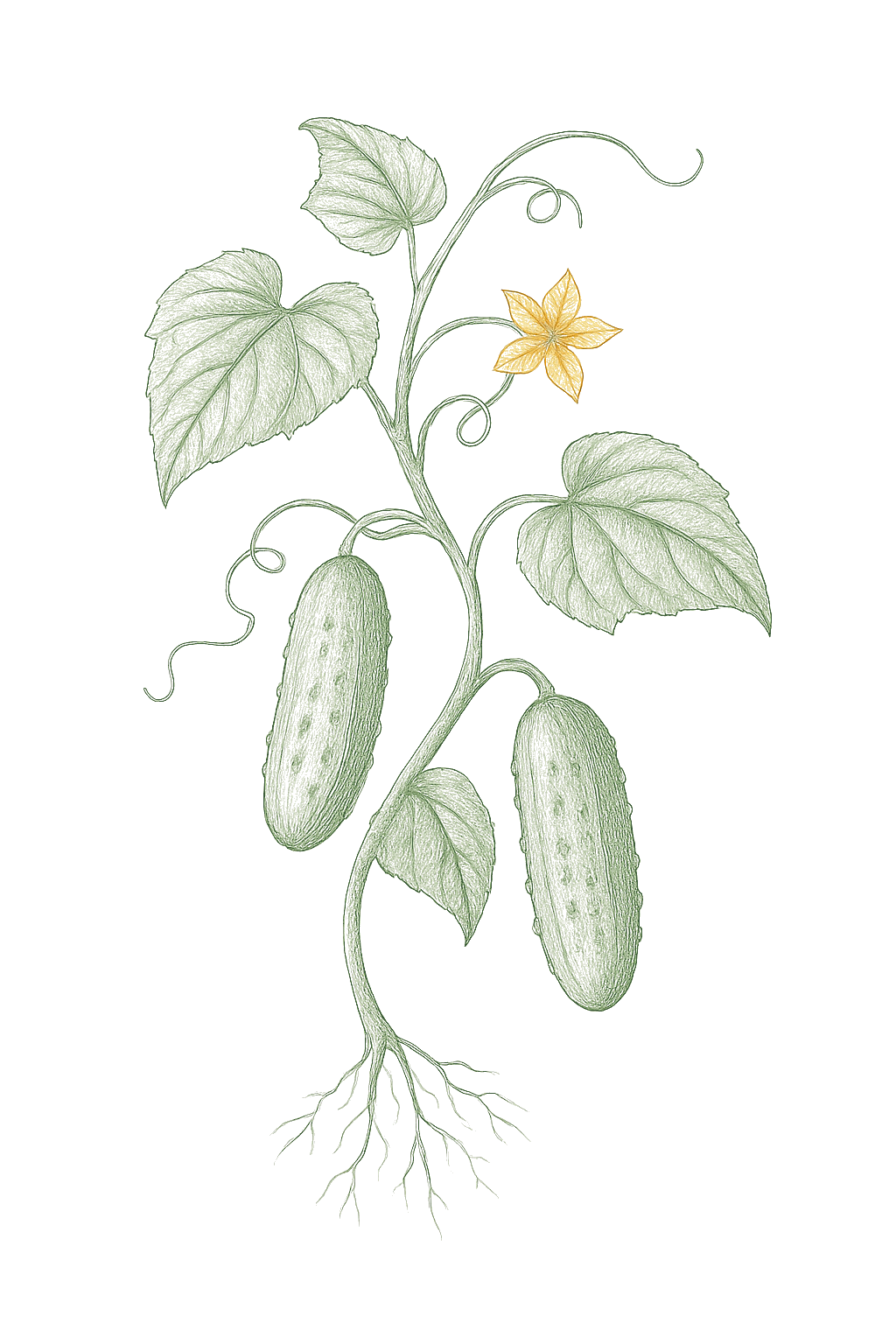
Pickling Cucumber mature plant
Fig. 01 · Pickling Cucumber, mature Zone 13
Mature in
48-58d
from transplant
Sunlight
Full sun
6-10 hrs daily
Water
Moderate
1 inch / week
Spacing
8-18"
between plants
Soil pH
6-6.5
slightly acidic
Today · in your zone

What's happening right now

July 24 · Zone 13 · Stage 01 · Germination

Off-season for pickling cucumber in zone 13.

The season at a glance

Planting calendar

In Zone 13, pickling cucumber can be planted January through October. Harvest runs February through December.

Jan
Feb
Mar
Apr
May
Jun
Jul
Aug
Sep
Oct
Nov
Dec
plant
plant
plant
plant
plant
plant
plant
plant
plant
plant
plant
too late
too early
harvest
harvest
harvest
harvest
harvest
harvest
harvest
harvest
harvest
harvest
harvest
harvest
indoors
plant out
harvest
Seasoned
Stagger your sowings

Succession planting

Pickling cucumbers produce heavily for a few weeks, then slow down. For a few pickles at a time, plant a little every 2 to 3 weeks. For a big pickling batch, plant a block all at once. A second planting in summer is a smart backup, since pests and mildew often wear out the first plants by late summer.Pickling cucumbers crop hard for a few weeks and then tire, so how you sow depends on your goal. For a steady trickle of fresh small fruit, succession sow every 2 to 3 weeks, taking advantage of the quick 48 to 58 day maturity. For putting up a batch, sow a block of a gynoecious variety all at once so a concentrated crop comes ready together on one pickling day. Either way, the real late-season payoff is a replacement planting: cucumber beetle, bacterial wilt, and powdery and downy mildew often take down the first planting by midsummer, so a fresh sowing in early to midsummer, counted back from your first fall frost, frequently outproduces the spring crop on cleaner plants.

Every 2 weeks · sow a short new rowUp to 12 sowings a season
Jan
Feb
Mar
Apr
May
Jun
Jul
Aug
Sep
Oct
Nov
Dec
sow
harvest
keep sowing
continuous harvest
The season, mapped

Seed to garden

The easiest way to grow pickling cucumbers is to sow seeds right where they will grow, once the soil is warm (about 70°F). Plant a few seeds 1 inch deep in each spot and keep the strongest. Start seeds indoors only if your season is short, about three weeks before planting out, ideally in peat pots you can plant whole, and move them outside while they are still small.Because cucurbits resent root disturbance, direct sowing once the soil is reliably warm (at least 70°F; seed will not germinate below about 50°F) is the simplest, most reliable method, and pickling types are quick from seed, so direct-sown plants lose little time. Sow several seeds about 1 inch deep per hill or station and thin to the strongest. Start seeds indoors only to gain two to three weeks in a short season, sowing in peat pots about three weeks before planting out and setting them out before they outgrow the pot. Gynoecious hybrid seed often includes a few pollenizer seeds in the packet, so sow the whole packet together rather than sorting it.


Start method
Both
Soil temp
70-90°F
From seed to fruit

The growing journey

Stage 01 · Germination
01
Germination
Days 3-10 · current stage
In warm soil, seeds sprout in about a week. Two seed leaves push up first. If the soil is cold, seeds rot instead of sprouting.Seeds sprout in about 4 to 10 days in warm soil (70°F is the target); cold soil below about 50°F rots seed rather than germinating it.
Plant seeds 1 inch deep once the soil is warm. Keep the soil damp until they sprout. If several come up together, keep the strongest one.Sow 1 inch deep in warm soil, once it is at least 70°F. Keep evenly moist, not soggy. If you sowed several seeds per spot, thin to the strongest seedling once true leaves appear.
FROM PLANT · Wait for warm soil before sowing. Cucumber seeds rot in cold ground but sprout fast once it warms up.Soil temperature, not the calendar, governs cucumber germination. Wait until soil is at least 70°F at 2 inches; seed sown in cold ground below about 50°F rots before it sprouts.
02
Seedling
Days 10-21
After the first two rounded leaves, true leaves appear and the plant grows quickly. Watch for striped or spotted beetles chewing the young leaves.Cotyledons followed by the first true leaves; growth is fast once warm. Watch for cucumber beetles, which target young plants and can transmit bacterial wilt, to which cucumbers are very susceptible.
Keep an eye out for beetles on young plants. Set up a trellis now if your cucumbers climb. Water regularly and keep weeds down. A light row cover protects seedlings, but remove it once flowers form.Protect from cucumber beetles, with row cover if needed (remove it at flowering for pollination). Provide a trellis early if growing vining types. Keep evenly watered and free of weeds.
FROM PLANT · Protect young plants from beetles. A light cover helps, but take it off once flowers appear so bees can reach them.Cucumber beetles swarm young plants and spread bacterial wilt, which cucumbers catch easily. A floating row cover protects seedlings, but pull it off at flowering so bees can pollinate.
03
Established and vining
Days 21-35
The plant grows fast, sending out vines and curling tendrils. Pickling types stay a bit bushier than big slicing cucumbers. This is when you feed it and decide whether to trellis it.Rapid leafy growth and lengthening vines that begin to throw tendrils. Pickling types often stay more compact than long slicing vines. This is the window to side-dress and to set a trellis if you want one, and to keep scouting for beetles and aphids.
Give the plant a light feeding of nitrogen now. Guide the vines onto their trellis. Add mulch to keep the soil evenly moist, which keeps the fruit from going bitter.Side-dress lightly with nitrogen as flowering nears. Train vines onto the trellis. Mulch to hold even moisture (which prevents bitterness). Keep scouting for cucumber beetles and aphids.
FROM PLANT · You can trellis pickling cucumbers or let them sprawl. Up a trellis the fruit is cleaner and the plant is healthier; on the ground it is easier to pick a big batch at once.A trellis is optional for pickling types but useful: fruit grown up a trellis stays straighter and cleaner and the plant gets less disease. Many pickling growers instead let plants run on the ground for one dense, concentrated pick, especially with gynoecious hybrids.
FROM PLANT · Keep the soil evenly moist and mulched. Letting cucumbers dry out, then soaking them, is what makes them taste bitter.Even moisture is the anti-bitterness habit. Mulch and water steadily; the drought and heat swings that stress the plant are exactly what drive the bitter compound into the fruit, worst at the stem end and skin.
04
Flowering
Days 28-42
Yellow flowers open. On many types the first flowers are male and fall off, which is normal. Female flowers have a tiny cucumber at their base. Some pickling varieties set a big batch of fruit all at once.Yellow flowers open. Monoecious pickling types carry separate male and female flowers, so male flowers usually open first and drop, which is normal; female flowers carry a tiny fruit behind the bloom. Gynoecious hybrids are nearly all female and set fruit in a tight, concentrated flush; parthenocarpic types set without pollination.
Let the bees do their work and do not spray the flowers. If tiny cucumbers turn yellow and shrivel, the flowers were not pollinated, and you can hand-pollinate with a small brush. Keep watering steadily.Encourage pollinators and avoid spraying open blooms, since fruit set depends on repeated bee visits. If small fruit yellow and shrivel, pollination is poor; hand-pollinate in the morning. Keep moisture steady now to avoid bitterness.
FROM PLANT · The first flowers often fall off without making cucumbers, that is normal. Real trouble is when tiny cucumbers turn yellow and shrivel, which means poor pollination.Early male flowers opening and dropping with no fruit is normal; females, each with a tiny cucumber behind the bloom, come a little later. Judge pollination by whether small fruit size up or yellow and shrivel.
FROM PLANT · If cucumbers are not forming, you can hand-pollinate. In the morning, pick a male flower, peel off the petals, and gently touch it to the center of a female flower.If set is poor in cool or pollinator-scarce conditions, hand-pollinate in the morning: pick a male flower, strip the petals, and dab pollen onto the center of each open female. Parthenocarpic types skip this entirely.
05
Harvest
Days 48-58
Shiny, firm, bumpy little cucumbers reaching the size you want, from about 1.5 inches for tiny gherkins to 2 to 4 inches for regular pickles. They grow fast, so they are ready before you expect.Glossy, firm, warty fruit reaching pickable size: about 1.5 inches for gherkins and cornichons, 2 to 4 inches for whole-pack dills, and up to 5 to 6 inches for spears and slices. The fruit sizes up fast, often noticeably bigger day to day at peak.
Check every day or two and pick the pickles while they are firm and warty. Cut the stem rather than pulling. Picking often keeps more coming, and remove any big yellow ones you missed.Pick every 1 to 2 days, cutting or clipping the stem. Harvest young for crispness and to keep the plant producing; a single over-mature, seedy fruit left on the vine tells the plant to stop setting, so remove any you missed.
FROM PLANT · Pick pickling cucumbers small and check every day or two, they grow fast. Tiny ones make gherkins, 2 to 4 inch ones make regular pickles. Picking often keeps more coming.Pick small and pick often. Gherkins go at about 1.5 inches, whole-pack dills at 2 to 4 inches; at peak the fruit sizes up fast, so check every 1 to 2 days. Harvesting promptly keeps the plant setting, and small fruit makes the crispest pickles.
FROM PLANT · If a pickling cucumber got big and yellow, pick it off anyway. Leaving over-ripe fruit on the plant makes it stop producing.Missed one and it turned fat, yellow, and seedy? Cut it off and compost it; leaving mature fruit on the vine tells the plant to stop setting, and an over-ripe pickling cucumber is too seedy to put up anyway.
06
End of season
Days 65-100
The plant slows down and the leaves may get powdery and white or yellow and spotted, or it wilts suddenly from disease. Frost kills it.Declining production, increasing powdery or downy mildew, or sudden wilting from bacterial wilt. The first frost kills the plant outright.
Pull out finished plants and clear them away at the end of the season. This helps prevent pests and disease next year. A second planting made in summer often keeps producing after the first one is done.Pull and remove spent vines rather than tilling them in, to cut overwintering pest and disease sites. A summer-sown succession often crops cleanly after the first planting fades to mildew or wilt, and a fresh gynoecious planting can give one more concentrated batch for late pickling.
FROM PLANT · At the end of the season, pull up old vines and clear them away. This cuts down on pests and disease next year.Pull spent vines and remove them rather than tilling them under, which buries overwintering beetles and disease residue. Clean beds now mean fewer pests and less angular leaf spot and anthracnose next season.
Beginner
Know your soil

Your soil

Identify yours

Not sure what soil you have? Grab a small handful of damp soil from your garden bed and squeeze it. If it crumbles apart easily, it's sandy. If it holds together but breaks when you poke it, it's loam (what most vegetables want). If it stays in a hard, slippery ball, it's clay.

What this crop wants

Plant pickling cucumbers in rich, well-drained soil with plenty of compost mixed in. They grow fast and have shallow roots, so they like soil that stays evenly moist but never soggy. Even watering matters a lot here, because you pick these cucumbers small and the skin is most of the fruit, and dry, stressed plants make bitter skins. Many gardeners plant them on low hills, which warm up quicker and drain better. If your soil is heavy or stays wet, build up mounds or use raised beds so the roots do not sit in water.

If your soil doesn't match

You have sandy soil

Mix 2-3 inches of compost into the top 6 inches of your bed before planting. Compost holds moisture (which sandy soil drains too fast) and adds the nutrients sandy soil tends to lack. Repeat each season. Compost breaks down over time.

You have clay soil

Mix 2-3 inches of compost AND a few inches of coarse sand or perlite into the top 6 inches of your bed. The compost feeds the plants; the sand breaks up the clay so air and water can move through. Don't add sand without compost. It can compact like concrete.

Containers and raised beds

If amending your soil sounds like too much work, or if your soil is heavy clay, full of rocks, or contaminated, build over it. A raised bed at least 12 inches deep filled with a 50/50 mix of compost and sandy loam gives you ideal growing soil with no battles. A 5-gallon container with quality potting mix does the same for one plant at a time. Both bypass your native soil entirely.

Learn more about your soil
The specs

Care guide

The numbers that matter, at a glance.

Sunlight
Full sun · 6-10 hrs/day
Water
moderate
Spacing
8-18 inches
Soil
loam
Days to maturity
48-58 days from transplant
Soil pH
6 to 6.5
Container OK?
Yes · 5+ gal pot
Germination temp
70-90°F
Soil chemistry

Soil pH for pickling cucumber

Preferred
6 to 6.5
Tolerated
5.8 to 7

Pickling cucumbers like soil that is slightly acidic to neutral, about pH 6.0 to 6.5, and most garden soil is already close. An inexpensive soil test tells you where you stand and whether you need to adjust it before planting.Pickling cucumbers do best in slightly acidic to neutral soil, around pH 6.0 to 6.5. They still grow across a wider band, roughly 5.8 to 7.0, but nutrient uptake tightens as the soil turns alkaline, and lime up to about pH 6.0 if a test reads below 5.8. Test before planting and amend only on the test's advice rather than by guess.

Verified · 2 sources View
Steady hand on the hose

Watering

When & how much
Frequency
Give pickling cucumbers about 1 inch of water a week, more when it is hot and dry. Water deeply rather than a little every day, and try to keep it steady so the fruit does not turn bitter.Aim for about 1 inch of water per week, more in heat or sandy soil, delivered deeply and less often rather than in light daily sprinkles. Even, steady moisture is what keeps the small pickling fruit from turning bitter and misshapen.
Amount
About 1 inch of water a week is a good target, more while the plant is flowering and the pickles are forming. These cucumbers are mostly water, so do not let them dry out.Around 1 inch per week is the working range, leaning higher during flowering and fruit sizing and through hot, dry spells. Pickling cucumbers are over 95 percent water and have shallow roots, so they show drought stress fast, and because the fruit is picked small the skin is a big share of each pickle, so bitterness from uneven water shows up strongly.
Method
Water the soil, not the leaves, using a soaker hose or watering wand at the base. Keeping the leaves dry helps prevent the leaf diseases these cucumbers are prone to, and a layer of mulch keeps the soil evenly moist so the fruit stays crisp and sweet.Water at the base of the plant with drip or a soaker hose, keeping the foliage as dry as possible, since wet leaves invite powdery and downy mildew and angular leaf spot on an already disease-prone crop. A 2 to 3 inch mulch holds soil moisture even, which directly reduces bitterness, and keeps soil from splashing the small fruit and the leaves.
Signs of trouble
Too much water
If lower leaves yellow, the plant wilts even though the soil is wet, or the base gets soft and mushy, it is getting too much water or the soil drains poorly.Yellowing lower leaves, wilting even when the soil is wet, and soft, rotting stems at the base point to overwatering or poor drainage. Saturated soil invites root and fruit rot, especially on heavy ground.
Too little water
Some midday wilting in hot weather is normal and passes by evening. Leaves that stay wilted mean the plant is too dry, and drought while fruit is forming gives bitter, misshapen pickles.Midday wilting that recovers overnight is normal in heat, but leaves that stay limp and dull signal real drought. The clearest fruit-stage tell is bitter, pinched, or curled pickles, which trace directly to inadequate or uneven water during sizing.
Feeding rhythm

Feeding

Frequency
At planting, then side-dress once or twice
Type
balanced at planting, then nitrogen side-dress
When to start
Work into the bed before planting, then side-dress about a week after flowering begins and again 3 weeks later

Pickling cucumbers grow fast and need a moderate amount of feeding, not a lot. Mix a balanced fertilizer or compost into the soil before planting, then feed with a little nitrogen about a week after the flowers start, and again a few weeks later if the plants look pale. Do not overdo the nitrogen, since too much makes leafy vines instead of pickles. Keep the plants evenly watered too, because feeding only helps a well-watered plant.Pickling cucumbers are moderate feeders over a short, fast season. Work a balanced fertilizer or several inches of compost into the bed before planting, then side-dress with a little nitrogen about a week after flowering starts and again roughly three weeks later if the plants look pale. The main pitfall is too much nitrogen, which drives lush vines and leaf at the expense of fruit and draws aphids and disease, and lush plants also hide the small fruit so you miss pickables. Pair feeding with steady, even moisture, since the nutrients only help a plant that is not drought-stressed, and drought stress is what turns pickles bitter.

N · P · K = 10-10-10

Use a balanced fertilizer with equal numbers, like 10-10-10, at planting, then a little nitrogen once flowers appear. Avoid high-nitrogen lawn fertilizer.A balanced ratio such as 10-10-10 worked in at planting suits pickling cucumbers, followed by a light nitrogen side-dress once they flower. Avoid high-nitrogen lawn-type fertilizers, which push foliage at the expense of fruit.

Try balanced 10-10-10 at planting, then a nitrogen source such as blood meal
Who grows well together

Companion planting

The most useful pickling cucumber companions are flowers that bring in bees, since most pickling types need bee visits to set fruit, plants like radish and nasturtium that lure pest beetles away, and beans that feed the soil. Dill is a nice neighbor too, since it draws helpful insects and is the classic herb for the pickle jar. The one rule that really matters is to keep pickling cucumbers away from other squash, melons, and pumpkins, which all share the same pests and diseases. Pickling cucumber companions earn their place by drawing pests away, bringing in bees, or feeding the soil, rather than by crowding the bed. The signature pest is the cucumber beetle, which also vectors bacterial wilt, so radish and nasturtium are traditionally interplanted to lure or deter beetles, and a row of sunflowers or corn can serve as a living trellis and windbreak. Monoecious pickling types are insect-pollinated, so pollinator flowers like borage and dill keep bees working the blooms and improve fruit set; dill is also the classic brining partner, so many growers tuck it in beside the pickles on purpose. Beans fix nitrogen for the moderately hungry vines. Most of these pairings are traditional or mechanistic rather than trial-proven, and are labeled accordingly. The firmest rule is a rotation one: keep pickling cucumbers away from other cucurbits, which share the whole pest and disease complex.

Other
Radish
Radishes are often planted among cucumbers to lure cucumber beetles, the cucumber's worst pest, away from the vines. They grow fast and are pulled before they crowd anything. A popular, low-risk traditional pairing.A long-standing trap and deterrent planting for cucumber beetles, the pest that also spreads bacterial wilt to highly susceptible cucumbers. Radishes are quick, cheap, and out of the bed before they compete, which makes them an easy interplant even though the beetle-reduction effect is traditional rather than trial-isolated. Traditional
Nasturtium
Nasturtiums lure cucumber beetles and aphids away from cucumbers and their flowers bring in bees. An easy, edible-flowered neighbor.Often planted near cucurbits as a trap and deterrent for cucumber beetles and aphids, and its flowers draw the bees cucumbers depend on for fruit set. Trap cropping is a documented principle, but the specific nasturtium-cucumber effect is not formally isolated, so treat it as a plausible aid. Well-grounded
Beans
Beans pull nitrogen from the air into the soil, which the fast-growing cucumber appreciates, and they do not share its pests. A good, traditional neighbor.Pole or bush beans fix nitrogen that benefits the moderately heavy-feeding cucumber, and they share none of the cucurbit pests. The nitrogen benefit largely reaches neighbors after the beans break down, so treat it as season-long soil-building rather than an instant feed, but the mechanism is sound. Well-grounded
Sunflower
A row of sunflowers gives cucumber vines something to climb and a bit of shade, and the blooms bring in bees. A practical, traditional support plant.Tall sunflowers can serve cucumbers as a living trellis and light windbreak, lifting the vines off the ground for cleaner, straighter fruit and better airflow, while their flowers recruit pollinators. The structural benefit is real and practical; the pairing is traditional rather than a measured yield effect. Traditional
Borage
Borage flowers are loved by bees, and cucumbers need bee visits to set fruit, so a few borage plants nearby can help with pollination. Mainly grown to bring in bees.A strong bee magnet whose flowers recruit the pollinators cucumber fruit set depends on, since the female flowers need repeated bee visits to size a fruit. Pollinator-habitat value is well grounded; the specific borage-cucumber pairing is traditional rather than trial-tested. Well-grounded
Herb
Dill
Dill flowers draw hoverflies, lacewings, and parasitic wasps that prey on aphids, and it is the classic kitchen partner for pickling cucumbers, so it doubles as a brining herb right beside the crop. The beneficial-insect draw is mechanistically sound; the specific cucumber pairing is traditional. Let some plants flower for the benefit. Well-grounded
interplant nearby
Keep apart from
Other cucurbits Keep cucumbers away from other squash, melons, and pumpkins. They all get the same pests and diseases, so planting them together makes those problems worse.Summer and winter squash, melon, and pumpkin share cucumber's whole pest and disease complex, including cucumber beetle with the bacterial wilt it spreads (to which cucumber is especially susceptible), squash bug, powdery and downy mildew, and angular leaf spot. Grouping them concentrates that pressure and lets problems build. A real epidemiology and rotation principle rather than a tested adjacency effect: spread cucurbits out and rotate them. Well-grounded
Potatoes Some gardeners keep potatoes and cucumbers apart, since both are hungry plants and potatoes can bring their own diseases. This is more tradition than a proven rule.A traditional caution that potatoes and cucumbers compete for the same nutrients and that potatoes can harbor blight and attract pests near the vines. There is no strong T1 mechanism for the specific pairing, so it persists mostly as garden lore. Traditional
Provenance tagged inline · see methodology for the labeling system Key
Harvest signals

When to pick

Pick pickling cucumbers while they are young, firm, and warty, before the skin dulls or yellows. Tiny gherkins are picked around 1.5 inches and regular pickles around 2 to 4 inches, but the size is up to you and your recipe. Cut or clip the stem instead of pulling, so you do not damage the vine. Check every day or two, because they grow fast and an over-ripe one turns yellow, fat, and seedy, and leaving big fruit on the plant makes it stop producing. For the crispest pickles, use them the day you pick.Harvest pickling cucumbers young and often, while the skin is glossy, firm, and warty and the seeds are still soft. Pick gherkins and cornichons at about 1.5 inches, whole-pack dills at 2 to 4 inches, and spears or slices up to about 5 to 6 inches; the exact size is your preference and your recipe, but smaller is crisper. Cut or clip the stem rather than pulling, to avoid tearing the brittle vine. At peak, check every 1 to 2 days, because the fruit quickly turns fat, yellow, and seedy, and a single oversized fruit signals the plant to stop setting new ones. Remove any oversized or yellowed fruit you missed to keep the plant producing, and process the harvest within a day for the crispest pickles.

Verified · 2 sources View
Yield

What to expect

One pickling cucumber plant makes a lot of small fruit over the season, since you pick them young. For putting up pickles, grow a block of plants together so you get a batch at once. Two or three plants are plenty if you just want a few.A healthy pickling plant yields heavily over its short season, easily dozens of small fruit per vine because you pick them so young. Gynoecious hybrids concentrate that yield into a tight window, while open-pollinated and parthenocarpic types spread it out. A pickling project wants a block of plants sown together so a batch comes ready at once; a couple of plants is plenty for occasional fresh snacking.

At its peak, a pickling cucumber plant makes fruit fast. Pick every day or two, since picking often actually keeps more coming. Some types give you a big batch all at once, perfect for a pickling day.At peak in warm weather a plant sets fruit quickly, and the small fruit sizes up so fast that picking every 1 to 2 days is essential. Frequent harvest at this stage actually keeps the plant producing; leaving a mature, seedy fruit on the vine signals it to slow down or stop. Gynoecious types can drop most of their crop in a concentrated flush ideal for a single canning day. Pickling cucumbers are one of the easier crops for beginners. The things that catch people out are bitter fruit from letting the plants get dry, the plant stopping when big fruit is left on it, and plants suddenly wilting from a beetle-spread disease. Water steadily, pick small and often, and watch for beetles early.The pickling cucumber is forgiving and productive even for a first-time grower; the usual first-year surprises are bitterness from letting the plants dry out, over-mature fruit shutting the plant down when you skip a few days of picking, and a sudden mid-season collapse from beetle-spread bacterial wilt. Steady water, picking small every day or two, and early beetle control head these off.

What changes yield
Even moisture: steady water through fruit set drives crisp, well-formed fruit; drought and heat swings cause bitterness that concentrates in the skin of the small pickle.Harvest frequency: picking young and often (every 1 to 2 days) keeps a plant productive; letting one fruit oversize and seed-up slows or stops new set.Variety habit: gynoecious hybrids set a heavy, concentrated crop for batch pickling; monoecious and parthenocarpic types spread the harvest over a longer window.Pollination: monoecious types need bee visits, and poor set in cool or pollinator-scarce conditions causes small fruit to abort; parthenocarpic types are exempt.Pest and disease pressure: cucumber beetle and the bacterial wilt it vectors, plus powdery and downy mildew, commonly end the first planting; a frost ends it.
Verified · 3 sources View
Pick your variety

Recommended varieties

Choose a pickling cucumber for how you want to pick it. Gynoecious types like Calypso give you a big crop all at once, which is great for making a batch of pickles, while other types spread the harvest out for a few pickles at a time. County Fair resists the beetle-spread wilt disease, Sumter handles heat and mildew, and Bush Pickle is compact for pots and small beds. Old favorites like National Pickling and Boston Pickling are productive and let you save seed. Whatever you grow, pick the fruit small and often.Pick a pickling cucumber by how you want to harvest. Gynoecious hybrids like Calypso and Fancipak set a heavy, concentrated crop that ripens close together, which is ideal for putting up a batch at once, while parthenocarpic and open-pollinated types spread the harvest over a longer window for steady small pickings. County Fair earns its place where cucumber beetles and bacterial wilt are bad, Sumter where mildew pressure is high, and Bush Pickle where space is short or you are growing in a pot. Classic open-pollinated heirlooms such as National Pickling and Boston Pickling are productive and seed-saveable, though home-saved seed can carry seedborne angular leaf spot, so refresh from clean seed periodically. Pick everything young for the size you want: small and warty is the point.

Calypso
Gynoecious (nearly all-female) hybrid, early to mid-season, that sets a heavy, concentrated crop of blocky, white-spined fruit; a workhorse for putting up a batch of pickles at once.
County Fair
Bacterial-wilt tolerant and nearly seedless when isolated from other cucumbers; blocky, uniform fruit well suited to whole-pack dills. A good choice where cucumber beetles are bad.
Fancipak
Gynoecious hybrid, early to mid-season, bred for uniform blocky pickling fruit and disease tolerance; reliable and productive.
Homemade Pickles
Productive open-pollinated type with crisp, medium-green, white-spined fruit good at everything from tiny gherkin size up to full dill-pickle size.
Sumter
Heat- and disease-tolerant Southern standard with straight, blocky fruit; dependable in the Southeast and Gulf where mildew pressure is high.
Bush Pickle
Compact bush habit on short vines, the best pickling pick for small beds, raised beds, and containers while still yielding full pickling fruit.
National Pickling
Classic 1920s open-pollinated heirloom bred for uniform blocky fruit for whole pickles; carries some cucumber mosaic virus and scab resistance and is seed-saveable.
Boston Pickling
Old open-pollinated heirloom with prolific, blocky, bumpy 3 to 5 inch fruit; a productive, seed-saveable standard for dills and relish.
Off the vine

Storing your harvest

Room temp
Pickling cucumbers do not keep long at room temperature, just a day or two. Use them soon or put them in the fridge, but not the coldest part. For the crispest pickles, use them the same day you pick.Pickling cucumbers are tender and short-lived off the vine. At room temperature they keep only a day or two before softening, so brine or refrigerate them promptly, with the caveat that cucumbers are chilling-sensitive and do not love a very cold fridge either. For crisp pickles, process the fruit within a day of picking.
Fridge
Keep pickling cucumbers in the fridge for about a week, in the warmer crisper drawer rather than the coldest spot, since too-cold storage causes soft, pitted spots. Keep them away from apples and tomatoes, which make them go bad faster.Stored in the warmest part of the refrigerator, ideally around 45 to 50°F at high humidity, pickling cucumbers keep about a week. They are chilling-sensitive below about 50°F, where prolonged cold causes pitting, water-soaked spots, and faster breakdown, so they store neither as long nor as cold as hardy vegetables. Keep them away from apples, tomatoes, and other ethylene producers, which hasten yellowing.
Freezer
Pickling cucumbers do not freeze well on their own, since they are mostly water and turn mushy. The best way to keep extra ones is to turn them into pickles.Pickling cucumbers do not freeze well for fresh use, turning limp and watery because of their high water content. The whole point of these varieties is that the answer to a glut is the brine crock or canner, not the freezer; frozen refrigerator-pickle recipes are the only freezer use worth it.
Verified · 2 sources View
When something goes wrong

Common problems

The pickles were bitterPickles tasted bitter
01 of 04
What happened The plant got stressed, usually by hot, dry, or uneven conditions, which makes cucumbers bitter. The bitterness sits mostly in the skin and stem end, which is a lot of a small pickle.Stress, usually heat or uneven water, drove up the plant's natural bitter compound (cucurbitacin), which concentrates in the skin and at the stem end. That hits pickling fruit hard, because the skin is a large share of a small pickle. Wide temperature swings, drought, and poor nutrition all bring it on, and some varieties are inherently more bitter than others. Next season Keep the plants evenly watered and mulched so they do not dry out, pick the pickles young, and try a variety known for mild flavor. Cutting off the stem end takes out a lot of the bitterness.Water steadily and mulch to keep soil moisture even, harvest before fruit oversizes, and grow non-bitter varieties. Cutting off the stem end removes most of the bitterness from a fruit you have already picked, though for pickles you usually keep the skin on.
Tiny cucumbers turned yellow and shriveledSmall fruit yellowed and shriveled instead of sizing up
02 of 04
What happened The flower was not pollinated well, so the little cucumber died instead of growing. This often happens in cool or rainy weather, or when there are few bees.Poor pollination. Each female cucumber flower needs several bee visits to set; without enough pollen the young fruit aborts, yellowing and shriveling at the tip rather than sizing up. Common in cool, wet, or pollinator-scarce conditions and early in the season. Next season Grow some flowers nearby for the bees, and hand-pollinate early cucumbers if needed. It usually gets better as more flowers open and bees get active, or grow a seedless variety that does not need bees.Plant flowers to draw pollinators, avoid spraying open blooms, and hand-pollinate in the morning if early set is poor. Gynoecious hybrids need a pollenizer in the mix (usually included in the seed packet), while parthenocarpic varieties set fruit without pollination and sidestep the problem entirely.
Plant suddenly wilted and diedHealthy vine wilted and collapsed in midsummer
03 of 04
What happened Usually bacterial wilt, a disease cucumber beetles spread that cucumbers catch easily. It clogs the plant's water pipes so the vine wilts even when watered. Cut a wilted stem and pull it apart slowly to see sticky white strings.Most likely bacterial wilt, to which cucumbers are highly susceptible: cucumber beetles infected the plant, and the bacterium clogged its water-conducting tissue, collapsing a previously vigorous vine. The sap-string test confirms it. Squash bug feeding can cause similar wilting. Next season Keep cucumber beetles down, since they spread the disease there is no cure for. Cover young plants until they flower, and pull any plant that wilts and shows the sticky-string sign.Control cucumber beetles from the seedling stage with row cover until flowering, keep young plants vigorous, grow less-bitter varieties that draw fewer beetles, and remove infected plants promptly. There is no cure once a plant is infected.
Leaves got white and powdery and the plant died backLeaves turned white and powdery, then the plant faded early
04 of 04
What happened Powdery mildew, a white coating on the leaves, spread until the leaves died and the plant stopped early. Downy mildew, with yellow patches and fuzzy gray undersides, does similar damage in damp weather.Powdery mildew defoliated the plant ahead of schedule. The white fungal coating spread across the leaves until they browned and died, cutting the productive season short and exposing fruit to sunscald. Downy mildew (yellow vein-bounded blotches with gray underside) does the same in humid weather. Next season Pick resistant varieties, give plants room and a trellis for air flow, water the soil not the leaves, and treat early spots. A second planting helps too.Choose resistant varieties, space and trellis or thin plants for airflow, water at the base, and treat at the first spots. A summer-sown succession of a quick pickling type can carry harvest past the worst of it.
The usual suspects

Pests & diseases

Pests
Cucumber beetles
P · 01
Symptoms Small yellow beetles with stripes or spots chew the leaves and flowers, especially on young plants. Worse, they spread bacterial wilt, a disease that makes cucumber vines suddenly wilt and die.Small yellow beetles, striped (three black stripes) or spotted (eleven black spots), chew young leaves, stems, flowers, and fruit. The bigger threat is indirect: both kinds transmit bacterial wilt, to which cucumbers are highly susceptible, so beetle feeding on seedlings can be followed weeks later by sudden, runaway vine wilt and collapse just as the pickling harvest should be starting. Cause Cucumber beetles feed on the plants and carry the germ that causes bacterial wilt, infecting cucumbers as they chew. Young seedlings are most at risk, and cucumbers catch the wilt easily.Striped and spotted cucumber beetles feed on cucurbits and carry the bacterium that causes bacterial wilt in their gut, infecting plants as they feed. Cucumber is more susceptible to the wilt than squash or pumpkin, so even light beetle pressure on seedlings can be costly. Bitter-fruited plants attract more beetles. Organic treatment Cover young plants with row cover (remove it when flowers open so bees can get in), pick the beetles off in the morning when they are slow, and use yellow sticky traps. Keeping the beetles down is the best way to avoid the wilt disease they spread.Protect seedlings with row cover removed at flowering, hand-pick beetles in the cool morning, and use yellow sticky traps to monitor and reduce numbers. Where bacterial wilt is a known problem, controlling the beetles is the only effective control of the disease, since there is no cure once a plant is infected. Prevention Cover seedlings until they flower, keep them growing strong, clear away weeds and old plants, and do not plant where squash-family crops grew last year.Exclude beetles from seedlings with row cover, keep young plants vigorous so they grow past the vulnerable stage, choose wilt-tolerant varieties such as County Fair, clear weeds and debris, and rotate away from where cucurbits grew. Aim control at the early-season colonizers that vector wilt.
Squash bug
P · 02
Symptoms Leaves get yellow spots, then brown and wilt, and you find clusters of shield-shaped gray-brown bugs and their bronze eggs on the undersides of leaves near the base of the plant.Leaves develop yellow specks that brown and wilt, and heavily fed vines wilt rapidly and turn brittle. Flat bronze to brick-red egg clusters appear on leaf undersides along the veins, and gray-brown adults and pale nymphs cluster near the crown and under debris. Cause Squash bugs pierce the leaves and stems and suck out the juices, which makes the vines wilt. They breed through the summer and hide in plant debris over winter.The squash bug, a true bug that feeds with piercing-sucking mouthparts on cucurbit foliage and stems, injecting saliva that wilts and browns the vines. Populations build through the season and are hardest to control once nymphs are large; the bugs overwinter as adults in garden debris. Organic treatment Pick the bugs off by hand and scrape off the egg clusters under the leaves. A board laid on the ground overnight draws them underneath, then lift it in the morning and destroy them. Treat the young bugs with insecticidal soap.Hand-pick adults, crush the egg masses on leaf undersides, and trap bugs by laying a board near the plants overnight, then lifting it in the morning and destroying the cluster underneath. Target young nymphs with insecticidal soap, since large nymphs and adults are tough to kill. Prevention Cover young plants until they flower, check under the leaves for eggs early in the season, and clean up old vines after harvest so the bugs have nowhere to overwinter.Use row cover on young plants until flowering, clean up vines and debris at season's end to cut overwintering sites, and rotate cucurbits. Scout leaf undersides for the bronze egg clusters from early in the season and act before nymphs mature.
Aphids
P · 03
Symptoms Tiny soft insects gather on the undersides of leaves and on new growth, making leaves curl and turn yellow, often with a sticky film. They can also spread viruses to your plants.Colonies of small soft-bodied insects, often melon aphids, cluster on leaf undersides and growing tips, causing leaves to curl, pucker, and yellow, with sticky honeydew and sooty mold following. Beyond direct feeding, melon aphids transmit cucumber mosaic and other viruses that mottle and distort the foliage and fruit. Cause Aphids are small insects that suck the plant's juices and multiply fast, especially on soft, over-fed growth. The sticky honeydew they leave behind grows black mold.Melon and other aphids suck sap and reproduce rapidly in warm weather, building up quickly on stressed or over-fertilized plants. The honeydew they excrete fosters sooty mold, and several aphid species spread cucumber mosaic virus, which some pickling varieties are bred to resist. Organic treatment Blast them off with a strong spray of water and treat the undersides of the leaves with insecticidal soap, repeating every few days. Ladybugs and other helpful insects eat aphids, so welcome them.Knock colonies off with a strong jet of water and spray insecticidal soap or horticultural oil with thorough coverage of leaf undersides, repeating every few days. Conserve ladybugs, lacewings, and parasitic wasps, which usually bring aphids under control. Reflective or aluminum-foil mulch deters them from young plants. Prevention Do not over-fertilize with nitrogen, check the undersides of leaves regularly, and let helpful insects do their work instead of spraying everything.Avoid excess nitrogen, which drives the soft growth aphids favor, scout leaf undersides and growing tips, and support natural enemies rather than spraying broadly. Reflective mulch deters aphids from young plants, and CMV-resistant pickling varieties reduce the virus risk.
Spider mites
P · 04
Symptoms Tiny specks and a dusty, stippled look on the leaves, sometimes with fine webbing underneath, mostly in hot, dry weather. The leaves can dry out and die fast.Fine pale yellow and reddish-brown stippling on the upper leaf surface, often with faint webbing on the undersides, in hot, dry weather. Damage can develop very quickly: leaves bronze, dry, and drop, and a heavy infestation can kill a plant. Cause Spider mites are tiny relatives of spiders that suck the juice from leaf cells. They love hot, dry, dusty conditions and breed very fast.Two-spotted spider mites feed on the contents of individual leaf cells, and they multiply explosively in hot, dry, dusty conditions, especially on water-stressed plants. They are not insects, so many insecticides do not touch them. Organic treatment Spray the undersides of the leaves with a strong jet of water, and treat with insecticidal soap, repeating in about five days. Keeping the plants watered and the area free of dust helps a lot.Knock mites off with a strong spray of water to the leaf undersides, and treat with insecticidal soap or horticultural oil twice, about five days apart, covering the undersides well. Conserve predatory mites, ladybugs, and minute pirate bugs, which are the main natural controls. Prevention Keep the plants well watered, since dry, dusty plants attract mites. Rinse the leaves in hot weather and avoid spraying broad insecticides that kill the helpful bugs.Keep plants well watered and avoid drought stress, since mites flare on dry, dusty plants and the same stress makes the small fruit bitter. Hose down foliage in hot spells, avoid broad-spectrum insecticides that kill the mites' natural enemies, and scout leaf undersides in hot weather.
Diseases
Powdery mildew
D · 01
Symptoms A white, powdery coating spreads over the leaves until they turn yellow and brown and die. The plant fades early and fewer pickles form.White, powdery patches appear on the upper and lower leaf surfaces and stems, spreading until leaves yellow, brown, and die back ahead of schedule. Early defoliation cuts the season short, reduces yield, and exposes the small fruit to sunscald. Cause A fungus that spreads on warm days with high humidity, especially where plants are crowded and air does not move well. It does not need wet leaves to take hold.Powdery mildew fungi (Podosphaera xanthii and Erysiphe cichoracearum) that thrive between about 50 and 90°F in dry weather with high humidity, and unlike most leaf diseases they do not need leaf wetness to infect. Crowded plantings, poor airflow, and shade worsen it, and it is one of the most common late-season cucumber diseases. Organic treatment Treat early, at the first white spots, with a labeled fungicide like sulfur or horticultural oil, and remove badly affected leaves. Water the soil, not the leaves. Once it covers the plant it is hard to stop.Treat at the first spots, before it spreads, with a labeled fungicide such as sulfur, potassium bicarbonate, neem, or horticultural oil, covering both leaf surfaces, and remove the worst leaves. Avoid overhead watering. Once it is widespread, control is mostly damage limitation. Prevention Pick resistant varieties, give plants plenty of room so air moves between them, plant in full sun, and water at the base. Start checking in midsummer and act at the first white spots.Choose resistant varieties, space plants generously for airflow, plant in full sun, and avoid excess nitrogen and overhead watering. Scout from midsummer and treat at the first sign, since prevention and early action beat rescue.
Downy mildew
D · 02
Symptoms Yellow patches show on top of the leaves, often boxed in by the veins, with fuzzy gray growth underneath in damp weather. The spots brown and spread until the leaves die. Cucumbers catch it easily.Angular yellow blotches, bounded by the leaf veins, appear on the upper leaf surface, with a grayish or purplish fuzzy growth on the underside in humid weather. Spots brown and run together, and severe infection rapidly defoliates the vines. Cucumber is one of the most susceptible cucurbits. Cause A mold-like disease that spreads in wet, humid weather and needs wet leaves to infect. It can move through a planting very quickly, and cucumbers are especially prone to it.A fungus-like water mold (Pseudoperonospora cubensis) that spreads on wind-borne spores and needs leaf wetness and humidity to infect, so it flares in wet, humid spells and dewy conditions. It moves fast once established and is favored by crowding and prolonged leaf wetness. Organic treatment Open up the planting so leaves dry faster, remove the worst leaves, and use a labeled fungicide when wet weather sets in. Do not water over the leaves.Improve airflow, let foliage dry, remove badly affected leaves, and apply a labeled fungicide such as copper or chlorothalonil, covering leaf undersides, when conditions favor the disease. Avoid overhead irrigation, which keeps leaves wet and feeds the infection. Prevention Give plants room so air moves between them, water at the base, and watch closely in humid weather. Choose resistant varieties if downy mildew is common where you live.Space for airflow, water at the soil line rather than overhead, choose resistant varieties where available, and avoid working among wet vines. Scout closely in humid weather, when the disease can appear and spread quickly.
Bacterial wilt
D · 03
Symptoms Vines wilt and die even though the soil is wet. If you cut a wilted stem and pull the two ends apart slowly, infected sap stretches into sticky white strings. Cucumbers get this disease easily.Individual leaves, then whole vines, wilt and collapse even though the soil is moist, often spreading until the plant dies. A field test helps confirm it: cut a wilted stem and slowly draw the cut ends apart, and infected sap pulls into thin, sticky white strands. Cucumber is especially susceptible. Cause A germ spread by cucumber beetles as they feed. It blocks the plant's water pipes, so the vine wilts even when watered. Cucumbers are very prone to it.A bacterium (Erwinia tracheiphila) spread by striped and spotted cucumber beetles, which carry it in their gut and infect plants as they feed. It clogs the water-conducting tissue, so the plant wilts despite adequate water. Cucumber and muskmelon are far more susceptible than squash and pumpkin. Organic treatment There is no cure once a plant has it, so pull and destroy infected plants. The real fix is keeping cucumber beetles down, since they spread it.There is no cure once a plant is infected; remove and destroy wilting plants to limit spread. Control is really beetle control, so management aims at keeping cucumber beetle numbers down, especially early in the season. Prevention Keep cucumber beetles under control, since they spread the disease. Cover young plants until they flower, and pull any plant that wilts and tests positive with the sap-string check.Manage cucumber beetles from seedling stage with row cover removed at flowering, keep young plants vigorous, choose wilt-tolerant varieties such as County Fair, and remove infected plants promptly. Controlling the beetle vector is the only effective control of the disease.
Angular leaf spot
D · 04
Symptoms Small water-soaked spots on the leaves, bounded by the veins so they look angular. In damp weather a white crust forms underneath, and the dried spots tear out, leaving ragged holes. Small spots can also show up on the pickles themselves.Small, water-soaked spots on the leaves expand until they are boxed in by the larger veins, giving them an angular shape. In humid weather a milky bacterial ooze dries to a thin white crust on the underside, and as the spots dry they tear away, leaving ragged holes. The fruit can develop small, sunken, water-soaked spots, which matters more for a whole-pack pickle than for a fruit destined to be sliced. Cause A bacterial disease carried on seed and spread by splashing water and wet hands. It is worst in warm, rainy weather and survives the winter in old plant debris. It can travel on saved seed, so start with clean seed.A seedborne bacterium (Pseudomonas syringae pv. lachrymans) spread by splashing water, rain, and handling wet plants, which overwinters in crop residue. It is most damaging in warm, wet weather. Because it rides on seed, saving seed from home-grown open-pollinated pickling heirlooms can carry it forward, so start from clean seed and lean on resistant varieties. Organic treatment There is no cure, so remove the worst leaves, stay out of the patch when the plants are wet, and use a labeled copper spray early if it is spreading. Water the soil, not the leaves.There is no rescue spray that cures it; remove badly affected leaves, avoid working among wet plants, and apply a labeled copper bactericide at the first sign to slow spread. Water at the base to keep foliage dry. Prevention Buy clean seed and resistant varieties, water at the base, stay out of the patch when it is wet, and clean up old vines at the end of the season. Move cucumbers to a new spot each year.Plant certified disease-free seed and resistant varieties, do not work among wet vines, water at the soil line rather than overhead, rotate cucurbits on a three to four year cycle, and remove crop debris after harvest.
Anthracnose
D · 05
Symptoms Brown or black spots on the leaves that can fall out and leave holes, and dark, sunken, circular spots on the pickles themselves that rot in wet weather.Yellowish or water-soaked leaf spots that turn brown to black and may drop out, giving a shot-hole look, plus elongated tan lesions on stems and dark, circular, sunken cankers on the fruit. In wet weather the fruit cankers ooze a pinkish spore mass and rot. Cause A fungus that spreads in rainy weather and splashing water, and survives on old plant debris and infected seed.A fungus (Colletotrichum orbiculare) that needs several days of rainy weather to infect and spreads in splashing water. It survives on old cucurbit residue and on infected seed. Organic treatment Remove infected leaves and fruit, water at the base, and use a labeled fungicide in long wet spells. Do not save seed from sick plants.Remove infected leaves and fruit, avoid overhead watering, and apply a labeled fungicide such as chlorothalonil preventatively in wet spells. Do not save seed from infected plants. Prevention Start with clean seed, rotate cucumbers to a new spot for a few years, clean up old vines after harvest, and water the soil rather than the leaves.Use disease-free seed and resistant varieties, rotate out of cucurbits for three years, remove and destroy old vines and residue after harvest, and water at the soil line to keep foliage dry.
Verified · 2 sources View
Seasoned
Where to plant next year

Crop rotation

Try not to grow pickling cucumbers or their relatives in the same spot more than once every 3 years or so. Moving them around the garden each year helps avoid a buildup of pests and disease. Clean up old vines at the end of the season too.Rotate cucurbits on a 3 year cycle, and a 3 to 4 year break where angular leaf spot or anthracnose has been a problem, since both persist on residue and on seed. The point is to break the buildup of cucumber beetle, beetle-vectored wilt, and soilborne and seedborne disease. Clear and remove spent vines at season's end rather than tilling them in, which removes overwintering pest and disease sites and makes rotation more effective.

Family
Cucurbitaceae
Years between
3 years
in the same bed
Avoid following
Do not plant pickling cucumbers where you grew squash, melons, pumpkins, or other cucumbers in the last few years. They get the same pests and diseases, which build up in the soil.Avoid planting pickling cucumbers where another cucurbit grew in the last few years, including squash, melon, pumpkin, and other cucumbers. They share cucumber beetle with the bacterial wilt it spreads, squash bug, powdery and downy mildew, angular leaf spot, and anthracnose, all of which build up in the soil and on debris.
Plant after
Legumes such as beans and peas, sweet corn, leafy greens, or alliums like onions and garlic make good preceding crops, since they do not share the cucurbit pest and disease complex, and a legume leaves nitrogen behind for the moderately hungry vines.
Verified · 2 sources View
In the app · pre-launch

When plant taps you on the shoulder

The plant app sends a timely reminder at every critical moment of your pickling cucumber season. The wording adjusts to whichever you pick: beginner or seasoned. Here are three you'll see in Zone 13.

p
plant
NaN days after seedling
Time to watch for beetles
Your young cucumbers are up. Check for small striped or spotted yellow beetles, which spread a wilt disease cucumbers catch easily, and cover the plants until they flower.
p
plant
NaN days after flowering
Plant a second cucumber now
Now is a good time to plant a second pickling cucumber as a backup. Pests and mildew often wear out the first plants by late summer, so a fresh planting keeps pickles coming.
p
plant
NaN days after harvest
Check for ready cucumbers
Your pickling cucumbers are making fruit. Check every day or two and pick them small while firm and warty, they grow fast.
Get personalized alerts.

plant sends the right notification at exactly the right moment, for your zone, your weather, your crops. Founding members lock the rate forever.

Back the Kickstarter →
Ask the gardener

Common questions

Got a question we missed?

We're building this guide with real growers. Got a question we missed? Ask here. We read every one and add the best answers right to this page.

Grown this before?

Share a tip

Learned something the hard way? Pass it on. Real growers' tips make this guide better for the next person, and we credit you by name when yours goes live.

Seasoned
Spot something wrong?

Report a problem

If you've grown this crop and you see a date, a temperature, a companion claim, or a recommendation that doesn't match your experience, tell us. Real growers' corrections make this guide better for the next person.

How we built this guide

Methodology & sources

Every date, temperature, spacing, and recommendation on this page is sourced from university cooperative extension publications, peer-reviewed agricultural research, NOAA climate data, and direct extension calendars. Where claims are softer (traditional gardening wisdom not formally documented), we say so.

Research-backed Documented in cooperative extension publications or peer-reviewed research
Well-grounded A known agronomic principle, but not formally tested for this specific pair
Traditional Time-tested gardening wisdom, limited formal research support
Last reviewed
July 2, 2026
Data version
crops_data_final · v1.0 · schema 2.9
Sources cited on this page
16 publications
Verified entries
Companion-planting claims tagged inline · zone dates verified against 5+ extensions
See all sources cited on this page
  • University of Minnesota Extension umn_ext
  • University of Maryland Extension umd_ext
  • Cornell Cooperative Extension cornell_ext
  • Iowa State University Extension iastate_ext
  • Michigan State University Extension msu_ext
  • NC State Extension ncsu_ext
  • Penn State Extension psu_ext
  • U. of Illinois Urbana-Champaign Extension uiuc_ext
  • UC Davis Postharvest Center ucd_postharvest
  • Texas A&M AgriLife Extension tamu_agrilife
  • Virginia Cooperative Extension 426-331 vce_426_331
  • Piedmont Master Gardeners piedmont_mg
  • UGA Vegetable Garden Calendar uga_calendar
  • Clemson Home & Garden Information Center clemson_hgic
  • UC IPM Statewide IPM Program uc_ipm
  • NOAA 1991-2020 Climate Normals noaa_normals

Growing notes, weekly.

Zone-aware seasonal nudges, what's worth planting now, and the occasional recipe from the harvest. No spam, ever.

Vol. 003 · Pickling Cucumber · plant.lifestyle