Pick your zone and the dates re-calibrate.
The Guide Fruit trees Vol. 004

Pomegranate

in Zone 11, this week

A pomegranate is a leafy shrub, easily trained into a small tree, that loves hot, dry summers, the kind of weather that gives most fruit trouble. One plant makes fruit on its own, so you do not need a second one. It is one of the easiest fruits to grow in a warm climate: once it is established it handles drought, poor and salty soils (as long as they drain), and it needs only a little winter cold. The main thing is where you live. Pomegranate needs a long, hot, dry summer to ripen sweet, richly colored fruit, so it is wonderful in hot inland and desert gardens and only so-so in cool foggy coastal spots or humid, rainy areas, where the fruit sets poorly and gets diseases. Its big weak spot is splitting: the fruit cracks open when the watering swings from dry to wet near ripening, so keep the water steady and pick before the fall rains. Pomegranate (Punica granatum) is a deciduous, multi-stemmed fruiting shrub, easily trained to a small tree, that thrives on exactly the hot, dry summers most fruit dreads. It is self-fruitful, so a single plant bears, and it is one of the most forgiving fruits a warm-climate gardener can grow: drought-tolerant once established, tolerant of alkaline and heavy soils given drainage, and needing only a short winter chill. The catch is climate fit. Pomegranate wants a long, hot, dry season to ripen sweet, well-colored fruit, so it is superb in California's interior valleys and the low deserts and merely marginal in cool-summer coastal or humid southeastern gardens, where poor set and fruit disease follow the humidity. Its signature failure is splitting: fruit cracks when water swings from dry to wet near ripening, so steady moisture and picking ahead of the fall rains are the two habits that make or break a crop.

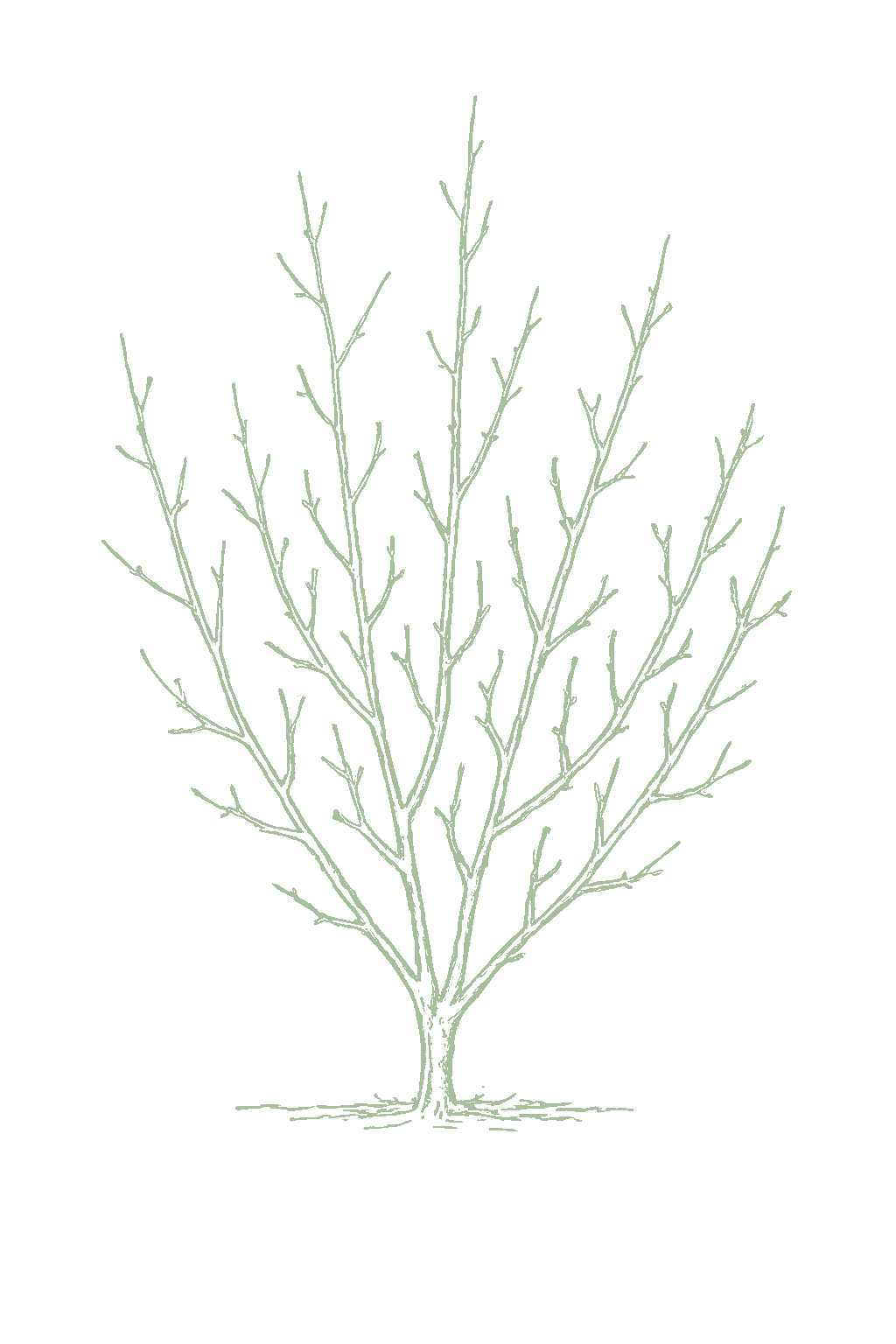
Pomegranate mature plant
Fig. 01 · Pomegranate, mature Zone 11
Container
20 gal
min 15 gal pot
Sunlight
Full sun
8-12 hrs daily
Water
Moderate
Spacing
10-15 ft
between trees
Soil pH
5.5-7
slightly acidic
Hardiness & fruiting range

Will it actually fruit here?

Hardiness tells you the tree will survive your winters. It does not tell you whether you will get fruit. Each zone carries its own verdict. Yours is marked.

3
survives,
rarely fruits
4
survives,
rarely fruits
5
survives,
rarely fruits
6
survives,
rarely fruits
7
survives,
rarely fruits
8
reliable
9
reliable
10
reliable
Your zone
11
reliable
Fruits reliably
Fruits reliably Survives only Too warm
← colder winterswarmer, less chill →
Zone 11: Zone 11 Florida is frost-free but gets almost no winter cold and is too humid for dependable fruit: the plant lives and may flower but does not reliably fruit. Treat it as an ornamental here.Zone 11 Florida is frost-free but banks too little winter chill (near zero) and is too humid for dependable fruiting: the plant survives and may flower, but does not set a reliable crop. Treat it as an ornamental here.
The growing year

Your pomegranate year, month by month

Florida Peninsula, Zone 11. Winters bank about 0 to 150 chill hours; these varieties need about 100 to 250 chill hours. Zone 11 Florida is frost-free but gets almost no winter cold and is too humid for dependable fruit: the plant lives and may flower but does not reliably fruit. Treat it as an ornamental here.Zone 11 Florida is frost-free but banks too little winter chill (near zero) and is too humid for dependable fruiting: the plant survives and may flower, but does not set a reliable crop. Treat it as an ornamental here.

A fruit tree runs on the same rhythm every year: rest, prune, bloom, grow, harvest, then settle in again.

Jan
Feb
Mar
Apr
May
Jun
Jul
Aug
Sep
Oct
Nov
Dec
▲ We are here
Tree’s year
Dormant rest Prune Bloom Growing fruit Harvest Post-harvest care
Chill hours

Will your winter be cold enough?

Pomegranate needs only a little winter cold, about 100 to 250 chill hours (hours between 32 and 45°F), which is much less than a peach or apple. Almost everywhere it is grown gets enough, even the low deserts, so cold in winter is hardly ever the problem. What pomegranate really needs is the other side of the year: a long, hot summer to make the fruit sweet and deeply colored. That is why it does so much better in hot inland and desert gardens than in cool, foggy coastal ones.Pomegranate needs only a short winter chill, on the order of 100 to 250 chill hours (hours between 32 and 45°F) depending on cultivar, far less than peach or apple. That low requirement is met almost everywhere it is grown, including the low deserts, so chill is rarely the limiter; the frost-free tropics are the only places that may fall short. The real climate driver for pomegranate is the opposite end of the season: it needs a long stretch of summer heat to ripen sweet, well-colored fruit, which is why hot interior and desert sites outperform cool coastal ones regardless of chill.

Your winter ~0 – 150 hrs
0 250 500 750 1000
Dependable here
Eversweet100
!Borderline in a warm winter
Wonderful150Granada150Parfianka150Angel Red150Salavatski150Kazake150

These need the cold end of your range. In a mild winter they bloom unevenly and crop lightly.

Bloom timing & cross-pollination

One tree is usually enough

Most pomegranates are self-fruitful: a single tree sets a full crop with its own pollen, so you don’t need a second variety to get fruit. Bees still move the pollen from blossom to blossom, so strong pollinator activity through bloom is what drives a heavy set.

Wonderful blooms mid season and is self-fruitful, setting a full crop on its own.Blooms alongside: Granada, Eversweet, Parfianka, Angel Red, Salavatski, Kazake.

Bar length shows how long each variety blooms, roughly 8 to 14 days. Bars that overlap bloom at the same time.

▲ Tap a variety to see its bloom timing

Very early Early Mid Late Very late
Wonderful✓ same time
Granada✓ same time
Eversweet✓ same time
Parfianka✓ same time
Angel Red✓ same time
Salavatski✓ same time
Kazake✓ same time
The pollination rule

Pomegranate is self-fruitful, which means one plant makes fruit by itself with no second plant needed. Bees and wind do the pollinating. A single plant will fruit, but adding a second pomegranate nearby, or just keeping bees active during bloom, can bump up how much fruit sets. If a pomegranate flowers but sets little fruit, the cause is usually the weather (damp, still, or cool weather at bloom makes the flowers drop) rather than a missing partner plant.Pomegranate is self-fruitful: a single plant sets a crop on its own, with no pollinizer partner required. It carries both perfect (fruit-forming) and functionally male flowers on the same plant, and it is pollinated by insects (chiefly bees) and by wind. Because self-pollination works, a lone plant fruits, but planting a second pomegranate nearby, or simply supporting bee activity at bloom, can improve fruit set. Poor set is far more often a weather problem (humid, still, or cool bloom conditions cause flowers to abort) than a pollination-partner problem.

Pick your variety

Recommended varieties

Pick a pomegranate first for your climate, then for taste. In hot, dry inland and desert areas almost any variety works; 'Wonderful' and 'Parfianka' are the classics for tart-sweet fruit and juice. Where summers are shorter or cooler, choose an early, sweeter kind ('Granada', 'Eversweet', or 'Angel Red') that ripens sooner. If your winters are cold (zone 7) or frosty, go with a tough Russian variety like 'Salavatski' or 'Kazake'. Every pomegranate makes fruit on its own, so one good plant is enough; a second only helps a little.Choose a pomegranate first by climate fit, then by flavor. In hot, dry interior and desert gardens the full range is open; favor 'Wonderful' and 'Parfianka' for classic tart-sweet fruit and juice. Where summers are shorter or cooler, pick an early, sweeter type ('Granada', 'Eversweet', 'Angel Red') that ripens before the season fades. At the cold edge (zone 7) or on frost-prone sites, a hardy Russian cultivar ('Salavatski', 'Kazake') is the safer bet. All pomegranates are self-fruitful, so one well-chosen plant is enough; a second only nudges set.

Wonderful
fresh eating, juice
Granada
fresh eating
Eversweet
fresh eating
Parfianka
fresh eating, juice
Angel Red
fresh eating, juice
Salavatski
fresh eating, juice
Kazake
fresh eating
Rootstock & size

How big will it get?

Pomegranate is grown on its OWN ROOTS, not grafted onto a rootstock. Plants are propagated from hardwood cuttings, so there is no rootstock to choose; you select a CULTIVAR for flavor, ripening season, and cold-hardiness instead. A practical upside of own-root growth: if a hard freeze kills the top, the plant resprouts true-to-type from the base rather than reverting to a rootstock.

Own roots (cutting-grown) standard
Mature height
8–15 ft
Bears
year 2–3
Container
pot OK, 20+ gal
Ask the nursery

Ask for the CULTIVAR you want (e.g. Wonderful, Parfianka, or a cold-hardy Salavatski); pomegranate is sold on its own roots, so there is no rootstock to specify.

From seed to fruit

The growing journey

Stage 01 · Planting (bare-root or cutting-grown, dormant)
01
Planting (bare-root or cutting-grown, dormant)
A leafless young plant with firm buds and healthy roots. Unlike a peach, there is no graft joint to keep above the soil, because a pomegranate grows on its own roots.A dormant bare-root or potted plant with firm buds and healthy roots. Because pomegranate is on its own roots, there is no graft union to set above the soil line.
Plant at the same depth it grew before, in a wide hole (on a raised mound if your soil is heavy or wet). Decide whether you want a bush or a small tree, cut it back a bit to start it, fill in with the soil you dug, water well, and mulch.Set the plant at nursery depth in a wide hole (on a raised mound if the soil is heavy or wet), decide its form (multi-stem shrub or single tree), head it back to start it, backfill with native soil, water in well, and mulch.
FROM PLANT · A pomegranate grows on its own roots, not grafted like a peach, so there is no graft joint to worry about. Just plant it at the same depth it was already growing.Pomegranate is on its own roots (cutting-grown), not grafted, so there is no graft union to keep above the soil. Set it at the depth it grew in the nursery.
FROM PLANT · Plant where it gets full sun and the soil drains. If your soil is heavy or wet, plant on a raised mound. Soggy roots are the one thing a pomegranate cannot handle.Plant in full sun on well-drained ground; on heavy or wet soil, plant on a raised mound. Waterlogged roots are the one thing pomegranate will not tolerate.
02
Year-one establishment
Healthy new shoots, lots of shoots from the base (suckers), and a plant settling in. Pick off any flowers or fruit this first year so it can focus on roots and branches.Steady new shoot growth, vigorous base suckers, and a strengthening root system. Remove any flowers or fruit that form so energy goes to roots and framework.
Water deeply and often this first summer, since a new plant needs steady water to root in. Keep a mulched, weed-free circle around the base, pull the extra base shoots to shape it, and remove any fruit.Water deeply and regularly through the first summer (the most water-sensitive period), keep a weed-free mulched circle around the base, manage suckers toward your chosen form, and remove first-year fruit.
FROM PLANT · Water a young pomegranate deeply and often through its first summer so the roots get going. It only becomes drought-tough after it is established.Keep a young pomegranate evenly watered through its first summer to establish roots; it becomes drought-tolerant only once established.
FROM PLANT · Decide early whether you want a bush or a small tree, and from the first year pull the extra shoots that pop up from the base to shape it.Decide the form early, multi-stem shrub or single tree, and manage the freely produced base suckers accordingly from year one.
03
Framework and sucker management (years one to three)
Pomegranate is grown as a bush with several trunks or as a single small tree. It sends up lots of shoots from the base (suckers), and the main early job is picking which shoots to keep and pulling the rest to make an open, well-lit plant.Pomegranate is grown either as a multi-stem shrub (three to six strong trunks) or a single-trunk tree. It suckers freely from the base, and the main early task is choosing which shoots to keep and removing the rest to build an open framework.
Each year keep the best trunks (or the single main stem) and cut away the extra base shoots and any branches that cross, crowd, or grow inward, keeping the middle open for light and air. Pomegranate fruits on older wood and shoot tips, so do not shear it back hard all over.Each year select and keep the best-placed trunks or the single leader, remove competing suckers and crossing, inward, and low growth, and keep the center open so light and air reach the fruiting wood. Pomegranate fruits on spurs on two-plus-year-old wood and at the tips of new growth, so avoid heavy heading.
FROM PLANT · Pomegranate makes fruit on older wood and on the tips of new shoots, so prune to shape and open it up rather than cutting it back hard all over, which cuts off the fruiting wood.Pomegranate fruits on spurs on older wood and on shoot tips, so prune to shape and open the plant rather than heading it back hard, which removes fruiting wood.
04
Winter dormancy
A bare, resting plant. Pomegranate needs only a little winter cold to wake up properly, so cold is seldom the problem, but it is frost-tender: hard freezes can hurt the wood, especially in late fall and early spring.A leafless plant at rest. Pomegranate needs only a short winter chill to break dormancy, so cold is rarely the limiter, but it is frost-tender: hard freezes can damage wood, especially before it is fully dormant or after buds swell.
Not much to do. In cold areas, protect young or potted plants from hard freezes. Clean up fallen leaves and any old dried fruit that carry disease. An established plant needs very little water now.Little is required. In cold-edge zones, protect young plants and container plants from hard freezes. Clear fallen leaves, mummified fruit, and debris that harbor disease. Established plants need minimal water now.
FROM PLANT · Pomegranate can be hurt by hard freezes: protect young and potted plants in cold snaps. If a plant does freeze back, it usually grows again from the base as the same variety, because it is on its own roots.Pomegranate is frost-tender: protect young and container plants from hard freezes, and expect that a plant frozen back will often resprout true-to-type from its own roots.
05
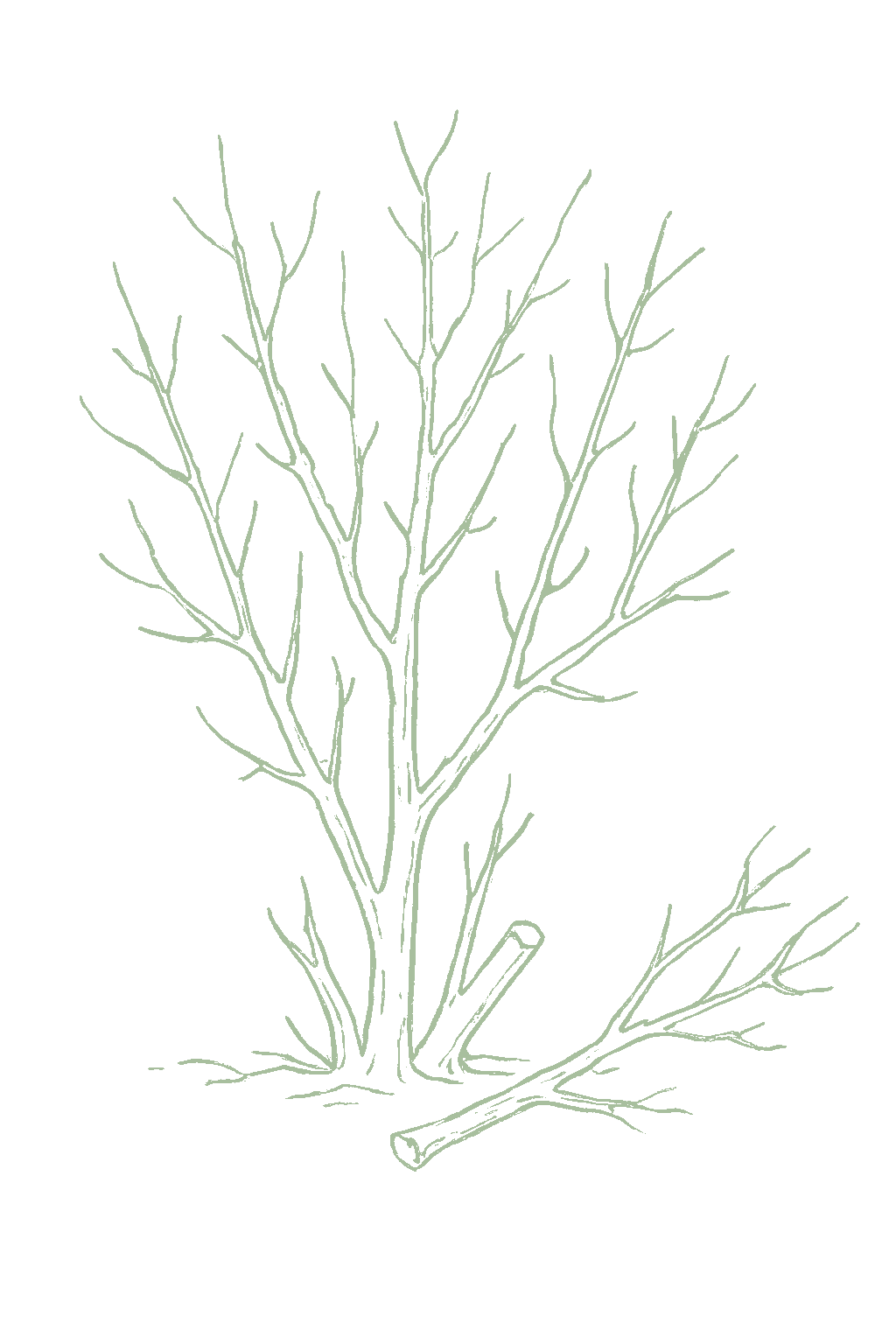
Dormant pruning
Bare branches, so you can see the whole shape. This is the time to keep the plant open, thin crowded branches, and pull suckers before it starts growing.Bare branches that show the plant's structure clearly. This is the time to maintain the open framework, thin crowded wood, and remove suckers before growth resumes.
Prune lightly in late winter: keep the open bush or tree shape, cut out dead, weak, crossing, or inward branches, thin to let light in, and remove the shoots from the base. Do not cut it back hard all over, because a lot of the fruit forms on older wood and shoot tips. Make clean cuts.Prune lightly to moderately in late dormancy: maintain the open shrub or tree form, remove dead, weak, crossing, and inward wood, thin to let in light, and clear base suckers. Avoid heavy heading, since much fruiting wood is on spurs on older wood and shoot tips. Make clean cuts.
FROM PLANT · Prune in late winter: thin the plant so light and air get in, cut out dead and crossing branches, and remove the base shoots. Keep it light and make clean cuts.Prune in late dormancy: thin for light and air, remove dead and crossing wood, and clear base suckers. Keep it light, and make clean cuts.
06
Bloom
Bright orange-red flowers opening a few at a time over several weeks. One plant makes fruit by itself. Because it blooms late, frost is rarely a problem; damp, still air is what hurts fruit set.Showy orange-red flowers opening in successive flushes over several weeks. Pomegranate is self-fruitful, so a single plant sets fruit. Because bloom is late, spring frost is rarely a threat; humid, still air is the bigger risk to set.
Not much to do. Make sure air moves through the plant and bees are active, and keep the water steady as fruit starts to form. In humid areas, an open, airy plant helps flowers set and cuts down disease.Little intervention is needed. Ensure good air movement and pollinator activity, and keep moisture steady as fruit begins to set. In humid climates, an open, breezy canopy reduces flower abortion and disease.
FROM PLANT · Pomegranate makes fruit on its own and blooms late over several weeks, so it usually avoids spring frost. Damp, still air during bloom, not frost, is the main thing that hurts fruit set.Pomegranate is self-fruitful and blooms late over several weeks, so it largely dodges spring frost. Humid, still air at bloom, not frost, is the main threat to fruit set.
07
Fruit set and even watering
Small round fruit forming from the flowers, with a little crown at the end. This is when steady watering really matters: uneven water from now until harvest is what cracks the fruit.Small round fruit developing from the flowers, with a persistent crown (the calyx) at the tip. This is when steady soil moisture becomes critical: uneven water from here to harvest is what splits the fruit.
Keep the soil evenly moist through the summer, which is the main way to stop the fruit from splitting. Thin a little only if a young plant has set too much. Watch for the leaf-footed bug, which damages the seeds inside without showing on the outside.Keep soil moisture EVEN through fruit development, the single biggest lever against splitting. Thin lightly only if a young plant is overloaded. Monitor for leaf-footed bug, whose feeding damages the arils invisibly from inside.
FROM PLANT · Keep the soil evenly moist from the time fruit forms until harvest. Going dry and then soaking (or a big rain) is what splits pomegranates, the most common problem there is.Keep soil moisture EVEN from fruit set to harvest. A dry spell followed by heavy water or rain is what splits pomegranates, the single most common failure.
FROM PLANT · Watch for the leaf-footed bug once fruit forms. Its feeding leaves no mark outside but darkens and shrivels the seeds inside and lets rot start in the fruit.Scout for leaf-footed bug from fruit set on. Its feeding leaves no external mark but darkens and withers the arils inside and opens the fruit to internal rot.
08
Harvest
Fruit at full color that feels heavy, makes a light metallic sound when tapped, and has flattened into a more six-sided shape. Pomegranates do not ripen more after picking, and fruit left on into the fall rains cracks open.Fruit at full varietal color that feels heavy, sounds metallic when tapped, and has flattened to a slightly ridged shape. Pomegranate does not ripen further off the plant, and fruit left into the fall rains splits.
Pick at full color, cutting the fruit off with clippers instead of pulling, leaving a little stem. Pick before big rains so it does not split. The fruit keeps for weeks or months; toss any split or moldy ones as you go.Pick at full color, cutting (not pulling) with a short stem. Harvest ahead of significant rain to avoid splitting. Fruit stores for weeks to months; cull any split or moldy fruit as you go.
FROM PLANT · Pick before the fall rains. Pomegranates do not ripen after picking, so wait for full color, but fruit left out through the rain will crack.Harvest ahead of the fall rains. Pomegranate does not ripen off the plant, so pick at full color; fruit left through rain splits.
FROM PLANT · Cut the fruit off with clippers instead of pulling, leaving a little stem. Whole pomegranates keep for weeks or months, and unlike peaches they do not mind the cold, so the fridge is fine.Cut, do not pull, the fruit, leaving a short stem. Whole pomegranates then store for weeks to months, and unlike peaches they are not chill-sensitive, so refrigerate freely.
The specs

Care guide

The numbers that matter, at a glance.

Sunlight
full sun · 8-12 hrs/day
Water
moderate
Spacing
120-180 inches
Soil
loam
Soil pH
5.5 to 7
Container OK?
Yes · 15+ gal pot
Soil chemistry

Soil pH for pomegranate

Preferred
5.5 to 7
Tolerated
5.5 to 7.2

Pomegranate grows well in a wide pH range, about 5.5 to 7.0, and tolerates up to around 7.2 (pH just measures how acidic or alkaline the soil is). It is unusually easygoing about alkaline soil, so most gardeners never need to adjust pH for it. Test your soil before planting, and only correct if it is far outside that range.Pomegranate does well across a broad pH band, roughly 5.5 to 7.0, and tolerates up to about 7.2. It is notably alkaline-tolerant, so pH is seldom a limiting factor and rarely needs amending. Test before planting and correct only if the soil is well outside the tolerated range.

Verified · 2 sources View
Steady hand on the hose

Watering

When & how much
Frequency
Water deeply and regularly through spring and summer, then cut back in winter. A young plant needs steady water to get established. An older plant can take drought but makes much better fruit with regular deep watering, about once a week in summer heat, more or less depending on your soil and the weather. The most important thing is to keep the water STEADY once the fruit is forming: letting it go dry and then soaking it (or the first fall rains) is what makes pomegranates split. In winter, when the plant is resting, it needs very little.Water deeply and regularly through the growing season, then ease off. Young plants need steady moisture to establish; bearing plants are drought-tolerant but crop far better with regular deep watering, roughly weekly in summer heat, adjusted for soil and weather. The critical discipline is CONSISTENCY from fruit set through ripening: a dry spell followed by heavy water (or the first fall rains) is what splits the fruit. In winter dormancy, water need drops sharply and rainfall usually suffices.
Amount
Each watering should soak the soil deeply down to the roots, not just wet the top. During the fruiting season, aim for about an inch of water a week, more when it is very hot, given as deep, even soaks. Keeping the moisture steady from the time fruit forms until harvest is what stops the fruit from cracking, so avoid letting it dry out and then flooding it.Water deeply enough to wet the full root zone each time rather than sprinkling the surface. Through the fruiting season aim for the rough equivalent of an inch of water per week, more in extreme heat, delivered as deep, even soaks. Steady soil moisture from set to harvest is what prevents splitting; the goal is even, never a dry-then-flood swing.
Method
Water the ground around the roots with a drip line or soaker hose, out to the edge of the branches. What matters most is deep, even watering, because steady moisture is what keeps the fruit from splitting. A layer of mulch helps hold moisture even; just keep it off the trunks.Water at the root zone with drip or a soaker hose out toward the canopy edge, keeping the base broad and even. Pomegranate tolerates overhead water better than stone fruit, but even, deep root-zone irrigation is what delivers the consistent moisture that prevents fruit split. Mulch to buffer soil-moisture swings, keeping mulch off the trunks.
Signs of trouble
Too much water
Too much water, or soil that drains poorly, shows up as yellow leaves, wilting even when the soil is wet, and a plant going downhill, because soaked roots cannot breathe and start to rot. Soil that stays wet all the time is your warning. Pomegranate likes steady moisture but not a swamp.Overwatering and poor drainage show as yellowing leaves, wilting in wet soil, and a declining plant, since waterlogged roots suffocate. Chronically wet, heavy soil invites Armillaria and other root rots, which are hard to reverse. Soil that never dries between waterings is the warning sign; pomegranate wants moisture but not a saturated root zone.
Too little water
Too little water shows as wilting, dull or yellow leaves, leaves dropping early, and small fruit. The worst result comes from uneven water: a plant that gets dry and is then watered heavily (or hit by fall rain) will crack its fruit. Try to keep the water steady so this does not happen.Underwatering shows as wilting, dull or yellowing leaves, early leaf drop, and small, poorly filled fruit. The most costly symptom is inconsistent water: a drought-stressed plant that is then rewetted, or catches the fall rains, splits its fruit. Catch dry stress before the fruit pays for it.
Feeding rhythm

Feeding

Frequency
1-2x per year
Type
balanced granular (e.g. 10-10-10)
When to start
late winter to early spring before growth; optional light second feeding in late spring

Pomegranate does not need much feeding. In late winter or early spring, scatter a small amount of balanced fertilizer around the plant and water it in. Do not overdo nitrogen (the first number on the bag), because too much grows leaves and base shoots instead of fruit. On poor or sandy soil, a light second feeding in late spring helps a young plant, but an established one usually needs very little.Pomegranate is a light feeder. Broadcast a modest amount of balanced fertilizer around the root zone in late winter to early spring as growth begins, and water it in. Avoid heavy nitrogen: excess N drives vegetative growth and suckering at the expense of flowers and fruit, and can worsen soft, split-prone fruit. On lean or sandy soils a light second feeding in late spring helps young plants; established plants often need little or none.

N · P · K = 10-10-10

A balanced fertilizer like 10-10-10 (the three numbers are nitrogen, phosphorus, and potassium) is plenty for a pomegranate. Go light, and especially do not overdo the first number, nitrogen, which grows leaves and shoots instead of fruit.A balanced ratio such as 10-10-10 suits pomegranate; it is a light feeder and draws modestly on all three nutrients. Keep nitrogen restrained, since excess pushes suckers and soft growth over flowering and fruit set.

Try 10-10-10 balanced fertilizer
Who grows well together

Companion planting

Pomegranate is self-fruitful, so one plant makes fruit on its own and you do not need a second plant to pollinate it (though a second pomegranate nearby can improve fruit set a little). For a shrub like this, the things that help are not the usual vegetable-garden pairings but the space around it: keep grass and weeds pulled back from the base so they do not compete with a young plant, and give it an open, sunny, breezy spot, because crowded, still, humid air at bloom makes flowers drop instead of setting fruit. Flowering plants nearby that draw bees can help set, and they bring in helpful insects that keep aphids and whiteflies down. Pomegranate is self-fruitful, so a single plant sets a crop on its own (a second plant nearby can modestly improve set). The interactions that matter for this shrub are about air, light, and the root zone, not classic vegetable companions: keep turf and weeds cleared from the base so they do not compete with a young plant, and site it in open, sunny, breezy ground, since crowded, humid, still air at bloom causes flowers to abort. Nearby pollinator plantings aid set and recruit the beneficials that hold aphids, whiteflies, and mealybugs in check.

Other
Flowering / pollinator and insectary plants
A skirt of flowering, pollinator- and beneficial-friendly plants around a pomegranate supports fruit set and pest balance. Pomegranate self-pollinates, so this is help rather than a requirement, but better bee activity improves set, and the same flowers recruit the lacewings, hoverflies, and parasitic wasps that keep aphids, whiteflies, and mealybugs in check. Keep them out toward the drip line rather than crowding the base, so air still moves freely through the canopy. Well-grounded
Keep apart from
Crowding and shade that block air movement Do not crowd a pomegranate against a wall of dense plantings or into shade. It needs full sun and moving air, especially at bloom: humid, still air causes flowers to abort and sets up the fruit diseases (Cercospora spot, gray mold, black heart) that plague pomegranate in muggy conditions. Give it an open, sunny, breezy site with room around the canopy so the foliage and fruit dry quickly after rain or dew. Research-backed
Provenance tagged inline · see methodology for the labeling system Key
Harvest signals

When to pick

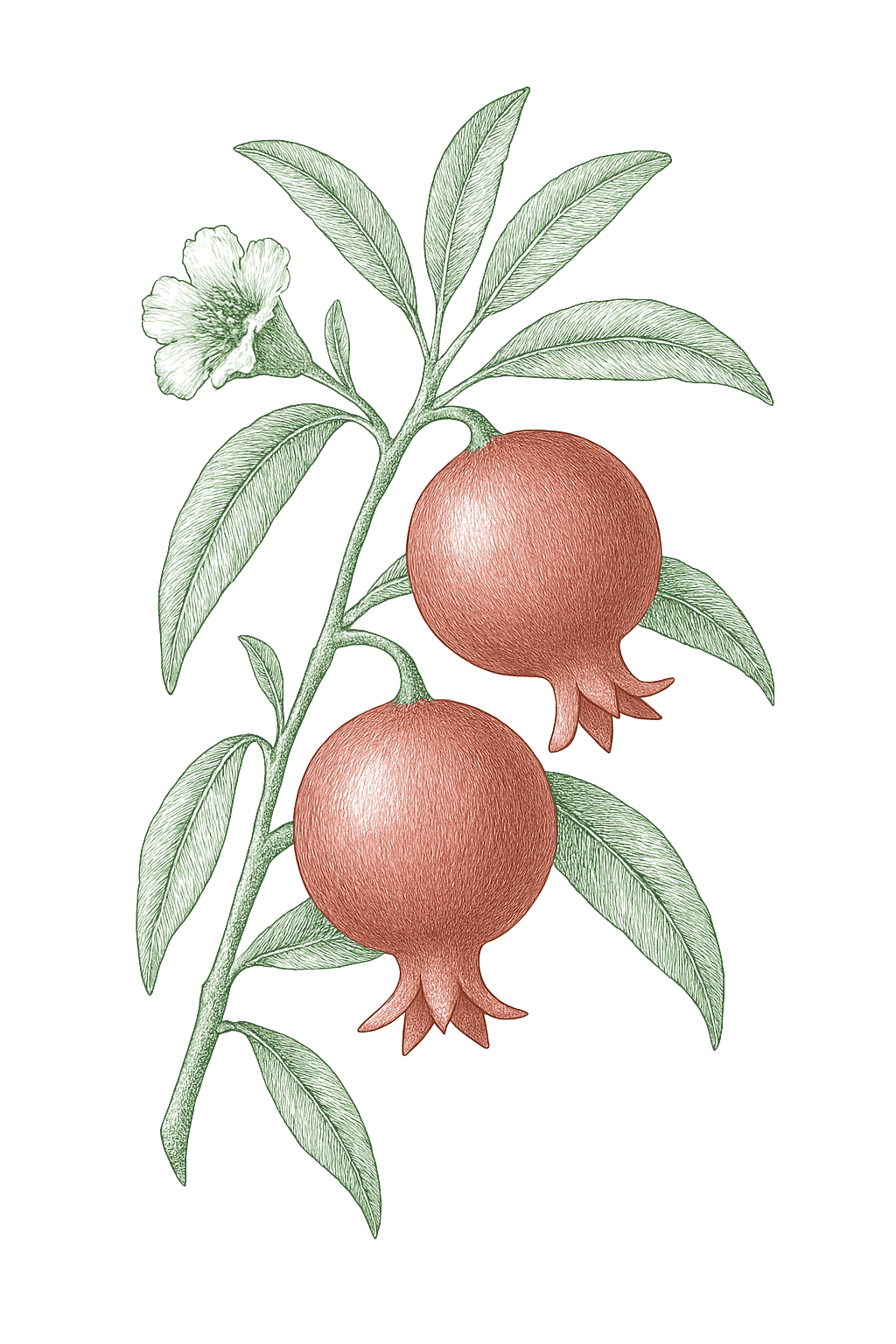
A pomegranate is ripe when the skin turns its full color (deep red for 'Wonderful'), goes from shiny to a little dull, and the round fruit flattens into more of a six-sided shape as the seeds inside swell. A ripe one feels heavy and makes a light metallic, tinny sound when you tap it. Pomegranates do not get sweeter after you pick them, so wait for full color, but do not leave them too long, because fruit left on the tree once the fall rains start will crack open. Cut the fruit off with clippers instead of pulling, and leave a little stem so you do not tear the skin.A pomegranate is ready when the rind takes on full varietal color (deep red for 'Wonderful'), shifts from glossy to a slightly matte finish, and the fruit's round shape flattens to a faintly hexagonal, ridged profile as the arils swell and press outward. A ripe fruit feels heavy for its size and makes a metallic, tinny sound when tapped. Pomegranate does not ripen further once picked, so pick at full color; but pick a touch early rather than late, because fruit left on the tree into the fall rains splits. Cut, do not pull, the fruit, leaving a short stem so you do not tear the rind.

Verified · 2 sources View
Yield

What to expect

A grown pomegranate (about year 5 onward) usually gives roughly 50 to over 100 fruit a year, something like 30 to 60 pounds, depending on the variety, its size, pruning, and how well your climate suits it. Hot, dry gardens with steady watering give the biggest, best crops; cool or humid gardens give less and lower quality.A mature pomegranate (roughly years 5 and up) commonly yields about 50 to 100-plus fruit per plant, on the order of 30 to 60 pounds, depending on cultivar, size, pruning, and climate fit. Hot, dry sites with even watering produce the heaviest, best-colored crops; cool or humid sites yield less and lower quality.

A pomegranate hits full production around years 5 to 6 and keeps producing for decades, often much longer than 30 years, as long as it gets full sun, steady water, and yearly pruning to keep it open and growing fresh fruiting wood.Plants reach full bearing around years 5 to 6 and stay productive for decades, often well beyond 30 years, given full sun, even moisture, and annual pruning to keep the canopy open and renew fruiting wood. Do not expect fruit the first year, or much the second. If a few fruit form early, pick them off so the plant can grow strong roots and branches. Your first real harvest usually comes around years 2 to 3, with full crops by years 5 to 6.Expect no crop in the planting year and little in year 2. Remove any early fruit so the plant builds roots and framework; the first meaningful harvest typically comes around years 2 to 3, with full bearing by years 5 to 6.

What changes yield
cultivar and climate fitsummer heat accumulation (color and sweetness)even moisture from set to harvest (split prevention)annual pruning and sucker managementfruit and root disease pressure (humid climates)leaf-footed bug and other fruit-piercing pestsplant age and establishment
Verified · 2 sources View
Off the vine

Storing your harvest

Room temp
Whole pomegranates last a long time at cool room temperature, out of the sun, often several weeks, because the tough skin protects the seeds inside. They do not ripen more after picking, so just store them as they are. A cool pantry or garage helps them keep. Toss any that are split or have soft, moldy spots, since those spread.Whole pomegranates keep remarkably well at cool room temperature, out of direct sun, for several weeks; the leathery rind protects the arils. They do not ripen further off the plant, so store them as-is. A cool pantry or garage extends counter life; discard any fruit that is split or shows soft, moldy spots, which spread.
Fridge
Kept whole in the fridge, pomegranates last one to two months, sometimes longer, in a bag in the crisper drawer. Once you take the seeds out, they keep about 5 to 7 days in a sealed container in the fridge. Unlike peaches, pomegranates do not mind the cold, so the fridge is the best place to store them.Refrigerated whole, pomegranates keep for one to two months, and often longer, in a plastic bag in the crisper. Loose arils (seeds) keep about 5 to 7 days refrigerated in a sealed container. Pomegranate is not prone to chilling injury the way peaches are, so cold storage is the best way to hold the crop.
Freezer
The seeds (arils) freeze really well. Take the seeds out of the fruit, spread them on a tray to freeze, then pack them into freezer bags. They keep for several months and are ready to use when thawed. The juice freezes well too. Do not freeze the whole fruit.Pomegranate arils freeze excellently. Separate the seeds from the rind and membrane, spread them in a single layer on a tray to freeze, then transfer to freezer bags; they keep their quality for several months and thaw ready to use. Juice also freezes well. Freezing whole fruit is not recommended.
Verified · 1 source View
When something goes wrong

Common problems

The fruit cracked open on the plantThe fruit split open on the plant
01 of 04
What happened Ripe or nearly ripe fruit cracked open, sometimes showing the seeds. This is the number-one pomegranate problem, and it is about water, not disease: the skin splits when the seeds soak up water faster than the skin can stretch, which happens when the watering swings from dry to wet, after a big watering or the first fall rains following a dry stretch. It is easy to blame the variety, but the fix is how you water and when you pick: keep the soil evenly moist from the time fruit forms until harvest, and pick before big rains instead of leaving fruit out.Ripening or ripe fruit cracked, often exposing the arils. This is the signature pomegranate failure, and it is a water problem, not a disease: the rind splits when the arils take up water faster than the skin can stretch, which happens when moisture swings from dry to wet, after a heavy irrigation or the first fall rains following a dry spell. It is tempting to blame the variety, but the fix is watering and timing: keep soil moisture EVEN from fruit set through harvest, and pick ahead of significant rain rather than leaving fruit on the plant. Next season Water evenly all summer while the fruit fills (deep, regular soaks, no going dry and then soaking), mulch to steady the soil, and pick at full color before the fall rains come.Keep soil moisture even all through fruit development (deep, regular watering, no dry-then-flood swings), mulch to buffer the soil, and harvest at full color ahead of the fall rains.
It flowered but I got almost no fruitThe plant flowered but set little or no fruit
02 of 04
What happened The plant flowered but barely fruited. On pomegranate the usual reasons are a young plant (it takes 2 to 3 years to start fruiting and 5 to 6 for full crops), damp or cool, still weather during bloom that makes the flowers drop, or too much nitrogen growing leaves and shoots instead of flowers. People often think it needs a partner plant, but pomegranate makes fruit on its own. The real fixes are patience, an open, sunny, breezy spot, and going easy on fertilizer.The plant bloomed but few or no fruit formed. On pomegranate the usual causes are a young plant (it takes 2 to 3 years to begin bearing and 5 to 6 for full crops), humid or cool, still weather at bloom that causes flowers to abort, or excess nitrogen driving leaves and suckers over flowers. People often assume it needs a pollinator partner, but pomegranate is self-fruitful and a lone plant should set. The real levers are patience, an open sunny breezy site, and restrained feeding. Next season Give a young plant a few years, plant it in an open, sunny, breezy spot so the bloom-time air is not damp and still, and go easy on nitrogen so it makes fruit instead of leaves.Give a young plant time, site it in open, sunny, breezy ground so bloom-time air is not humid and still, and keep nitrogen feeding light so the plant favors fruit over leafy growth.
The fruit looked okay but was rotten insideThe fruit looked fine but was rotten inside
03 of 04
What happened A fruit that looked almost fine on the outside was brown and moldy inside when you cut it. This is Alternaria heart rot, or black heart: a fungus gets in through the flower in damp bloom weather, or through insect holes (especially from the leaf-footed bug), and rots the inside with little sign outside. There is no cure once it is inside. It is much less of a problem in hot, dry weather, so the fixes are climate, pest control, and cleanup, not a spray.A fruit that looked nearly normal outside was brown and moldy inside when cut. This is Alternaria heart rot (black heart): the fungus infects through the flower in wet or humid bloom weather, or enters through insect punctures (notably leaf-footed bug), and rots the interior with little or no external sign. There is no cure once it is inside. It is far less of a problem in hot, dry climates, so the controls are climate, pest management, and sanitation, not a spray. Next season Grow it in a hot, dry, open, airy spot if you can, control the leaf-footed bug and other fruit-piercing pests, water at the ground instead of over the top, and clean up any rotted or old dried fruit so it does not spread.Favor hot, dry-summer siting and open, airy canopies, control leaf-footed bug and other fruit-piercing pests, water at the ground rather than overhead, and remove infected and mummified fruit so spores do not carry over.
The fruit was pale, sour, or small
04 of 04
What happened The fruit ripened but was pale, bland or sour, or small. The most common reason is not enough summer heat: pomegranate needs a long, hot summer to build color and sweetness, so cool coastal or short-summer spots give lower-quality fruit even on a healthy plant. Watering too much late, letting a young plant carry too much fruit, or picking too early (it does not ripen after picking) also hurt quality. The fix is matching the climate, choosing the right variety, and picking at full color.The fruit ripened but was poorly colored, bland or sour, or undersized. The most common cause is not enough summer heat: pomegranate needs a long, hot season (roughly temperatures above 85°F for 120-plus days) to build color and sugar, so cool coastal or short-summer sites give lower-quality fruit even on a healthy plant. Over-watering late, under-thinning on a young plant, or picking underripe (pomegranate does not ripen off the plant) also dull quality. The fix is climate fit, variety choice, and picking at full color. Next season In cooler or shorter-summer areas, pick an early, sweeter variety (Granada, Eversweet, Angel Red), give it the hottest, sunniest spot you have, keep the water steady, and only pick when it is at full color.In cooler or shorter-summer areas, choose an early, sweeter variety (Granada, Eversweet, Angel Red), give it the hottest, sunniest spot you have, keep water even, and pick only at full color.
The usual suspects

Pests & diseases

Pests
Leaf-footed bug
P · 01
Symptoms Usually you see nothing wrong on the outside of the fruit, because the damage is inside. If you cut a fruit open, you find brown spots on the inner skin and seeds (arils) that have gone dark, shriveled, or corky. It is worst late in the season as the fruit ripens, and it can let rot start inside.Often no external mark on the fruit at all; the damage is inside. Cut a fed-on fruit and you find brown spots on the inner rind where the insect's needlelike mouthpart pierced, and arils that have darkened, withered, or turned corky. Late-season feeding as fruit ripens is the worst, and it opens the door to internal fungal rots. Cause A big brown bug called the leaf-footed bug, named for the little leaf-shaped flares on its back legs. It and its young pierce the fruit to feed, and that can carry in yeasts and fungi that discolor and rot the seeds inside. The adults spend winter hidden in sheltered groups, then move onto the fruit as it forms.The leaf-footed bug (Leptoglossus species), a large brown true bug with flattened, leaf-like flares on its hind legs. Adults and nymphs pierce fruit to feed; on pomegranate their feeding can introduce yeasts and fungal spores that discolor and rot the arils. They overwinter as adults in sheltered aggregations and move onto fruit as it develops. Organic treatment For a backyard plant, the best fixes are hands-on: in the cool early morning, knock the bugs into a bucket of soapy water, and clean up the weedy, sheltered places where they spend the winter and gather. Where you can, cover fruit clusters with fine mesh bags. Flowers nearby that bring in helpful insects also keep numbers down.There is no easy rescue spray for a backyard plant. The practical controls are physical: hand-pick or knock adults and nymphs into soapy water in the cool early morning when they are sluggish, clear the weedy and sheltered spots where they overwinter and aggregate, and bag developing fruit clusters in mesh where feasible. Encourage the natural egg parasites and general predators by keeping insectary flowers nearby. Prevention Keep an eye out from the time fruit forms, because you cannot see the damage from outside until you cut a fruit open. Keep weeds cleared to take away the places the bugs hide and breed, and look for the adults gathering in spring. Catching and removing them early, before there are many, works best.Monitor from fruit set onward, since the internal damage is invisible until you cut the fruit. Keep the area weed-free to remove overwintering and breeding habitat, and watch for the adults congregating in spring. Early detection and hand-removal before populations build is the most effective home strategy.
Aphids
P · 02
Symptoms Groups of tiny soft insects on new shoots and the undersides of leaves, leaving a sticky coating (honeydew) that turns into black sooty mold, plus curled new leaves and ants running up and down the plant.Clusters of small soft-bodied insects on new shoots, leaf undersides, and flower stems, with sticky honeydew, sooty black mold on leaves and fruit, curled or distorted new growth, and attending ants. Cause Aphids, tiny sap-sucking insects that build up on soft new growth in spring. They multiply quickly, and the sticky honeydew they leave grows black mold and attracts ants that guard them.Several aphid species colonize tender pomegranate growth in spring, multiplying fast in warm weather. Their honeydew supports sooty mold and draws ants, which protect the aphids from predators. Organic treatment Spraying the plant with a strong stream of water knocks most aphids off and is often all an established plant needs. Let the good bugs (ladybugs, lacewings) do their job by avoiding harsh sprays; insecticidal soap helps if there are a lot. Keeping ants off the plant lets the helpful insects control them.A strong jet of water knocks aphids off and is often enough on an established plant. Preserve natural enemies (ladybugs, lacewings, syrphid larvae) by avoiding broad-spectrum sprays; insecticidal soap or horticultural oil handles heavier infestations. Control ants, which farm aphids, to let predators work. Prevention Do not overfeed with nitrogen, because all that soft new growth attracts aphids. Grow flowers nearby to bring in helpful insects, and keep ants away so those helpers can do their work.Keep nitrogen feeding moderate, since lush growth pushed by excess nitrogen draws aphids. Support beneficial insects with nearby flowers, and manage ants so predators are not chased off.
Whitefly
P · 03
Symptoms Tiny white insects like little moths that flutter up when you brush the plant, sitting under the leaves along with their flat, pale young. They leave sticky honeydew and black sooty mold, and a lot of them yellow the leaves.Tiny white moth-like insects that fly up in clouds when the plant is disturbed, gathered on leaf undersides with their pale nymphs; honeydew and sooty mold follow, and heavy infestations yellow and weaken leaves. Cause Whiteflies, small sap-sucking insects that live under the leaves and multiply fast in warm weather. Like aphids, they leave honeydew that grows sooty mold.Whiteflies, small sap-feeding insects that colonize leaf undersides and reproduce rapidly in warm weather. Like aphids, they excrete honeydew that fosters sooty mold. Organic treatment Spray the leaves with water and let helpful insects do most of the work; they usually keep whiteflies under control outdoors. Insecticidal soap sprayed under the leaves helps if there are many, and yellow sticky cards catch the adults.Hose off foliage and rely on natural enemies (lacewings, ladybugs, parasitic wasps), which usually keep whiteflies in check on an outdoor plant. Insecticidal soap or horticultural oil on leaf undersides helps in heavy cases; yellow sticky traps monitor and reduce adults. Prevention Keep the plant healthy, avoid overfeeding with nitrogen, and do not let it get dusty and stressed, which whiteflies like. Avoid harsh sprays so the helpful insects survive.Keep plants healthy and avoid excess nitrogen and dusty, stressed conditions that favor whitefly buildup. Preserve natural enemies by avoiding broad-spectrum insecticides.
Mealybugs and scale
P · 04
Symptoms Fuzzy white cottony spots (mealybugs) tucked into branch joints and inside the crown of the fruit, or small hard brown bumps (scale) stuck to stems and leaves. Both leave sticky honeydew and black mold, and mealybugs hiding in the fruit crown can get inside the fruit.Cottony white tufts (mealybugs) in leaf axils, branch crotches, and inside the fruit calyx (crown), or small immobile brown or waxy bumps (scale) on stems and leaves; both produce honeydew and sooty mold, and mealybugs hidden in the crown can contaminate the fruit interior. Cause Mealybugs and scale insects, sap-sucking pests that hide in sheltered spots, including the crown of the fruit. Ants move them around and protect them, and their honeydew grows black mold.Mealybugs and various scale insects, slow-moving or immobile sap feeders that shelter in protected spots including the fruit's crown. Ants tend and spread them, and their honeydew fuels sooty mold. Organic treatment Wipe visible mealybugs with a cotton swab dipped in rubbing alcohol, spray with horticultural oil or insecticidal soap, and cut out badly infested branches. Keep ants off so the helpful insects can work, and throw away any fruit with bugs packed into the crown.Spot-treat with horticultural oil or insecticidal soap, dab visible mealybug colonies with an alcohol-dipped swab, and prune out heavily infested wood. Control ants to let natural enemies (including mealybug destroyers and parasitic wasps) suppress them. Remove fruit with infested crowns. Prevention Keep ants away, do not overfeed, and check the fruit crowns and branch joints where these pests hide. An open, airy plant with good light bothers them.Keep ants under control, avoid excess nitrogen, and inspect the fruit crown and branch crotches where these pests hide. Good airflow and light through the canopy discourage them.
Diseases
Alternaria heart rot (black heart)
D · 01
Symptoms From the outside the fruit looks almost fine, maybe a bit light or a paler red, but inside it is rotting: the seeds turn brown and mushy with black mold. There is usually no sign on the outside, so you only find it when you cut the fruit open.The fruit looks nearly normal outside, perhaps a little light in weight or slightly off-color (a paler red), while the interior rots: arils turn brown and mushy and a black mold sporulates inside. There is often no external cue, so the rot is discovered only on cutting. Cause A fungus called Alternaria gets into the fruit through the open flower in damp, rainy bloom weather and grows quietly inside. Wounds from insects (like the leaf-footed bug) or birds let it in too. Wet weather around bloom is the main cause, so it is worse in humid areas.The fungus Alternaria (and related molds) infects through the open flower during rainy or humid bloom weather and grows silently inside the developing fruit. Insect and bird punctures (notably leaf-footed bug feeding) give it a second way in. Wet weather at and after bloom is the main driver, which is why it is a bigger problem in humid climates. Organic treatment Once a fruit is rotting inside, it cannot be saved. The way to fight it is to prevent it: it is much less of a problem in hot, dry weather, so keep the leaf-footed bug and other fruit-piercing pests under control, keep the plant open and airy, and pick off and throw away any rotted or old dried fruit so the mold does not spread to next year.There is no cure once the inside is rotting; the fruit is lost. Control is preventive: it is far less of a problem in hot, dry climates, so the main levers are managing leaf-footed bug and other fruit-piercing pests, keeping the canopy open and airy, and removing and destroying infected and mummified fruit so spores do not carry over. Prevention Grow it where summers are hot and dry if you can, keep the plant open, and water at the ground rather than over the top. Keep fruit-piercing bugs in check, clean up rotted and old dried fruit, and know that in humid, rainy areas this disease may limit your crop, so pick the most open, breezy spot.Favor dry-climate siting, open canopies, and drip (not overhead) watering to keep bloom and fruit dry. Control fruit-piercing insects, sanitize by removing mummies and rotted fruit, and, in humid regions, expect this to be a limiting disease and choose the most open, breezy sites.
Botrytis gray mold / fruit rot
D · 02
Symptoms Fuzzy gray-brown mold on the flowers and fruit, often starting at the crown end or a wound, with soft brown rot that spreads in cool, damp weather and in storage. It can spread from one fruit to another where they touch.Fuzzy gray-brown mold on flowers, on fruit (often starting at the crown or a wound), and on stored fruit; soft brown rot spreads in cool, wet, or humid conditions and in storage, and can move between touching fruit. Cause A fungus called Botrytis, or gray mold, that infects flowers and damaged or overripe fruit in cool, damp weather. It survives on old fruit and plant litter and is a common cause of rot in stored fruit.The fungus Botrytis cinerea (gray mold), which infects flowers and wounded or overripe fruit in cool, wet, humid conditions. It overwinters on plant debris and old fruit and is a common cause of post-harvest rot. Organic treatment Pick off and throw away moldy flowers, fruit, and litter right away. Keep the plant open and dry, pick before the rains, handle fruit gently so it does not bruise, and refrigerate good fruit soon, since cold slows the mold. Once a fruit is rotting there is no home spray that fixes it.Remove and destroy moldy flowers, fruit, and debris promptly. Keep the canopy open and dry, harvest before rains, handle fruit gently to avoid wounds, and refrigerate sound fruit quickly, since cold storage slows the mold. There is no home spray cure once fruit is rotting. Prevention Keep the plant open and the leaves dry: prune for airflow, water at the ground, clean up old fruit and litter, and handle and chill fruit carefully at harvest. Remove split or damaged fruit, which is where the mold gets in.Prioritize air circulation and dry foliage: open pruning, root-zone watering, prompt sanitation of old fruit and debris, and gentle handling with quick cooling at harvest. Cull split and wounded fruit, which are entry points.
Cercospora fruit and leaf spot
D · 03
Symptoms Small dark spots on the fruit and leaves that grow and run together; badly spotted fruit looks rough and russeted, and heavy leaf spotting yellows the leaves and drops them. It is worst in warm, humid, rainy areas.Small dark spots and blotches on fruit and leaves that enlarge and merge; heavily spotted fruit is russeted and downgraded, and severe leaf infection causes yellowing and drop. Most common and damaging in warm, humid, rainy climates. Cause A fungus (Cercospora punicae, along with related fungi in the same wet climates) that spreads when leaves and fruit stay wet for a long time. It is a big reason pomegranate does poorly in the humid Southeast and other rainy places.The fungus Cercospora punicae (with related fungi such as Colletotrichum and Botryosphaeria in the same wet climates). It thrives on prolonged leaf and fruit wetness, so it is a leading reason pomegranate fruits poorly in the humid Southeast and other rainy regions. Organic treatment There is no easy home cure, so prevention matters: plant in an open, sunny, breezy spot so the leaves dry quickly, prune to open the plant, water at the ground, and clean up fallen leaves and spotted fruit. In damp, rainy climates this disease will likely limit your fruit quality no matter what.Home control is limited and preventive: choose an open, sunny, breezy site so foliage dries fast, prune for airflow, water at the ground, and remove fallen leaves and infected fruit. In consistently humid, rainy climates, expect this disease to cap fruit quality regardless of care. Prevention The best defense is where and how you plant it: an open, breezy, sloped spot with good air movement, wide spacing, an open plant, watering at the ground, and cleaning up fallen leaves and fruit. In hot, dry climates it is barely a problem.Site selection is the main defense: open, sloped, breezy ground with strong air movement, especially at bloom. Wide spacing, open canopies, ground-level irrigation, and sanitation of fallen debris reduce pressure. In hot, dry climates it is a minor issue.
Verified · 3 sources View
Seasoned
Where to plant next year

Crop rotation

For a pomegranate, the site rules are about sun and drainage, not rotation: pick a sunny, well-drained spot, stay away from soggy ground and places where oaks were just removed, and it will grow there for many years.Pomegranate's site rules are about drainage and light, not rotation: give it full sun and soil that drains, avoid low wet ground and recently cleared oak sites (Armillaria), and it will hold that spot productively for decades.

Family
Lythraceae (Punica granatum)
Avoid following
You do not rotate a pomegranate the way you rotate vegetables, because it stays in one spot for many years. Unlike a peach, it does not have a strong replant problem, so what grew there before matters little. The main thing to avoid is a wet, poorly drained spot, especially where oaks or other trees were just removed, because a root fungus called Armillaria can live there.Annual crop rotation does not apply to a pomegranate, which holds its site for decades. Pomegranate has no strong replant-disease complex like stone fruit, so it is not fussy about the previous crop. The one real site concern is Armillaria (oak root fungus): avoid planting where oaks or other woody plants were recently removed on heavy, wet ground, and always choose a well-drained spot.
Plant after
any well-drained, sunny site; pomegranate has no stone-fruit-style replant-disease history and is easygoing about the previous crop
Verified · 2 sources View
Ask the gardener

Common questions

Got a question we missed?

We're building this guide with real growers. Got a question we missed? Ask here. We read every one and add the best answers right to this page.

Grown this before?

Share a tip

Learned something the hard way? Pass it on. Real growers' tips make this guide better for the next person, and we credit you by name when yours goes live.

Seasoned
Spot something wrong?

Report a problem

If you've grown this crop and you see a date, a temperature, a companion claim, or a recommendation that doesn't match your experience, tell us. Real growers' corrections make this guide better for the next person.

How we built this guide

Methodology & sources

Every date, temperature, spacing, and recommendation on this page is sourced from university cooperative extension publications, peer-reviewed agricultural research, NOAA climate data, and direct extension calendars. Where claims are softer (traditional gardening wisdom not formally documented), we say so.

Research-backed Documented in cooperative extension publications or peer-reviewed research
Well-grounded A known agronomic principle, but not formally tested for this specific pair
Traditional Time-tested gardening wisdom, limited formal research support
Last reviewed
June 30, 2026
Data version
crops_data_final · v1.0 · schema 2.9
Sources cited on this page
16 publications
Verified entries
Companion-planting claims tagged inline · zone dates verified against 5+ extensions
See all sources cited on this page
  • University of Minnesota Extension umn_ext
  • University of Maryland Extension umd_ext
  • Cornell Cooperative Extension cornell_ext
  • Iowa State University Extension iastate_ext
  • Michigan State University Extension msu_ext
  • NC State Extension ncsu_ext
  • Penn State Extension psu_ext
  • U. of Illinois Urbana-Champaign Extension uiuc_ext
  • UC Davis Postharvest Center ucd_postharvest
  • Texas A&M AgriLife Extension tamu_agrilife
  • Virginia Cooperative Extension 426-331 vce_426_331
  • Piedmont Master Gardeners piedmont_mg
  • UGA Vegetable Garden Calendar uga_calendar
  • Clemson Home & Garden Information Center clemson_hgic
  • UC IPM Statewide IPM Program uc_ipm
  • NOAA 1991-2020 Climate Normals noaa_normals

Growing notes, weekly.

Zone-aware seasonal nudges, what's worth planting now, and the occasional recipe from the harvest. No spam, ever.

Vol. 004 · Pomegranate · plant.lifestyle