Today · in your zone
What's happening right now
Off-season for sweet potato in zone 5.
Tap to switch. plant calibrates to where you are in the journey.
Sweet potatoes are a warm-weather crop grown for the sweet, starchy roots that form underground. Despite the name, they are not related to regular potatoes; they belong to the morning glory family. You do not grow them from seed or from tubers. Instead you plant slips, which are rooted sprouts, set out only after all frost is past and the soil is warm. The plants send out long, trailing vines that cover the ground, so they are grown on ridges or mounds with plenty of room. Sweet potatoes need a long, hot summer (about 3 to 4 months of warm, frost-free weather) and they love heat, so the warm South, Gulf, Florida, and the desert Southwest are the best places to grow them, while cooler northern gardens are a stretch and use black plastic and fast varieties. Go easy on fertilizer, especially nitrogen, or you get lots of vine and few sweet potatoes. Dig the crop before the first frost, which kills the vines, then cure the roots somewhere warm and humid for a week or two, which heals the skins and makes them sweet, and store them warm, around 55 to 60°F. Never put sweet potatoes in the fridge or anywhere cold, which ruins them. This is the opposite of how you store regular potatoes. The young leaves are also good to eat as a cooked green. Sweet potato (Ipomoea batatas) is a warm-season, frost-tender member of the morning glory family (Convolvulaceae), not a nightshade and unrelated to the ordinary potato despite the shared name. It is grown for its swollen storage roots and planted not from seed or tubers but from slips: rooted sprouts pulled from a bedded seed root and set out only after all frost danger has passed and the soil is warm, above about 65°F. The plant is a vigorous, sprawling groundcover, running long vines that root at the nodes, and it is grown on raised ridges or mounds that drain well and give the roots room to expand. The crop needs a long, hot season, roughly 90 to 120 frost-free days, and it relishes the summer heat that stalls many other vegetables, so the warm South, Gulf, Florida, and the low deserts are its stronghold while short-season northern gardens are marginal and lean on black plastic and fast varieties. Feed sparingly and keep nitrogen low, since rich ground grows rampant vine and few roots. The crop is dug before the first frost, which kills the vines, then cured warm and humid (about 80 to 85°F at high humidity for one to two weeks) to heal the skins and turn starch to sugar, and stored warm, near 55 to 60°F. Sweet potatoes are damaged by cold and must never be refrigerated or stored below about 50 to 55°F, the opposite of white potato storage. The young leaves and shoots are also edible as a cooked green.
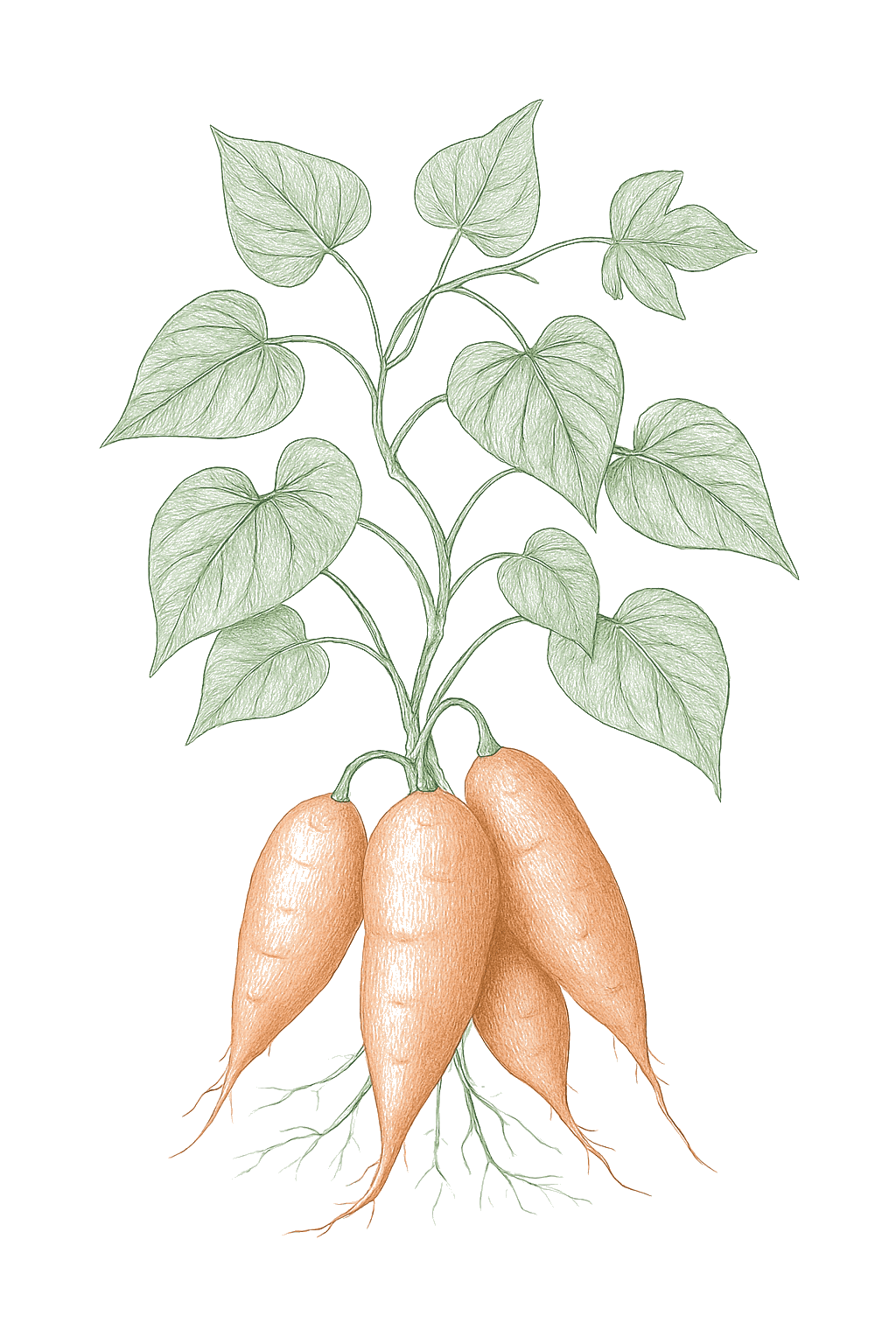
Off-season for sweet potato in zone 5.
In Zone 5, sweet potato can be planted May through June. Harvest runs September through October.
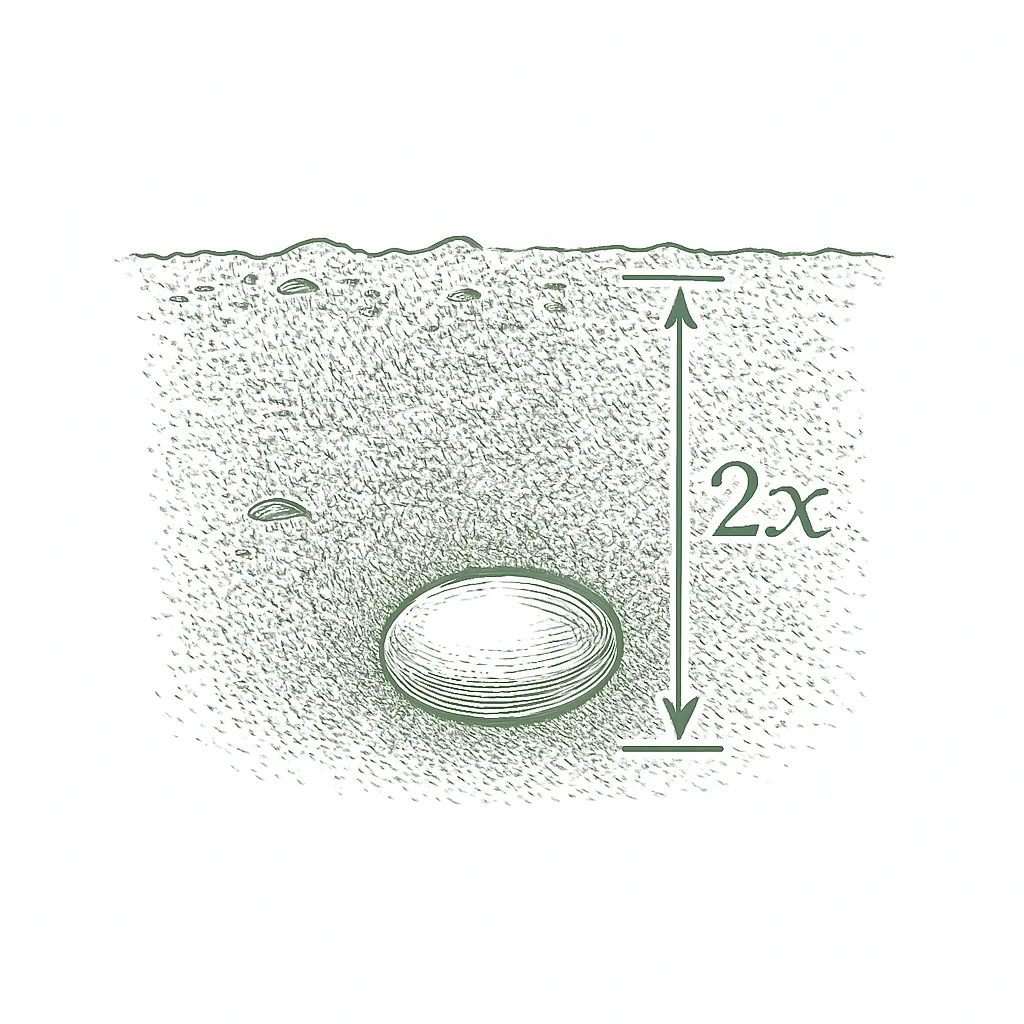
Grow sweet potatoes from slips, which are rooted sprouts. You can buy them as certified disease-free plants, or grow your own by half-burying a healthy sweet potato in warm, damp soil about 6 weeks ahead and pulling off the sprouts once they have roots. Plant the slips 3 to 4 inches deep, with a couple of the leaf joints buried, spacing them 12 to 18 inches apart along ridges or mounds in rows about 3 to 4 feet apart. Wait until all frost is past and the soil has warmed to about 65°F. There is nothing to start from seed indoors. In cool-summer areas, laying down black plastic warms the soil and gives you extra time.Sweet potatoes are grown from slips: rooted sprouts pulled from a bedded seed root, not from seed and not from seed-potato-style pieces. Buy certified, disease-free and weevil-free slips, or bed a healthy root in warm, moist medium about 6 weeks ahead and pull the sprouts once they have roots. Set slips 3 to 4 inches deep with two or more nodes buried, spacing them 12 to 18 inches apart on ridges or mounds in rows 3 to 4 feet apart, once all frost danger has passed and the soil is above about 65°F (70 to 80°F is better). There is no indoor seed-starting step; the slip itself is the transplant. In short-season areas, planting through black plastic warms the soil and buys extra growing days.







Not sure what soil you have? Grab a small handful of damp soil from your garden bed and squeeze it. If it crumbles apart easily, it's sandy. If it holds together but breaks when you poke it, it's loam (what most vegetables want). If it stays in a hard, slippery ball, it's clay.
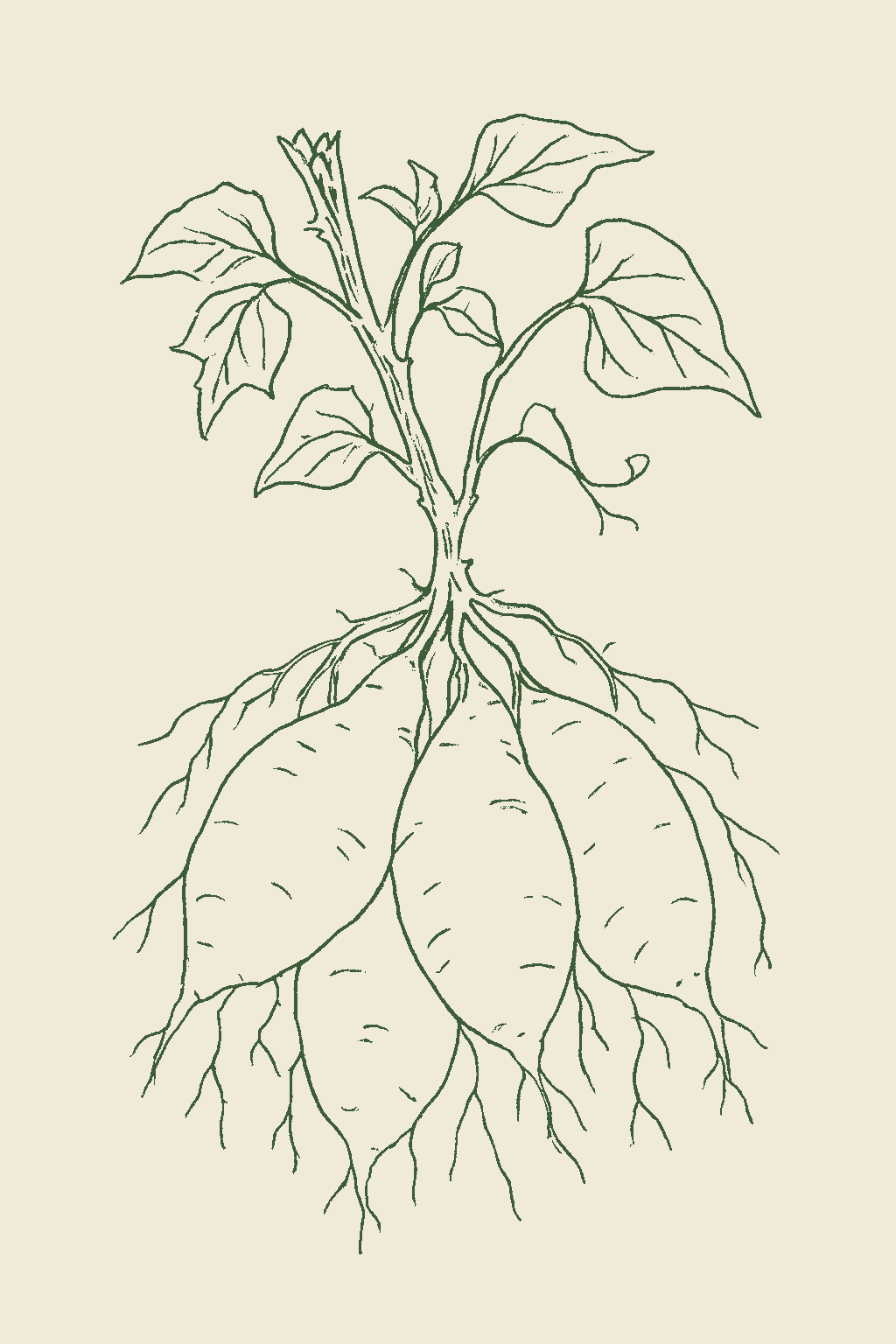
Sweet potatoes want loose, well-drained, sandy or loamy soil that the swelling storage roots can push through easily. Light soil on raised ridges or mounds is ideal, because it drains well and gives the roots room to grow smooth and long. Heavy, wet clay is the thing to avoid: it stays soggy, rots the roots, and forces them into short, knobby shapes. If your soil is heavy, build up a ridge or a raised bed of loose mix, which also warms up faster in spring. Keep the soil slightly acidic, about pH 5.8 to 6.5. Go easy on nitrogen and fresh manure, which grow lots of leafy vine and few roots.
Mix 2-3 inches of compost into the top 6 inches of your bed before planting. Compost holds moisture (which sandy soil drains too fast) and adds the nutrients sandy soil tends to lack. Repeat each season. Compost breaks down over time.
Mix 2-3 inches of compost AND a few inches of coarse sand or perlite into the top 6 inches of your bed. The compost feeds the plants; the sand breaks up the clay so air and water can move through. Don't add sand without compost. It can compact like concrete.
If amending your soil sounds like too much work, or if your soil is heavy clay, full of rocks, or contaminated, build over it. A raised bed at least 12 inches deep filled with a 50/50 mix of compost and sandy loam gives you ideal growing soil with no battles. A 5-gallon container with quality potting mix does the same for one plant at a time. Both bypass your native soil entirely.
The numbers that matter, at a glance.
Soil pH measures how acidic or alkaline your soil is, on a scale from 1 to 14 where 7 is neutral. Sweet potatoes like it slightly acidic, about 5.8 to 6.5, which is close to what most vegetables want. They are not fussy and will grow from about 5.0 up to nearly neutral, so you rarely need to change your soil much. A cheap soil test from your local extension office tells you your number, and if your soil is very alkaline, mixing in compost helps. Do not overdo lime.Sweet potatoes grow best in slightly acidic soil, roughly pH 5.8 to 6.5 (University of Georgia gives 6.0 to 6.5). They are adaptable and will crop from about 5.0 up toward neutral, so pH is rarely the limiting factor. Where soil pox and Streptomyces soil rot are a problem on susceptible varieties, growers avoid pushing the pH high and lean on resistant cultivars rather than heavy liming. Amend very alkaline ground with organic matter and confirm your starting point with a soil test before planting.
Sweet potatoes do not need much feeding, and too much of the wrong kind backfires. Mix a low-nitrogen fertilizer like 5-10-10 into the ridge before you plant, then feed once more about a month after setting the slips. Do not pile on high-nitrogen fertilizer or fresh manure: that grows a jungle of leafy vine and hardly any sweet potatoes underneath. A little compost worked into the bed is the safe way to enrich it.Sweet potatoes are light feeders and specifically want restrained nitrogen. University of Georgia suggests working in about 30 pounds of 5-10-10 per 1,000 square feet before planting, then side-dressing roughly 4 pounds of 5-10-10 per 100 feet of row about 4 to 6 weeks after transplanting. Favor a low-nitrogen, higher-potassium ratio: too much nitrogen (and fresh manure) grows lush, sprawling vine and few storage roots, while adequate potassium supports root sizing and quality.
The three numbers on a fertilizer bag are nitrogen, phosphorus, and potassium (N-P-K). Sweet potatoes do best with a low first number, like 5-10-10, not a high-nitrogen feed. Too much nitrogen grows leaves and vines instead of sweet potatoes, so use a low-nitrogen fertilizer and some compost.Sweet potatoes are light feeders that want low nitrogen and good potassium. A blend such as 5-10-10 worked into the ridge before planting covers most home soils. Excess nitrogen drives vine at the expense of roots, and fresh manure has the same effect, so lean on a low-nitrogen fertilizer and compost rather than a balanced or high-nitrogen feed.
Sweet potatoes are easygoing and take up a lot of ground with their sprawling vines, so companions are mostly about using the edges of the bed. Bush beans and other legumes are a sensible neighbor because they add nitrogen to the soil. The main thing to avoid is crowding them next to other sprawling vine crops like squash and pumpkins, which fight for the same space and sunlight. Do not trust every companion chart online; many of their claims have never been tested. Sweet potatoes are undemanding neighbors but greedy for space, since a single plant can run vines many feet in every direction. The best-grounded pairing is with legumes (bush beans, southern peas), which fix nitrogen and share the bed without heavy competition. Aromatic herbs are a traditional edge planting. The clearest practical avoids are other rampant vine crops, squash, pumpkins, and melons, which compete for the same ground and light. Most companion-chart claims for sweet potato are folklore; treat them with healthy skepticism, since university reviews find little evidence behind most of them.
You harvest sweet potatoes by the calendar and, most importantly, before frost, not by watching the tops die back. They are usually ready about 3 to 4 months after planting, when the roots are full size; the older leaves may yellow, but unlike regular potatoes the vines do not obviously die down. Dig before the first fall frost, because frost kills the vines and cold soil hurts the roots. Loosen the soil with a fork well away from the plant so you do not stab the sweet potatoes, lift them gently, and handle them carefully because they bruise easily and the skins are thin at first. Let them dry off out of the sun, do not wash them, then cure them somewhere warm and humid for a week or two before storing. If frost hits the vines, cut them off and dig within a day or two.Sweet potatoes are harvested by days-to-maturity and, above all, before frost, not by a die-back signal. The crop is usually ready about 90 to 120 days from transplanting slips, when the roots have reached full size; the oldest leaves may yellow, but the vines do not clearly die back the way potato tops do. Dig before the first fall frost, since frost kills the vines and cold soil damages the roots and shortens storage. Loosen the soil with a fork well outside the plant so you do not spear or bruise the roots, lift them gently, and handle them carefully, since sweet potatoes bruise easily and skins are thin at harvest. Let them dry briefly out of direct sun, do not wash them, then cure warm and humid, about 80 to 85°F for one to two weeks, before storing. If a frost catches the vines, cut them off and dig within a day or two so rot does not travel down into the roots.
About 3 to 6 sweet potatoes, roughly 1 to 2 pounds, from each plant when things go well, though it varies a lot with the variety and the season. A row gives you something like a pound or more per foot on a good site.Roughly 3 to 6 storage roots, about 1 to 2 pounds, per plant in good conditions, varying widely with variety, season length, and care. By the row, a home crop often runs about 1 to 1.5 pounds per foot of row on a good site.
A sweet potato planting is ready all at once, about 3 to 4 months after planting, and you dig it when the roots are sized and before frost. It does not keep producing after that, so cure and store the crop, which lasts for months.A sweet potato planting matures over a single window, about 90 to 120 days, and is dug once when the roots reach size and before frost. It is not a repeat-harvest crop; for a longer supply, cure and store the crop, which keeps for months, or in frost-free regions stagger plantings. Sweet potatoes are grown fresh each year from slips, so your first crop can do as well as any later one. What matters is good slips, a long warm season, loose well-drained ridges, steady water, and going easy on nitrogen.Sweet potatoes are grown fresh from slips each season, so there is no first-year-versus-later difference as with perennials; results depend on certified slips, a long warm season, loose well-drained ridges, even moisture, and restrained nitrogen.
Pick a variety for your area and how long your season is. In cooler, shorter-season gardens, choose the fastest kinds (Georgia Jet, Beauregard, Centennial) and warm the soil with black plastic. Where summers are long, bigger keepers like Jewel and Covington do well and store for months. If nematodes are a problem, pick a resistant variety like Covington or Centennial. For a pot or a small bed, the compact bush type Vardaman is ideal. There are also white, purple-skinned Japanese, and purple-fleshed types to try. Always buy certified disease-free slips, not sprouts off a grocery-store sweet potato.Choose by maturity and your climate. In short-season and northern gardens, lean on the fastest orange types (Georgia Jet, Beauregard, Centennial) and warm the soil with black plastic. Where the season is long, higher-yielding keepers like Jewel and Covington size up and store well. Covington and Centennial carry useful root-knot nematode resistance, and Sumor is a Fusarium-wilt-resistant option where that disease occurs. For containers or tight beds, the compact bush type Vardaman saves space. Beyond the standard orange types, there are pale-fleshed heirlooms, purple-skinned Japanese types (Murasaki), and deep-purple-fleshed varieties. Always start from certified disease-free and weevil-free slips.
Move your sweet potatoes to a different spot each year and do not put them back in the same bed for about 3 to 4 years. This keeps soil diseases, nematodes, and the sweet potato weevil from building up. Planting after beans or peas is great, since those add nitrogen. Avoid beds that were just lawn, grass, or corn, where wireworms live.Rotate sweet potatoes on a 3 to 4 year cycle, keeping them out of a bed for several seasons to break the buildup of Fusarium wilt, black rot, scurf, root-knot nematode, and the sweet potato weevil. Following a legume (which adds nitrogen) or a clean, non-host crop is ideal. Avoid planting into ground recently in sod, grass, or corn, which harbors wireworms, and avoid heavily manured beds, which favor rampant vine and soft rots.
The plant app sends a timely reminder at every critical moment of your sweet potato season. The wording adjusts to whichever you pick: beginner or seasoned. Here are three you'll see in Zone 5.
plant sends the right notification at exactly the right moment, for your zone, your weather, your crops. Founding members lock the rate forever.
We're building this guide with real growers. Got a question we missed? Ask here. We read every one and add the best answers right to this page.
Learned something the hard way? Pass it on. Real growers' tips make this guide better for the next person, and we credit you by name when yours goes live.
If you've grown this crop and you see a date, a temperature, a companion claim, or a recommendation that doesn't match your experience, tell us. Real growers' corrections make this guide better for the next person.
Every date, temperature, spacing, and recommendation on this page is sourced from university cooperative extension publications, peer-reviewed agricultural research, NOAA climate data, and direct extension calendars. Where claims are softer (traditional gardening wisdom not formally documented), we say so.
Spot a data point that doesn't match your experience? Submit a correction; accepted corrections earn full author credit on the page.
Zone-aware seasonal nudges, what's worth planting now, and the occasional recipe from the harvest. No spam, ever.