Today · in your zone
What's happening right now
Off-season for carrot in zone 3.
Tap to switch. plant calibrates to where you are in the journey.
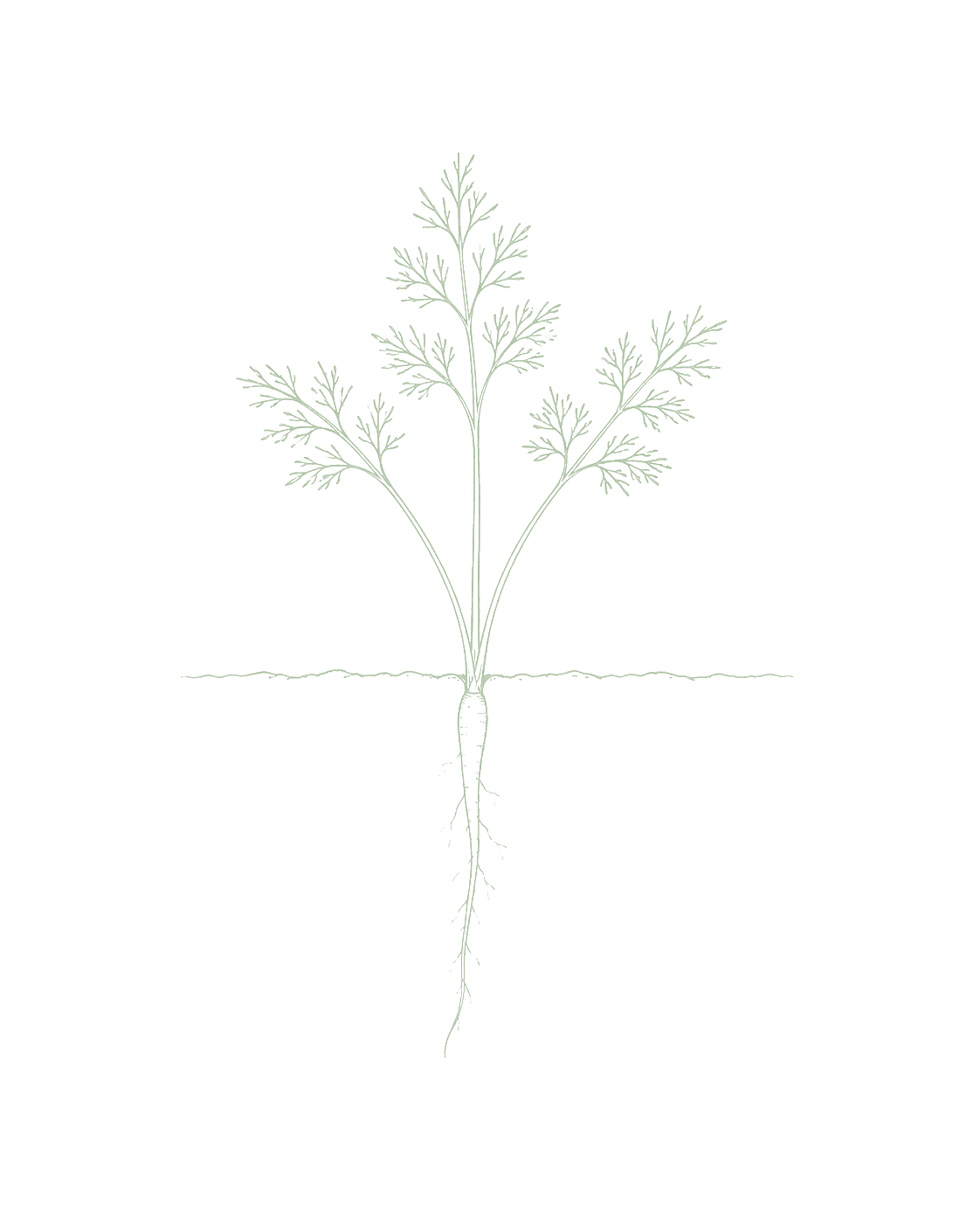
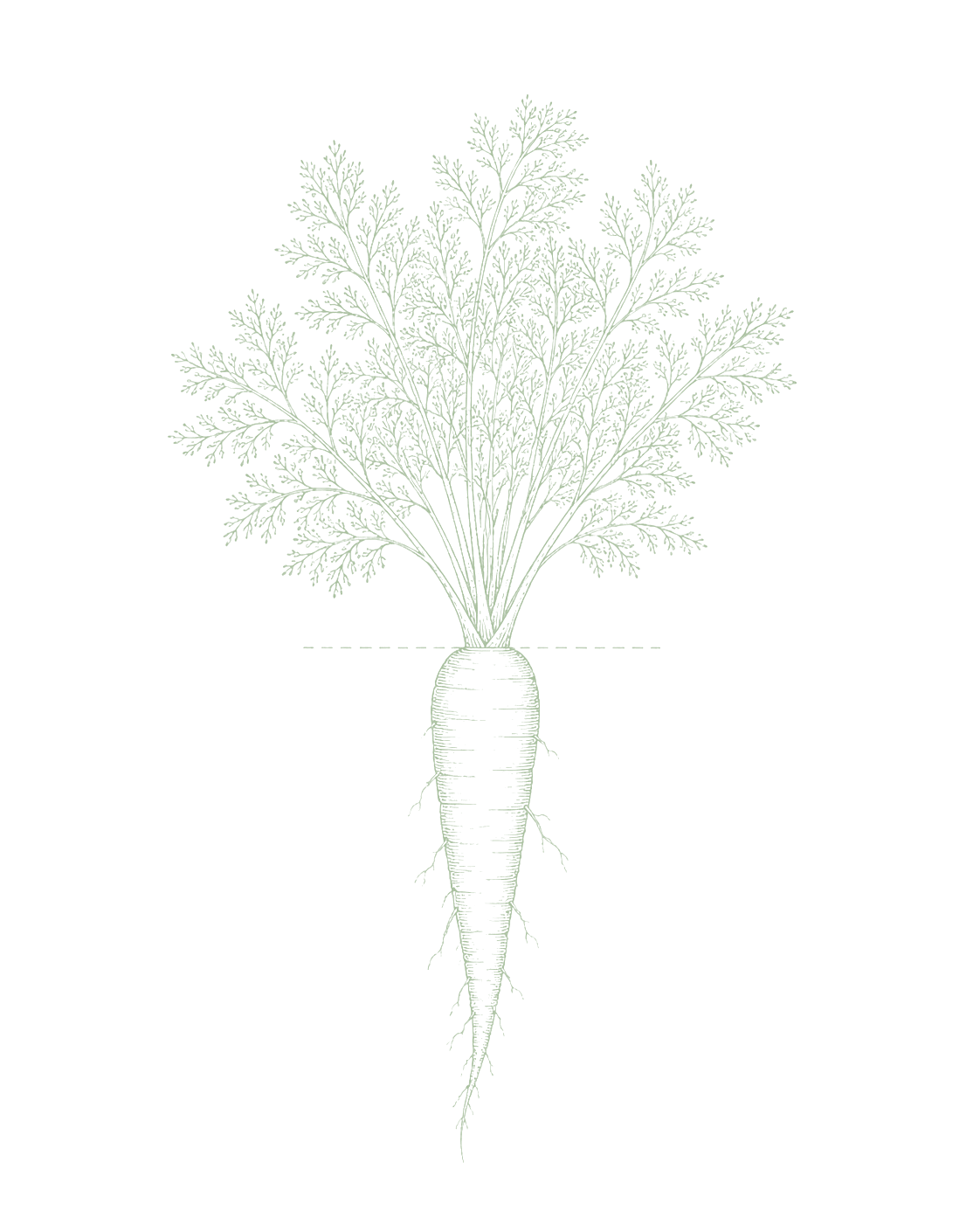
Carrots are a cool-weather root vegetable. The part you eat is one long root that grows straight down, so they need loose, rock-free soil and plenty of depth to grow well. Always plant carrot seeds right where they will grow, because moving a young carrot bends or splits that root. The seeds are slow, often taking 2 to 3 weeks to come up, and the tiny sprouts cannot break through a hard, dried-out crust, so keep the soil surface damp until they appear. Roots are usually ready in about 60 to 75 days and taste best when they finish growing in cool weather. In heat above about 75°F they turn tough and can taste bitter, though the plant itself keeps growing. A light frost actually makes carrots sweeter, which is why fall and winter carrots are often the best tasting. When you plant depends on your climate: spring and fall where summers are cool, and fall through early spring where summers are hot. Carrot (Daucus carota) is a cool-season root crop grown for its swollen taproot, which forms best in loose, stone-free, deeply worked soil that lets the root drive straight down. It is direct-sown only: the taproot extends almost immediately, so transplanting forks or stunts it. Seed is slow and erratic to germinate, often 2 to 3 weeks, and the fine seedlings cannot push through a crusted surface, so the seedbed must stay evenly moist from sowing until emergence. Roots size up over roughly 60 to 75 days and hold flavor and texture best when they finish in cool weather; sustained air temperatures above about 75°F push roots toward coarse texture, fibrousness, and strong or bitter flavor rather than killing the plant. Carrots tolerate light frost and sweeten after it as the root converts stored starch to sugar, which is why fall crops in cold climates and winter crops in mild ones are often the sweetest. The crop succeeds across a wide range of zones, but the planting season inverts by climate: a spring-through-early-summer and fall window where summers are cool, and a fall-through-early-spring window where summers are hot.
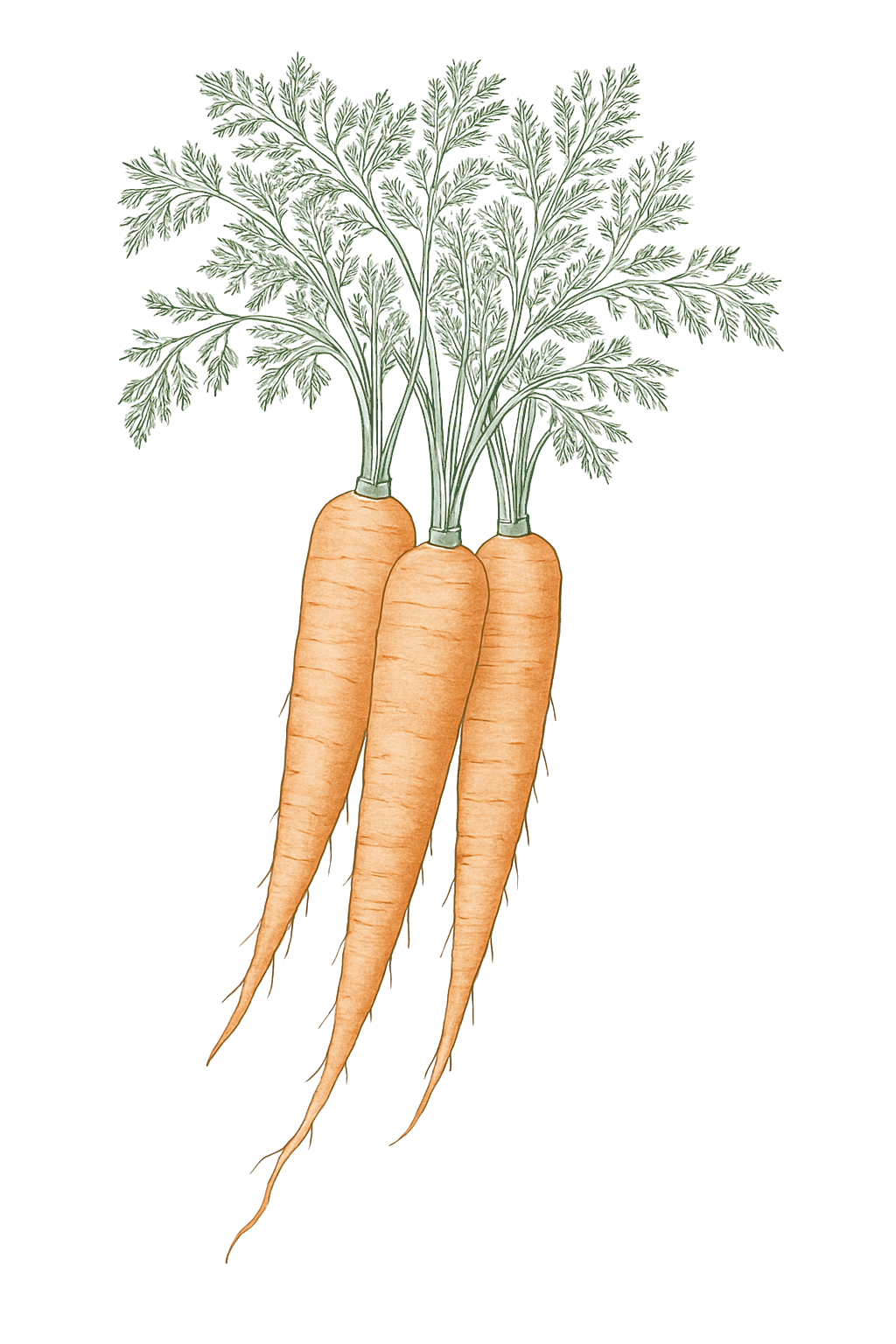
Off-season for carrot in zone 3.
In Zone 3, carrot can be planted April through July. Harvest runs September through October.
Instead of planting all your carrots at once, sow a short row every 3 weeks or so. That way they are ready a few at a time over several weeks rather than all on the same day. In places with cool summers, start in spring and keep going into early summer, then sow one more batch in late summer for fall. In places with hot summers, grow them in fall, winter, and early spring and skip the summer heat. Carrots left in the ground too long in hot weather get tough and lose their sweet flavor, so stop sowing before the hottest part of the year.Carrots succession well: sow a short row every 3 weeks through the cool-season window rather than one large planting, so roots mature in sequence instead of all at once. In cold-summer climates that means spring through early summer, then a late-summer sowing for a fall and winter-storage crop; in hot-summer climates it means fall through early spring, skipping the heat. Stop spring sowings before sustained heat arrives, because carrots near maturity held in hot soil turn coarse, fibrous, and strong-flavored. The exact number of sowings per season is set by the length of your cool window, not a fixed cap.
Plant carrot seeds right in the garden where they will grow. Do not start them in pots or trays. Carrots make one long root (the part you eat), and moving a started plant breaks or bends that root, so you end up with forked, stubby carrots. Sow the seed straight into loose soil about 3 to 4 weeks before your last spring frost, once the ground is no longer frozen or soggy. Cover the tiny seeds only lightly (about 1/8 to 1/4 inch) and keep the surface damp until they come up. Be patient: carrot seeds are slow and can take 2 to 3 weeks to sprout. A trick is to scatter a few fast-sprouting radish seeds in the same row to mark where the carrots are.Always direct-sow carrots into the garden; never start them in pots or cells. The taproot begins extending almost immediately and transplanting damages and misdirects its growth, producing forked or stunted roots. Direct-seed about 3 to 4 weeks before the last spring frost once the soil is workable and has reached at least 45°F, sowing seed shallowly (1/8 to 1/4 inch) and keeping the surface evenly moist, since a crusted seedbed blocks the small seedlings. Germination is slow, often 2 to 3 weeks; many growers sow a few fast radishes in the same row to mark it. There is no indoor-start or hardening-off step for carrots.
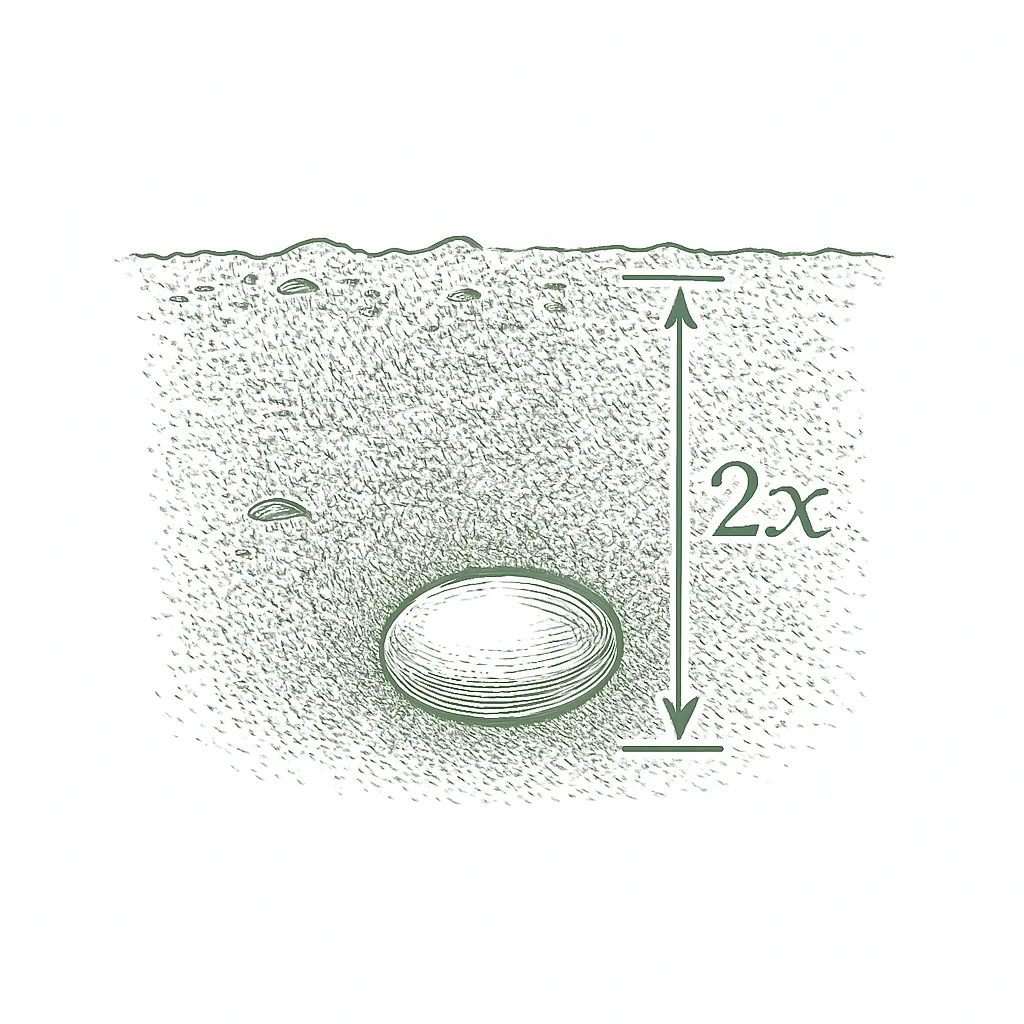

Not sure what soil you have? Grab a small handful of damp soil from your garden bed and squeeze it. If it crumbles apart easily, it's sandy. If it holds together but breaks when you poke it, it's loam (what most vegetables want). If it stays in a hard, slippery ball, it's clay.
Carrots want deep, loose soil with no rocks or hard clumps, the looser the better. This matters more for carrots than for most vegetables: a carrot growing down into heavy clay or packed soil will come out short, forked, or twisted instead of long and straight. Loosen the soil at least 8 inches down before you plant, and mix in some compost. Go easy on fertilizer that is high in nitrogen (the first number on the bag), because too much makes big leafy tops but small roots. If your soil is heavy clay, a raised bed or a deep container filled with loose mix is the easiest fix.
Mix 2-3 inches of compost into the top 6 inches of your bed before planting. Compost holds moisture (which sandy soil drains too fast) and adds the nutrients sandy soil tends to lack. Repeat each season. Compost breaks down over time.
Mix 2-3 inches of compost AND a few inches of coarse sand or perlite into the top 6 inches of your bed. The compost feeds the plants; the sand breaks up the clay so air and water can move through. Don't add sand without compost. It can compact like concrete.
If amending your soil sounds like too much work, or if your soil is heavy clay, full of rocks, or contaminated, build over it. A raised bed at least 12 inches deep filled with a 50/50 mix of compost and sandy loam gives you ideal growing soil with no battles. A 5-gallon container with quality potting mix does the same for one plant at a time. Both bypass your native soil entirely.
The numbers that matter, at a glance.
Soil pH measures how acidic or alkaline your soil is, on a scale from 1 to 14 where 7 is neutral. Carrots like it right around 6.0 to 6.8, slightly acidic. They are not very fussy about it, so do not stress over pH if your roots are coming out fine, getting the soil loose and stone-free matters more. If you want to know your number for certain, a cheap soil test from your local extension office will tell you, and let you know whether to add anything before planting.Carrots grow best in neutral to slightly acidic soil, roughly pH 6.0 to 6.8, with extension sources placing the optimum band between about 5.8 and 6.8. Below 5.5, phosphorus, calcium, and molybdenum availability drops; above 7.5, micronutrients including boron, manganese, and iron become less available. pH is rarely the first thing that limits a home carrot crop (soil texture and even moisture matter more), but a $10 to $15 soil test from your local extension office removes the guesswork and tells you whether lime or sulfur is warranted before sowing.
If your soil has compost mixed in, carrots usually need no extra feeding. If they look weak and pale, you can give one light feeding of a low-nitrogen fertilizer after the leafy tops fill in. Never use fresh manure or high-nitrogen lawn fertilizer, because that is exactly what causes forked roots and too many leaves.In decent garden soil amended with compost, carrots often need no supplemental feeding at all. If growth is weak, a single light side-dressing of a low-nitrogen fertilizer once the tops are established is enough. Avoid fresh manure and high-nitrogen lawn-type feeds entirely, since they cause the forking and excessive top growth carrots are prone to.
The three numbers on a fertilizer bag are nitrogen, phosphorus, and potassium (N-P-K). Carrots do not want much of the first one: too much nitrogen makes big leafy tops but forked, hairy roots. Pick a fertilizer that is low in the first number with more of the other two, like a 5-10-10, and mostly just mix compost into the soil before planting.Carrots are light feeders, and excess nitrogen is the classic mistake: it grows lush tops and forked, hairy roots at the expense of a clean taproot. Favor a low-nitrogen blend with adequate phosphorus and potassium to support root development, such as a 5-10-10. Most of the feeding is done by working modest, well-finished compost into the bed before sowing.
Carrots are easygoing about neighbors. The most reliable trick is sowing a few fast radishes in the carrot row to mark it and save space. Onions and chives are a popular choice to help fend off the carrot fly, though they do not always work. The main plants to keep away are carrot's close relatives, dill, parsnip, and fennel, since they share the same pests. Do not trust every companion-planting chart online; many of their claims have not held up when tested. Carrots fit easily into mixed beds. The best-supported pairing is the radish row-marker trick, which extension research presents as a genuine space-saver. Allium pairings (onion, chives) for carrot rust fly are popular and mechanistically plausible but not firmly proven, useful, not guaranteed. The clearest avoids are carrot's own family, dill, parsnip, and fennel, which share its pests and diseases. Treat most other companion-chart claims with skepticism: university reviews find many are not backed by evidence.
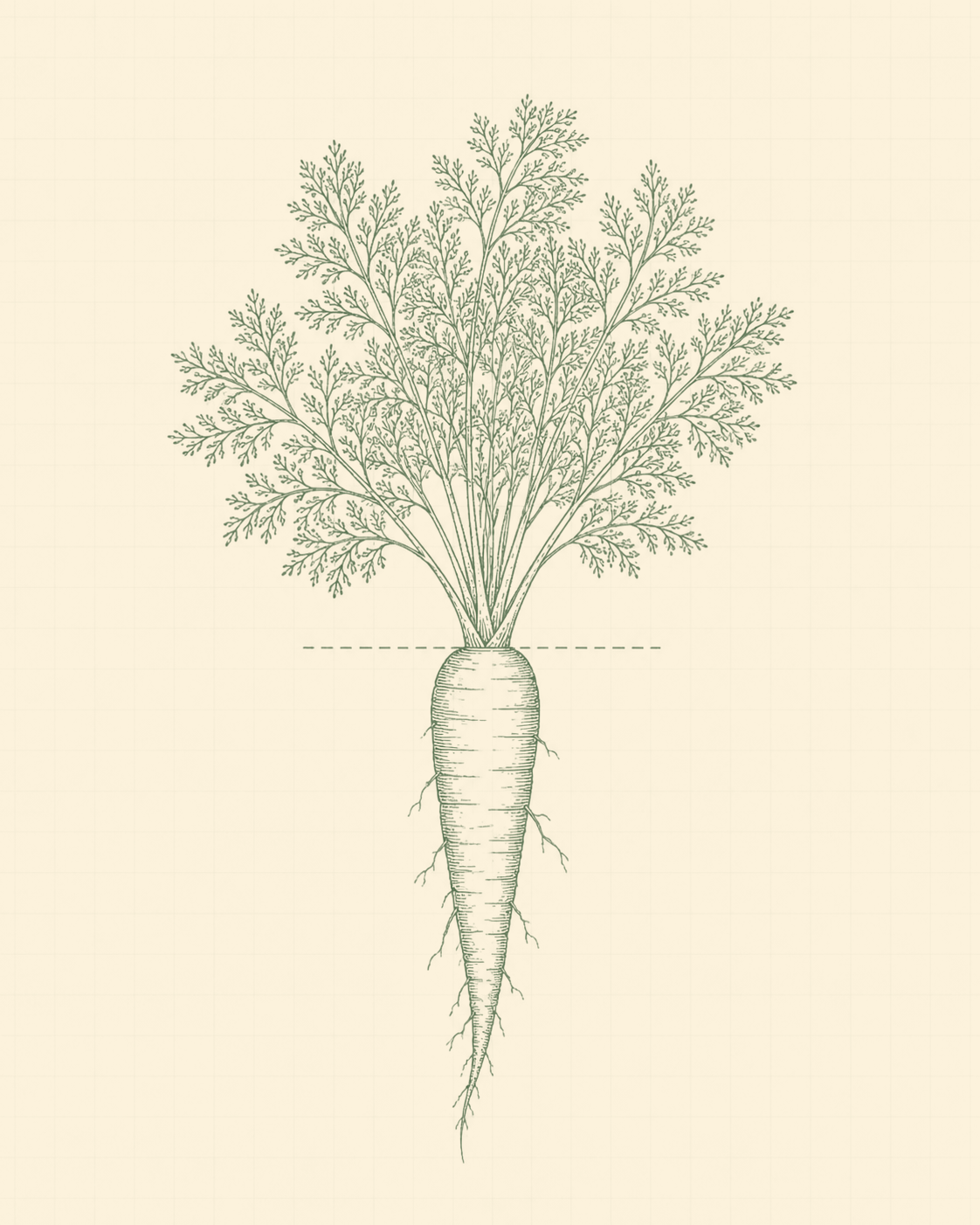
Carrots are ready based on their size, not a set date. Gently scrape the soil away from the top of a root and look at the shoulder, the widest part where the leaves meet the root. When it looks about 1/2 to 3/4 inch across or bigger, pull one to check. For most kinds this is around 60 to 75 days after planting. There is no rush: carrots taste even better after a light frost, and they keep well right in the ground for weeks. In cold areas you can pile straw over the row and dig them as needed into winter until the ground freezes solid. Before pulling, loosen the soil next to the row with a fork so the roots come out whole instead of breaking off. Just do not leave fully grown carrots sitting in hot summer soil, where they get tough and may crack.Carrots are ready when the root has reached usable size, judged by the shoulder rather than the calendar: brush soil from the crown and look for a shoulder roughly 1/2 to 3/4 inch or more across, which for most varieties lands around 60 to 75 days from sowing. Size, not a fixed date, is the cue, and pulling a test carrot is the surest check. Flavor improves in cool weather and after light frost, so there is no rush to lift them; in mild soil they hold well in the ground for weeks, and in cold regions a heavy straw mulch lets them overwinter for pull-as-needed harvest until the ground freezes hard. Loosen the soil beside the row with a fork before pulling, especially in heavier ground, so the roots lift cleanly instead of snapping. Do not leave mature roots in hot soil, where they grow coarse and woody and may split.
Each carrot plant gives you one carrot, the single root it grows. So it helps to think about how much row you plant rather than per plant. Spaced 2 to 4 inches apart, a foot of row gives you roughly 3 to 6 carrots, often about 1 pound.One root per plant. Carrots are not a cut-and-come-again crop, so yield is best thought of by row length rather than per plant: at a 2 to 4 inch final spacing, expect roughly 3 to 6 carrots per foot of row, often around 1 pound of roots per foot in good soil.
Carrots do not keep producing after you pick them, since each plant makes just one root. A planting is ready about 60 to 75 days after sowing and you harvest it over a few weeks. For a steady supply, plant a new short row every few weeks instead of one big batch.There is no repeat harvest; a sowing matures over a short window roughly 60 to 75 days after planting and is lifted over a few weeks. Continuous supply comes from succession sowing every few weeks, not from a single long-bearing planting. Carrots are grown fresh from seed each year, so your very first planting can do just as well as any later one. The main things that decide your results are loose, rock-free soil and keeping the bed evenly damp while the seeds sprout.Carrots are an annual grown fresh from seed every season, so there is no first-year-versus-later distinction as there is with perennials; the first sowing performs as well as any, provided the soil is loose and stone-free and moisture stays even during germination.
Pick your carrot variety to match your soil. If your soil is deep and loose, you can grow the long, slender kinds. If it is shallow, heavy, or rocky, grow the short, fat, or round kinds (like Chantenay or Paris Market), which handle tough soil much better and fork less. For your first try, Nantes types are the easiest: sweet, smooth, and fairly fast. There are fun colors too (purple, yellow, white), but matching the shape to your soil matters more than color.Carrot variety choice is driven mostly by soil. In deep, loose, sandy soil the long types (Imperator, longer Nantes) reach full length; in shallow, heavy, or rocky soil the short, broad, or round types (Chantenay, Danvers, Paris Market) perform far better and resist forking. For a first crop, Nantes types are the most forgiving: sweet, smooth, and quick. Maturity and color (orange, plus purple, yellow, and white novelties) vary by cultivar, but matching root shape to your soil matters most.
Move your carrots to a different spot each year and do not put them (or their relatives like parsley and dill) back in the same bed for about three years. This stops pests and diseases from piling up in the soil. It is best to plant carrots after a crop that did not get heavy fertilizer, since leftover nitrogen makes the roots fork.Rotate carrots on a three-year cycle, keeping them and all other carrot-family crops out of a bed for two seasons after they are grown there. This breaks the buildup of soilborne pathogens and root pests the family shares. Following a light-feeding or nitrogen-depleting crop is ideal; following a heavily manured crop is not, because residual nitrogen causes forking.
The plant app sends a timely reminder at every critical moment of your carrot season. The wording adjusts to whichever you pick: beginner or seasoned. Here are three you'll see in Zone 3.
plant sends the right notification at exactly the right moment, for your zone, your weather, your crops. Founding members lock the rate forever.
We're building this guide with real growers. Got a question we missed? Ask here. We read every one and add the best answers right to this page.
Learned something the hard way? Pass it on. Real growers' tips make this guide better for the next person, and we credit you by name when yours goes live.
If you've grown this crop and you see a date, a temperature, a companion claim, or a recommendation that doesn't match your experience, tell us. Real growers' corrections make this guide better for the next person.
Every date, temperature, spacing, and recommendation on this page is sourced from university cooperative extension publications, peer-reviewed agricultural research, NOAA climate data, and direct extension calendars. Where claims are softer (traditional gardening wisdom not formally documented), we say so.
Spot a data point that doesn't match your experience? Submit a correction; accepted corrections earn full author credit on the page.
Zone-aware seasonal nudges, what's worth planting now, and the occasional recipe from the harvest. No spam, ever.